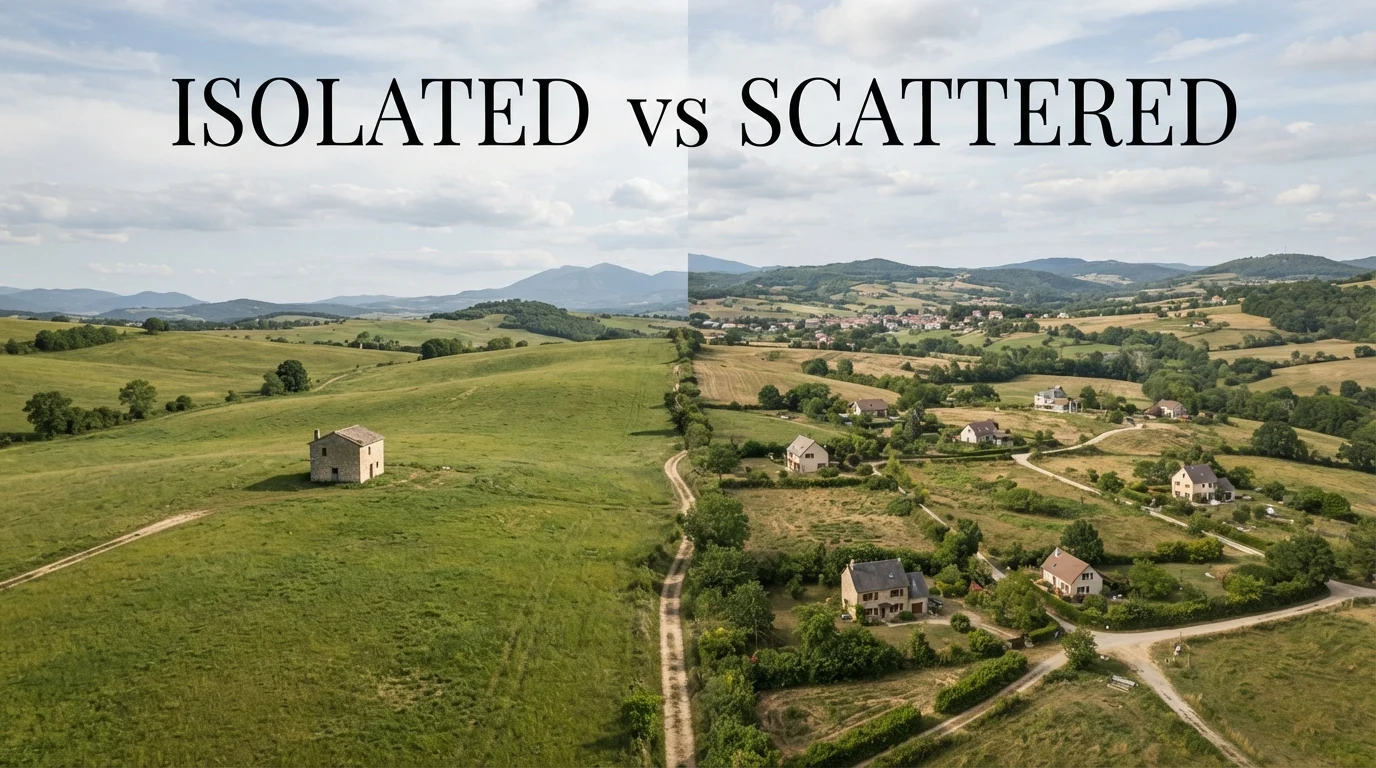
The words isolated and scattered both describe things that are separated or not gathered together. However, they have different meanings and are used in different situations.
Understanding the difference between isolated vs scattered can help you choose the right word when describing people, objects, places, information, or events.
Although both words suggest separation, isolated emphasizes being alone, separated, or cut off from others, while scattered describes things spread out over a particular area or distributed in different places.
For example, an isolated house stands far away from other homes, while scattered houses are spread across a large area. Similarly, an isolated student may feel separated from classmates, whereas scattered papers are lying in different places.
These differences are important in everyday conversations, academic writing, and professional communication.
Learning how each word works will help you use both terms naturally and avoid common English mistakes.
Quick Answer: Isolated vs Scattered
Isolated means separated, alone, or disconnected from others. Scattered means spread out or distributed irregularly across an area.
Use isolated when emphasizing separation or lack of connection. Use scattered when describing things spread across different locations. For example, an isolated village is remote, while scattered villages are spread across a region.
Why Do People Confuse Isolated and Scattered?
People often confuse isolated and scattered because both words describe things that are not together in one place.
However, their meanings focus on different aspects of separation.
- Isolated focuses on something being alone, separated, or disconnected.
- Scattered focuses on multiple things being spread out over an area.
For example:
- An isolated tree stands alone in an open field.
- Scattered trees grow at different points across the field.
In the first sentence, the emphasis is on one tree being separate from its surroundings. In the second, the emphasis is on several trees being distributed across an area.
The easiest way to understand the difference is to remember that isolation describes separation, while scattering describes distribution.
What Does Isolated Mean?
Isolated is an adjective that describes someone or something separated from others, placed alone, or disconnected from a surrounding group or environment.
It can refer to physical distance, social relationships, emotional experiences, or situations that happen independently.
Definitions of Isolated
The word isolated can have several related meanings:
- Separated physically: Located far away from other people or places.
- Socially disconnected: Having little contact or interaction with others.
- Emotionally alone: Feeling separated from other people.
- Independent or separate: Existing without being connected to other events or circumstances.
- Occasional or individual: Happening separately rather than as part of a larger pattern.
Examples of Isolated in Sentences
- The family lives in an isolated cabin in the mountains.
- She felt isolated after moving to a new city.
- The researchers studied an isolated community.
- Police investigated an isolated incident of vandalism.
- The small island remained isolated during the winter.
Isolated as Different Parts of Speech
The word isolated is primarily used as an adjective.
| Form | Word | Example |
|---|---|---|
| Verb | Isolate | Scientists isolate the sample. |
| Noun | Isolation | Isolation can affect social relationships. |
| Adjective | Isolated | They live in an isolated area. |
| Adverb | Isolately (rare) | This form is uncommon in modern English. |
The most useful related forms are isolate, isolation, and isolated.
Common Uses of Isolated
1. Isolated places
Used to describe locations far from other communities or populated areas.
Example: The hikers discovered an isolated waterfall.
2. Isolated people
Used when someone has limited social contact or feels disconnected.
Example: He became isolated after leaving his hometown.
3. Isolated incidents
Used to describe individual events that are not necessarily part of a larger pattern.
Example: The company described the problem as an isolated incident.
4. Isolated cases
Used in research, medicine, and everyday discussions to describe individual occurrences.
Example: Only a few isolated cases were reported.
What Does Scattered Mean?
Scattered is commonly used as an adjective and as the past tense and past participle of the verb scatter.
It describes things spread over a wide area or distributed in different places without a clear arrangement.
Unlike isolated, which emphasizes separation or disconnection, scattered usually suggests that multiple objects, people, or items are spread out.
Definitions of Scattered
The word scattered has several common meanings:
- Spread over an area: Located in different places rather than gathered together.
- Distributed irregularly: Arranged without a particular order or pattern.
- Dispersed: Moved or spread away from a central location.
- Fragmented: Divided into separate pieces or groups.
- Occasional or widely distributed: Happening at different times or locations.
Examples of Scattered in Sentences
- Colorful leaves were scattered across the garden.
- Small villages are scattered throughout the countryside.
- She found scattered notes on her desk.
- The children scattered when the bell rang.
- Scattered clouds covered parts of the sky.
Scattered as Different Parts of Speech
The word scattered is primarily used as an adjective and as a verb form.
| Form | Word | Example |
|---|---|---|
| Verb | Scatter | The wind can scatter the seeds. |
| Noun | Scattering | The scattering of seeds helps plants grow. |
| Adjective | Scattered | Scattered papers covered the floor. |
| Adverb | Scatteredly (rare) | This form is uncommon in everyday English. |
The most important related forms are scatter, scattered, and scattering.
Common Uses of Scattered
1. Scattered objects
Used when physical items are spread across different locations.
Example: Toys were scattered across the living room.
2. Scattered communities
Used to describe homes, towns, or villages distributed across a large area.
Example: Scattered settlements can be found throughout the valley.
3. Scattered information
Used when information is available in different places rather than organized together.
Example: The report contains scattered information about the project.
4. Scattered clouds
Used in weather descriptions when clouds appear in different parts of the sky.
Example: Scattered clouds appeared in the afternoon.
Isolated vs Scattered: Key Differences
Although isolated and scattered both communicate separation, they are not interchangeable in every sentence.
The main difference is that isolated emphasizes being separate or alone, whereas scattered emphasizes being spread across multiple locations.
| Feature | Isolated | Scattered |
|---|---|---|
| Main meaning | Separated or alone | Spread over an area |
| Focus | Separation | Distribution |
| Typical use | People, places, incidents | Objects, people, clouds, information |
| Number | Can describe one or more things | Usually describes multiple things or occurrences |
| Arrangement | Separate or disconnected | Irregularly distributed |
| Opposite | Connected, integrated | Gathered, concentrated |
| Example | An isolated house | Scattered houses |
Examples That Show the Difference
Example 1: Houses
- Isolated houses stood far from the nearest town.
- Scattered houses appeared throughout the countryside.
The first sentence emphasizes distance and separation. The second describes houses distributed across an area.
Example 2: People
- He felt isolated from his classmates.
- The people were scattered across the park.
Isolated describes a feeling of social separation, while scattered describes physical distribution.
Example 3: Information
- The isolated information was difficult to connect with the main research.
- Scattered information appeared throughout the document.
The first describes information that is separate or disconnected. The second describes information distributed in different parts of a document.
When to Use Isolated
Choose isolated when you want to emphasize that something is separate, alone, disconnected, or independent.
Here are situations where isolated is the better choice.
1. Describing Remote Locations
Use isolated for places that are far from other populated areas.
Example: They built an isolated house near the forest.
2. Describing Social Separation
Use isolated when someone has little interaction with other people.
Example: The new employee felt isolated in the unfamiliar workplace.
3. Describing Individual Events
Use isolated when an event occurs separately and does not necessarily represent a larger trend.
Example: The manager considered the mistake an isolated incident.
4. Describing Separate Cases
Use isolated when referring to individual examples or occurrences.
Example: Researchers identified several isolated cases of unusual behavior.
5. Describing Disconnected Systems
Use isolated when something operates separately from other systems or networks.
Example: The computer was kept isolated from the main network.
When to Use Scattered
Choose scattered when describing multiple things distributed across different places or spread over an area.
Here are common situations where scattered is appropriate.
1. Describing Objects Spread Out
Example: Books and notebooks were scattered across the table.
2. Describing Communities Across a Region
Example: Small farms are scattered throughout the countryside.
3. Describing Natural Features
Example: Wildflowers were scattered across the hillside.
4. Describing Information in Different Places
Example: Important details were scattered throughout the research paper.
5. Describing Weather Conditions
Example: Scattered showers are expected in some parts of the state.
10+ Practical Examples of Isolated vs Scattered
The following examples demonstrate how these words work in everyday American English.
| Isolated | Scattered |
|---|---|
| An isolated cabin stood beside the lake. | Cabins were scattered around the lake. |
| She felt isolated at her new school. | Students were scattered throughout the playground. |
| The village was isolated by heavy snow. | Small villages were scattered across the valley. |
| Police investigated an isolated incident. | Scattered incidents were reported across the region. |
| The laboratory kept the sample isolated. | The samples were scattered across several tables. |
| An isolated tree stood in the field. | Trees were scattered throughout the field. |
| He worked in an isolated office. | Offices were scattered across the building. |
| The island remained isolated for months. | Small islands were scattered across the ocean. |
| The system operated in an isolated environment. | Files were scattered across different folders. |
| An isolated problem affected one department. | Scattered problems affected several departments. |
| The researcher examined an isolated case. | Scattered evidence appeared in the records. |
| The house was isolated from nearby buildings. | Houses were scattered along the road. |
Common Mistakes When Using Isolated and Scattered
Even advanced English learners sometimes confuse these words. Understanding the following mistakes can help you use them correctly.
Mistake 1: Using Isolated When You Mean Spread Out
Incorrect: Scattered flowers were isolated throughout the garden.
Correct: Scattered flowers were spread throughout the garden.
Explanation: Scattered is appropriate because the flowers are distributed across different parts of the garden.
Mistake 2: Using Scattered to Describe Emotional Separation
Incorrect: She felt scattered from her friends.
Correct: She felt isolated from her friends.
Explanation: Isolated describes social or emotional separation. Scattered does not normally express this meaning.
Mistake 3: Confusing an Isolated House With Scattered Houses
Incorrect: An isolated houses stood across the valley.
Correct: An isolated house stood across the valley.
Also correct: Scattered houses stood across the valley.
Explanation: Isolated is suitable for one separate house, while scattered describes multiple houses distributed across an area.
Mistake 4: Using Scattered for an Individual Incident Without Context
Incorrect: The company reported a scattered incident.
Correct: The company reported an isolated incident.
Explanation: Isolated incident is the established expression for an individual event that is separate from a larger pattern.
Mistake 5: Using the Wrong Verb Form
Incorrect: The wind isolated leaves across the garden.
Correct: The wind scattered leaves across the garden.
Explanation: Scatter means to spread things across different locations. Isolate means to separate something from other things.
Easy Memory Trick: Isolated vs Scattered
A simple memory trick can help you remember the difference.
- Isolated = Alone: Think of one house standing far away from other houses.
- Scattered = Spread: Think of many leaves spread across the ground.
Remember these two short expressions:
Isolated means separated.
Scattered means spread out.
Whenever you are unsure which word to use, ask yourself whether you are describing separation or distribution.
If the focus is on being alone or disconnected, choose isolated. If the focus is on things being spread across different locations, choose scattered.
American English vs British English: Isolated and Scattered
There is no meaningful difference between American and British English in the basic meanings or standard spelling of isolated and scattered.
Both varieties use:
- Isolated for something separated, remote, or disconnected.
- Scattered for things distributed across an area.
For example:
- American English: The houses are scattered across the countryside.
- British English: The houses are scattered across the countryside.
Both sentences are correct and natural.
The spelling of both words also remains the same in American and British English.
Similar and Related Words
Learning synonyms can help you expand your vocabulary and understand the difference between isolated and scattered more clearly.
Words Similar to Isolated
| Word | Meaning |
|---|---|
| Alone | Without other people |
| Separate | Not joined or connected |
| Remote | Far from populated places |
| Detached | Not connected to something |
| Solitary | Existing or happening alone |
| Secluded | Private or away from others |
| Disconnected | Not linked or associated |
Words Similar to Scattered
| Word | Meaning |
|---|---|
| Spread | Extended across an area |
| Dispersed | Distributed in different directions |
| Distributed | Divided among different places |
| Sprinkled | Spread in small amounts |
| Strewed | Spread objects over a surface |
| Disorganized | Not arranged properly |
| Widespread | Existing over a large area |
Remember that synonyms are not always interchangeable. The best choice depends on the context and the exact meaning you want to communicate.
Frequently Asked Questions (FAQs)
1. What is the main difference between isolated and scattered?
Isolated describes something that is separate, alone, or disconnected from others. Scattered describes multiple things spread across different locations. For example, an isolated house stands alone, while scattered houses are distributed across a particular area.
2. Can isolated and scattered be used interchangeably?
No, isolated and scattered are not generally interchangeable. Although both suggest separation, isolated emphasizes being alone or disconnected, while scattered emphasizes distribution. Choosing the wrong word can change the meaning of your sentence.
3. Is isolated singular or plural?
Isolated is an adjective, so it does not change according to whether the noun is singular or plural. You can say “an isolated house” or “isolated houses.” The adjective remains the same in both examples.
4. Is scattered a verb or an adjective?
Scattered can function as both a verb form and an adjective. As a verb form, it describes the action of spreading something, as in “She scattered the papers.” As an adjective, it describes things that are already spread out, as in “scattered papers.”
5. What is the opposite of isolated?
Common opposites of isolated include connected, integrated, included, and involved. The best opposite depends on the context. For example, connected works for physical or technical separation, while socially included works for emotional or social isolation.
6. What is the opposite of scattered?
Common opposites of scattered include gathered, collected, concentrated, clustered, and organized. For example, scattered leaves are spread across the ground, while gathered leaves are brought together in one place.
7. Can a place be both isolated and scattered?
Yes, depending on the context. A remote region can contain scattered houses. The region is isolated because it is far from other populated areas, while the houses are scattered because they are spread across different locations.
8. Which word is better for describing people in different locations?
Scattered is generally better when describing people distributed across different locations. For example, “The visitors were scattered throughout the museum.” However, isolated is more appropriate when describing people who are socially disconnected or physically separated from others.
Remember This: Isolated vs Scattered
Keep these simple points in mind:
- Isolated means alone, separated, remote, or disconnected.
- Scattered means spread out or distributed across different places.
- Use isolated for remote locations, social separation, and individual incidents.
- Use scattered for objects, communities, information, and weather conditions.
- Both words have the same meanings and spellings in American and British English.
The most important distinction is separation versus distribution.
Conclusion
Understanding isolated vs scattered becomes easy when you focus on what each word describes. Isolated refers to something that is alone, separated, or disconnected from others.
Scattered describes things spread across different places without being gathered together. Although both words involve separation, they communicate different ideas and should be used according to context.
When describing a remote house, a socially disconnected person, or an individual event, isolated is usually the correct choice.
When describing leaves on the ground, houses across a valley, or information in different sections of a document, scattered is more appropriate. Remembering that isolated means alone and scattered means spread out will help you use both words accurately and confidently.

I’m Camden Holland, a passionate writer at Symbolop, where I explore the meanings, history, and cultural significance of symbols. I enjoy creating clear, engaging content that helps readers discover the fascinating stories behind symbols from around the world.


