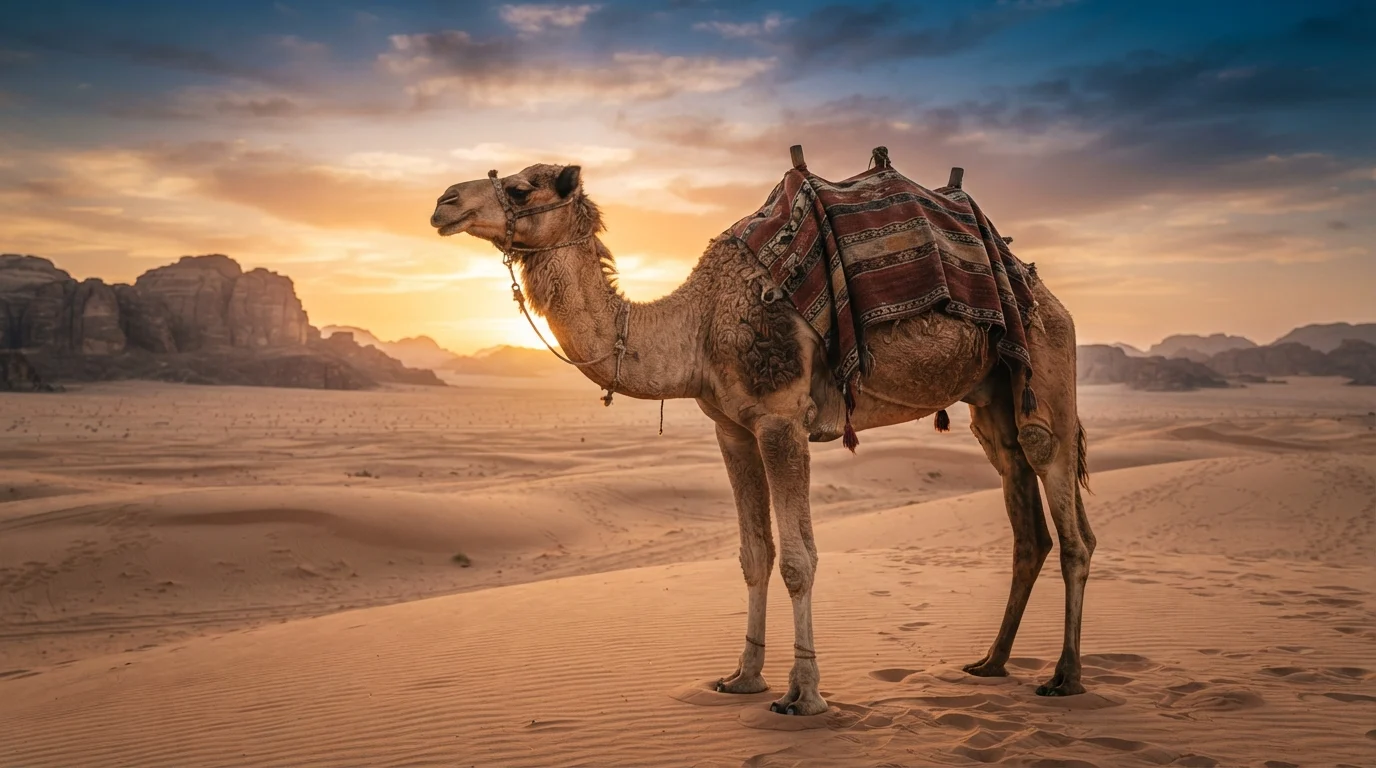
Camel symbolism represents endurance, patience, resilience, wisdom, and the ability to survive difficult circumstances.
Known for traveling across harsh deserts with remarkable efficiency, the camel symbolizes inner strength, self-reliance, and the power to keep moving forward when life becomes challenging.
Across different cultures and spiritual traditions, camels are associated with perseverance, resourcefulness, humility, and long journeys. Their ability to withstand demanding environments makes them powerful symbols of survival and determination.
If you encounter a camel in a dream, see one during a meaningful experience, or feel drawn to its symbolism, this remarkable animal can inspire you to trust your abilities and remain steady through life’s uncertainties.
Camel Symbolism Meaning (Clear Definition)
Camel symbolism refers to the qualities and ideas associated with camels, including endurance, patience, survival, adaptability, and the wise use of resources.
Because camels are well suited to desert environments, they often symbolize the ability to preserve energy, overcome obstacles, and continue toward a goal despite limited resources.
The primary symbolic meanings of a camel include:
- Endurance: Remaining strong during prolonged challenges.
- Patience: Accepting that meaningful progress takes time.
- Resilience: Recovering from hardship and continuing forward.
- Self-reliance: Trusting your abilities and preparing for uncertainty.
- Wisdom: Using resources carefully and making thoughtful decisions.
- Prosperity: Representing wealth, trade, transportation, and valuable resources in certain cultural contexts.
- Humility: Carrying responsibilities without constantly seeking recognition.
The camel’s symbolism is especially relevant when life requires persistence rather than quick results. It reminds us that success often depends on consistent effort, careful preparation, and the ability to adapt.
What Does Camel Symbolism Represent?
Camels represent several interconnected qualities that can offer guidance in everyday life. Their symbolism often reflects the relationship between strength, responsibility, patience, and survival.
1. Endurance and Perseverance
One of the strongest meanings of camel symbolism is endurance. Camels are adapted to survive demanding desert conditions, making them natural symbols of lasting strength.
In human life, this symbolism can represent the determination to continue through difficult seasons, whether you are pursuing a career, managing family responsibilities, or working toward a personal goal.
The camel teaches an important lesson: you do not need to move quickly to make meaningful progress. Sometimes, the most powerful achievement is simply continuing.
2. Patience and Timing
Camels are associated with long journeys that require time and preparation. Symbolically, they encourage patience and discourage the expectation of immediate results.
If you are waiting for a breakthrough, the camel can serve as a reminder that growth often happens gradually. A slow journey is not necessarily a failed journey.
3. Resilience During Hardship
Deserts represent difficult environments, uncertainty, and periods when resources seem scarce. The camel’s ability to navigate such conditions makes it a symbol of resilience.
This meaning can be especially comforting during periods of loss, disappointment, or personal change. It encourages you to recognize your capacity to adapt without allowing hardship to define your future.
4. Self-Reliance and Resourcefulness
Camels are associated with traveling long distances while conserving energy and making efficient use of their physical adaptations.
In symbolic terms, they encourage you to prepare for challenges, manage your resources, and become more confident in your own abilities.
Self reliance does not mean refusing help. Instead, it means developing the skills, judgment, and emotional stability needed to navigate uncertainty.
5. Wealth and Abundance
In some societies, camels have historically represented wealth, livelihood, transportation, and social status. Their importance to trade and survival made them valuable economic assets.
For this reason, camel symbolism can also suggest prosperity, security, and the responsible management of material resources.
However, abundance does not always mean money. It can also mean having the patience, knowledge, relationships, and emotional strength needed to build a stable life.
6. Responsibility and Burden
Camels are famously associated with carrying people and goods across long distances. This makes them symbols of responsibility, duty, and the burdens people carry.
If you identify with this meaning, consider whether you are taking on too much. Strength is valuable, but it should not require you to carry every responsibility alone.
7. Adaptability and Survival
The camel’s desert adaptations represent the importance of adjusting to changing circumstances.
In daily life, this symbolism encourages flexibility. When your original plans no longer work, you can find another route without abandoning your destination.
| Camel symbolism | Symbolic meaning | Life lesson |
|---|---|---|
| Endurance | Lasting strength | Keep moving through challenges |
| Patience | Trust in timing | Allow progress to develop naturally |
| Resilience | Recovery from hardship | Adapt rather than give up |
| Self reliance | Independence | Prepare and trust your abilities |
| Wealth | Security and prosperity | Manage resources wisely |
| Burden-bearing | Duty and responsibility | Balance service with self care |
| Adaptability | Survival and flexibility | Change your approach when necessary |
Spiritual Meaning of Camel Symbolism
Spiritually, camel symbolism is often interpreted as a reminder to develop patience, inner strength, and trust during uncertain periods.
Although interpretations vary among individuals and traditions, the camel’s ability to travel through difficult landscapes makes it a meaningful symbol of spiritual perseverance.
The Camel as a Symbol of Inner Strength
The camel can represent a kind of strength that does not need to be loud or dramatic. Instead, it reflects the quiet determination to continue when circumstances become uncomfortable.
This interpretation encourages you to look beyond temporary feelings of discouragement and recognize the deeper resources you possess.
You may not always feel strong, but strength can also mean resting, adjusting your expectations, and taking the next manageable step.
Trusting the Journey
A desert journey often involves uncertainty, distance, and limited visibility. Spiritually, this can represent times when you do not know exactly how your life will unfold.
The camel symbolizes continuing with care even when the final destination is not yet clear.
Its message is not that you should ignore risks or accept every difficult situation. Rather, it encourages you to combine faith with preparation and wise action.
Spiritual Preparation and Conservation
Camels are associated with conserving energy and surviving long journeys. This can serve as a metaphor for protecting your emotional and spiritual resources.
You may need to choose your commitments carefully, spend more time in reflection, or step away from unnecessary conflict.
Sometimes, spiritual growth means recognizing that your energy is valuable and should be directed toward what matters most.
Humility and Service
Because camels have long supported human travel and trade, they can also symbolize service, cooperation, and dependable support.
This interpretation invites you to consider how you contribute to the lives of others. Quiet acts of kindness and consistent responsibility can be just as meaningful as visible achievements.
What Does It Mean if You Feel Drawn to a Camel?
If camels repeatedly capture your attention, you might use that interest as an opportunity for personal reflection.
Consider these questions:
- Where in my life do I need more patience?
- Am I carrying responsibilities that should be shared?
- What resources can I preserve for a future challenge?
- Am I confusing slow progress with failure?
- How can I become more adaptable without losing sight of my values?
These questions offer a grounded way to explore camel symbolism without assuming that every encounter is a supernatural sign.
Biblical / Religious Meaning of Camel Symbolism
Camels appear in several religious traditions, including Judaism, Christianity, and Islam. Their meanings depend on the specific passage, historical setting, and cultural context.
In biblical narratives, camels are often associated with travel, wealth, trade, and the movement of people across long distances. In Islamic tradition, camels are connected to life in Arabia, travel, and several important religious narratives.
Camel Symbolism in the Bible
Camels appear throughout the Old Testament and New Testament, where they can reflect material wealth, transportation, and the realities of life in the ancient Near East.
For example, camels feature in the stories of Abraham, Rebekah, and other biblical figures. In these contexts, they can indicate prosperity, long distance travel, and the movement of valuable goods.
The Bible also uses camels in figurative language.
In Matthew 19:24, Jesus compares a camel passing through the eye of a needle with the difficulty of a rich person entering the kingdom of God. The image emphasizes the spiritual danger of attachment to wealth and the limitations of relying on material possessions.
In Matthew 23:24, the camel appears in another vivid comparison concerning hypocrisy and misplaced priorities.
These passages show why camel symbolism in Christianity cannot be reduced to a single positive meaning. Depending on the context, a camel may be associated with provision and wealth or used to challenge greed, pride, and spiritual inconsistency.
Camel Symbolism in Islam
Camels hold an important place in the historical and cultural world of Islam. They were essential to transportation, trade, and daily life across the Arabian Peninsula.
The Quran refers to camels in different contexts, including a striking invitation to reflect on their creation in Surah Al Ghashiyah (88:17). This verse encourages contemplation of the natural world and the signs of creation.
Camels also appear in Islamic narratives involving prophets and their communities. The she camel associated with the Prophet Salih is a notable example in Quranic accounts.
Consequently, camels may evoke reflection on creation, divine power, livelihood, and the moral responsibilities of human beings.
Specific interpretations vary, so it is important not to treat every symbolic association as an established religious teaching.
Camel Symbolism in Judaism
In the Hebrew Bible, camels appear in accounts involving patriarchal families, journeys, trade, and wealth. They reflect the historical importance of livestock and transportation in the ancient Near East.
Camels also appear in biblical dietary laws, including Leviticus 11:4, which identifies the camel as an animal that is not permitted for consumption under those laws.
The religious significance of camels therefore depends on the text being considered rather than on one universal interpretation.
Is a Camel a Sign of Good Luck in Religion?
There is no single religious rule that identifies every camel encounter as a sign of good luck.
Some cultural traditions associate camels with prosperity, safe travel, and abundance because of their historical value. Religious interpretations, however, depend on the beliefs and teachings of a particular tradition.
A balanced approach is to appreciate the camel’s historical and spiritual significance without assuming that seeing one predicts a specific future event.
Camel Symbolism in History and Culture
Throughout history, camels have played a major role in transportation, commerce, migration, and survival. Their practical importance helped shape the meanings people attached to them.
Camels in Arabian Culture
In Arabian societies, camels have traditionally been valued for transportation, milk, meat, wool, and other practical uses.
They made long journeys across arid landscapes possible and supported communities whose livelihoods depended on movement and trade.
As a result, camels became associated with endurance, hospitality, independence, and wealth. Their care and management also formed an important part of traditional knowledge.
The camel’s significance remains visible in regional heritage, poetry, festivals, and cultural traditions.
Camels and the Silk Road
Camels were important to many historical trade networks connecting parts of Asia, the Middle East, and North Africa.
Bactrian camels, which have two humps, were particularly suited to some cold and arid regions of Central Asia. Dromedary camels, which have one hump, played a major role in desert transportation across North Africa and the Arabian Peninsula.
Camels helped transport goods such as textiles, spices, and other valuable commodities. Their role in commerce encouraged associations with prosperity, exchange, exploration, and cultural connection.
They were not the only animals used in historical trade, but they were exceptionally important in environments where other forms of transportation could be difficult.
Camels as Symbols of Wealth and Status
In certain historical societies, owning camels represented substantial economic value. A camel could support transportation, provide useful products, and help a household or community participate in trade.
This made camels indicators of wealth and practical security.
Symbolically, this history explains why a camel can represent abundance. Unlike a purely decorative symbol of luxury, the camel’s value was closely connected to work, survival, and the ability to sustain a livelihood.
Camels and Nomadic Life
For many nomadic and pastoral communities, camels have supported movement between grazing areas and sources of water.
They symbolize mobility, independence, and the knowledge required to live in challenging environments.
This symbolism also reflects an important truth: survival is not based on individual strength alone. It depends on shared knowledge, cooperation, and a deep understanding of the surrounding landscape.
The Camel as a Symbol of Patience Across Cultures
The camel’s reputation for endurance has made it a widely recognizable symbol of patience.
Although the precise meaning varies across societies, the animal frequently evokes long journeys and the ability to persist despite difficult conditions.
Its cultural significance demonstrates how an animal’s practical qualities can become powerful metaphors for human character.
Camel Symbolism in Literature and Art
Camels have appeared in literature, visual art, travel narratives, religious imagery, and popular culture. Their symbolic meaning often depends on the environment and the story in which they appear.
The Camel as a Symbol of a Long Journey
In literature, a camel traveling across a desert can represent a difficult personal journey.
The desert may symbolize uncertainty, isolation, or transformation, while the camel represents the determination needed to cross it.
Writers can use this imagery to describe a character who must endure hardship before reaching a new stage of life.
The Camel as a Symbol of Wisdom
A camel’s association with survival can make it a symbol of practical wisdom.
Rather than suggesting abstract intelligence alone, this symbolism emphasizes knowing how to use limited resources, recognize danger, and conserve energy.
In a story, a camel may therefore reinforce themes of preparation, patience, and thoughtful action.
The Camel in Religious Art
In religious and historical artworks, camels often appear in scenes of travel, trade, and biblical narratives.
They may help establish a setting or communicate the social and economic realities of the ancient world.
For example, camels are sometimes depicted in artistic representations of journeys associated with biblical figures or the arrival of the Magi in Christian tradition. Their role can emphasize distance, movement, and the significance of a journey.
The Camel in Modern Popular Culture
Modern illustrations, children’s stories, advertisements, and decorative designs sometimes use camels to communicate adventure, exotic landscapes, humor, or endurance.
A camel in a contemporary story may represent independence, a challenging expedition, or the ability to keep going when circumstances become difficult.
Because popular imagery can simplify cultural traditions, it is useful to distinguish modern artistic associations from the meanings a camel holds within particular communities.
Dream Meaning of Camel Symbolism
Dreaming about a camel can be interpreted as a reflection of patience, responsibility, endurance, or a long-term goal. However, dreams do not have one universally established meaning, and their interpretation depends on personal experiences and emotions.
The details of the dream can help you explore what the camel might represent in your life.
Dreaming of a Camel Walking in the Desert
A camel walking through a desert may symbolize a period of transition or a journey that requires perseverance.
You might be working toward a distant goal, navigating uncertainty, or learning to trust yourself during a challenging time.
Consider whether you feel confident about your direction or uncertain about how much farther you need to travel.
Dreaming of Riding a Camel
Riding a camel may represent progress, guidance, or the ability to manage a difficult situation.
If the journey feels comfortable, the dream could reflect confidence in your plans. If the ride feels unstable, it might mirror uncertainty about your direction or your ability to manage current responsibilities.
Dreaming of a Camel Carrying Heavy Loads
A heavily loaded camel may symbolize the responsibilities you carry in your waking life.
This could relate to work, financial obligations, family expectations, or emotional demands.
The dream may encourage you to examine whether your responsibilities are manageable and whether you need support from others.
Dreaming of a White Camel
A white camel may evoke peace, hope, purity, or a fresh beginning, depending on your personal and cultural associations with the color white.
This is a possible symbolic interpretation rather than a universal rule. The emotions you experience during the dream may offer more insight than the color alone.
Dreaming of a Baby Camel
A baby camel may represent a new responsibility, a developing skill, or a goal that needs time and care to grow.
It can also symbolize the early stages of resilience. You may be learning how to manage a new situation before you feel fully confident.
Dreaming of an Aggressive Camel
An aggressive camel might reflect frustration, pressure, or a situation that feels difficult to control.
It could also symbolize conflict with someone who seems stubborn or demanding.
Rather than treating the dream as a prediction, consider if any current circumstances are leaving you feeling overwhelmed or defensive.
Dreaming of a Dead Camel
A dead camel may symbolize exhaustion, the end of a demanding period, or concern about losing an important source of support.
If the dream feels upsetting, it may be useful to reflect on your current energy levels and if you have been pushing yourself too hard.
Dreams are personal experiences, not reliable forecasts of future events.
Modern Meaning of Camel Symbolism
Today, camel symbolism remains relevant because many people face long-term challenges that require patience, discipline, and adaptability.
The camel offers a useful metaphor for navigating these demands without expecting every obstacle to disappear quickly.
Camel Symbolism in Personal Growth
In personal development, the camel represents the ability to build strength over time.
It reminds you that lasting change often depends on small, repeated actions rather than dramatic bursts of motivation.
Whether you are developing a new habit, learning a skill, or recovering from disappointment, steady progress can be more valuable than speed.
Camel Symbolism in Work and Career
In professional life, the camel can represent perseverance, preparation, and dependable effort.
A demanding project may require you to manage your time, conserve energy, and remain focused on long-term outcomes.
The camel also offers a reminder to avoid burnout. Endurance is not about working without rest; it is about managing your resources so you can continue effectively.
Camel Symbolism in Relationships
In relationships, camel symbolism may represent loyalty, patience, and shared responsibility.
Strong relationships often require people to support each other through difficult periods while recognizing that each person has limits.
The camel’s association with carrying burdens can also encourage reflection on whether responsibilities are being shared fairly.
Camel Symbolism in Financial Life
Because camels historically represented valuable assets and helped sustain trade, they can symbolize financial preparedness and resource management.
This interpretation encourages you to plan for uncertainty, save where possible, and avoid unnecessary waste.
Financial security is not simply about accumulating wealth. It also involves making thoughtful decisions and developing habits that support long-term stability.
Camel Symbolism as a Personal Emblem
Some people may choose a camel as a personal symbol because it reflects their values.
A camel emblem, illustration, or piece of jewelry could represent:
- Strength during difficult periods.
- Patience with long-term goals.
- Independence and resourcefulness.
- Commitment to family or community.
- The ability to adapt without giving up.
Ultimately, the most meaningful personal symbol is one that reflects your own experiences rather than a fixed interpretation imposed by others.
Frequently Asked Questions About Camel Symbolism
1. What Does a Camel Symbolize Spiritually?
A camel commonly symbolizes endurance, patience, resilience, and trust during difficult journeys. Spiritually, it can serve as a reminder to protect your energy, remain grounded, and continue moving toward meaningful goals.
2. Is Camel Symbolism a Sign of Good Luck?
In some cultural contexts, camels symbolize prosperity, wealth, safe travel, and abundance. However, seeing a camel does not universally predict good luck, and its meaning depends on the cultural or personal context.
3. What Does It Mean to Dream About a Camel?
Dreaming about a camel may reflect perseverance, responsibility, or a long-term personal journey. The camel’s behavior, the dream’s setting, and your emotions can help you explore a possible personal meaning.
4. What Does a Camel Symbolize in the Bible?
In the Bible, camels can represent wealth, transportation, and long distance travel. They also appear in figurative teachings about wealth and spiritual priorities, so their meaning depends on the specific passage.
5. What Does a Camel Represent in Personal Growth?
In personal growth, the camel represents consistency, patience, adaptability, and the ability to withstand setbacks. It encourages you to manage your resources wisely and recognize that lasting progress often takes time.
Conclusion: The Deeper Message of Camel Symbolism
Camel symbolism reminds us that strength is not always about moving quickly or overcoming every obstacle immediately.
Sometimes, strength means conserving your energy, adapting to changing circumstances, and continuing one step at a time.
Through its associations with endurance, patience, resilience, prosperity, and responsibility, the camel offers a powerful lesson for everyday life: prepare wisely, carry your burdens thoughtfully, and trust the value of steady progress.
If you encounter camel symbolism through culture, spirituality, literature, or dreams, let it remind you that even a long and difficult journey can become manageable when approached with patience and purpose.

I’m Beau Warren, a passionate writer exploring the meanings behind symbols, dreams, colors, animals, and traditions. I enjoy creating well-researched, engaging content that inspires curiosity and deeper understanding every day.


