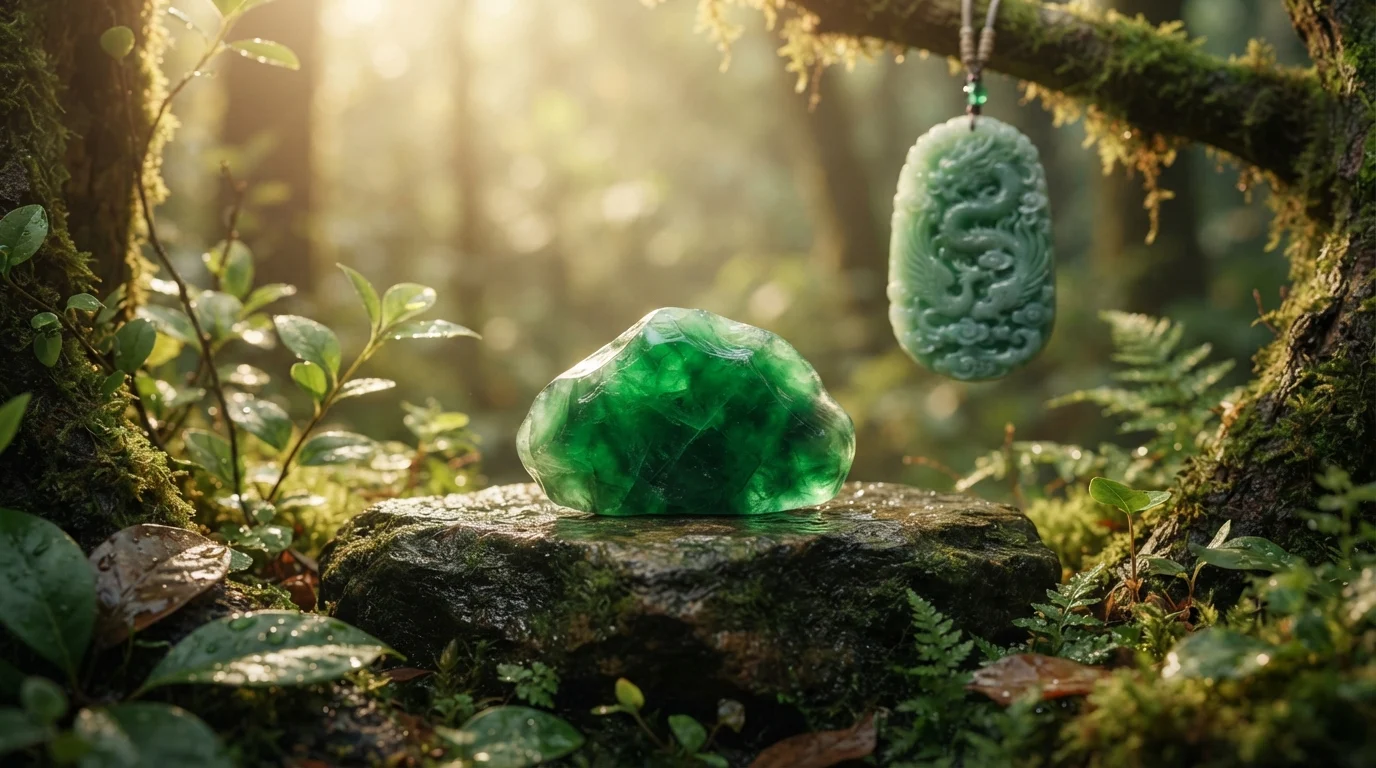
Jade symbolism is deeply connected to wisdom, prosperity, harmony, protection, and emotional balance. For thousands of years, jade has been treasured as more than a beautiful gemstone.
Its rich green colors, smooth texture, and lasting durability have made it a powerful symbol of life, renewal, and inner peace across different cultures.
If you wear jade jewelry, keep a jade stone nearby, or feel drawn to its calming appearance, understanding jade symbolism can reveal meaningful connections between nature, spirituality, and personal growth.
From ancient Chinese traditions to modern crystal practices, jade represents the idea that true prosperity involves more than wealth. It also includes strong relationships, a peaceful mind, good character, and a balanced life.
Jade Symbolism Meaning (Clear Definition)
Jade symbolism refers to the meanings and cultural associations attached to jade, a gemstone traditionally valued for its beauty, durability, and spiritual significance. It commonly represents wisdom, prosperity, protection, harmony, longevity, and renewal.
Jade is especially important in Chinese culture, where it has long been associated with virtue, status, good fortune, and spiritual refinement. In other cultures, jade objects have also carried ceremonial, artistic, and social significance.
The main symbolic meanings of jade include:
- Wisdom: Making thoughtful decisions and developing sound judgment.
- Prosperity: Welcoming abundance, opportunity, and financial well-being.
- Protection: Representing safety, resilience, and a sense of security.
- Harmony: Encouraging balance in emotions, relationships, and daily life.
- Longevity: Symbolizing endurance, vitality, and the wish for a long life.
- Renewal: Connecting the color green with nature, growth, and fresh beginnings.
- Purity of character: Reflecting integrity, compassion, and moral strength.
Jade’s meaning can vary according to its color, cultural background, and personal significance. It is important to distinguish these traditional symbolic associations from scientifically established effects.
What Does Jade Symbolism Represent?
Jade symbolism represents a combination of material prosperity, inner development, and lasting relationships. Its meanings often reflect the qualities people hope to cultivate in themselves and their communities.
1. Wisdom and Good Judgment
Jade has historically been associated with wisdom and refined character, particularly in Chinese philosophical traditions.
Its smooth surface and remarkable durability have made it a fitting metaphor for a person who develops patience, self control, and thoughtful judgment over time.
As a symbol of wisdom, jade encourages you to consider the consequences of your decisions rather than reacting impulsively. It reminds you that knowledge becomes more valuable when combined with humility and compassion.
2. Prosperity and Good Fortune
One of the most familiar meanings of jade is prosperity. Its long-standing association with wealth, valuable possessions, and good fortune has made it a popular choice for jewelry, ornaments, and meaningful gifts.
Jade is often given to celebrate new opportunities, business milestones, weddings, and other important life events.
Symbolically, jade prosperity extends beyond money. It can also represent supportive friendships, personal fulfillment, and the ability to recognize opportunities.
3. Protection and Security
Jade has been used in ornaments, amulets, and ceremonial objects in various cultural traditions. Some people have worn jade as a protective talisman, believing it could help guard against misfortune.
This history connects the stone with safety, reassurance, and resilience.
In a personal context, jade can serve as a reminder to establish healthy boundaries, make careful choices, and protect the relationships and values that matter most. Its traditional protective meaning is a cultural belief, not a scientifically verified shield against harm.
4. Harmony and Emotional Balance
Jade’s gentle green appearance often evokes forests, plants, and peaceful natural landscapes.
This visual connection makes it a symbol of harmony, calmness, and emotional balance. In contemporary spiritual practices, people may use jade as a reminder to slow down, reflect, and approach difficult situations with patience.
Its symbolism encourages you to seek balance rather than perfection.
5. Longevity and Vitality
Jade’s toughness and resistance to wear have helped establish its association with endurance and longevity.
In some Chinese traditions, jade has been connected with long life and enduring well-being. Jade objects have also appeared in historical funerary contexts, reflecting beliefs about death, status, and the afterlife.
Today, longevity symbolism can inspire a commitment to sustainable habits, meaningful relationships, and a life shaped by enduring values.
6. Love and Faithfulness
Jade jewelry is sometimes exchanged as a gift to express affection, loyalty, and commitment.
Its durability makes it a meaningful metaphor for relationships that grow stronger through patience and mutual respect.
As a symbol of love, jade can represent emotional steadiness rather than dramatic displays of affection. It reminds us that trust develops through consistent actions.
7. Growth and Renewal
Because green is widely associated with plant life and springtime, green jade can symbolize growth, regeneration, and fresh beginnings.
This meaning can be especially relevant during periods of transition, such as starting a new career, rebuilding confidence, or developing healthier relationships.
Jade’s symbolism encourages you to remain open to change while staying connected to your core values.
Spiritual Meaning of Jade Symbolism
The spiritual meaning of jade is commonly associated with harmony, wisdom, compassion, protection, and a deeper connection with nature.
Different spiritual traditions interpret jade in different ways. There is no single universal spiritual meaning, but several themes appear frequently in contemporary interpretations and historical traditions.
Jade as a Symbol of Inner Peace
Jade is often used in spiritual settings as a reminder of calmness and self awareness.
Its soft green tones can evoke the natural world, encouraging reflection and a slower, more deliberate approach to life.
If jade holds spiritual significance for you, you might use it as a personal reminder to pause before reacting, recognize your emotions, and respond with greater clarity.
The stone does not guarantee inner peace, but the meaning you attach to it can support a reflective routine.
Jade and the Heart Chakra
In modern chakra-based crystal practices, green jade is frequently associated with the heart chakra, which is traditionally connected with love, compassion, acceptance, and emotional openness.
Within this framework, jade may symbolize:
- Compassion toward yourself and others.
- Forgiveness and emotional understanding.
- Healthier personal boundaries.
- Greater appreciation for meaningful relationships.
- A willingness to give and receive love.
These associations belong to spiritual and metaphysical traditions rather than established medical science.
Jade as a Symbol of Abundance
Jade is often incorporated into modern spiritual practices focused on abundance and prosperity.
Some people keep jade stones or wear jade jewelry as reminders of their goals, hopes, and intentions.
This practice can provide a symbolic focus for reflection, but jade has not been scientifically demonstrated to attract money or change financial outcomes. Practical planning, informed decisions, and consistent effort remain important.
Jade and Personal Transformation
Jade’s connection with nature and renewal makes it a meaningful symbol of personal transformation.
It can represent the process of becoming more patient, thoughtful, and emotionally resilient.
Rather than expecting instant change, jade symbolism encourages steady development. Just as a plant grows gradually, personal growth often requires time, attention, and persistence.
Jade as a Reminder of Integrity
In traditional Chinese thought, jade has been associated with virtues such as benevolence, righteousness, wisdom, and integrity.
This connection gives the stone a meaning that goes beyond appearance or material value.
Spiritually, jade can remind you to align your actions with your principles, treat people fairly, and choose honesty even when doing so is difficult.
Biblical / Religious Meaning of Jade Symbolism
Jade does not have a prominent, clearly established symbolic role in the Bible comparable to its role in Chinese cultural traditions.
However, its broader associations with beauty, precious stones, wisdom, and renewal can be explored through religious reflection.
It is important to distinguish direct biblical references from later spiritual interpretations.
Jade and Precious Stones in the Bible
The Bible refers to precious stones in several contexts, including descriptions of sacred objects, royal adornment, and the foundations of the New Jerusalem in Revelation 21.
However, identifying ancient gemstone names with modern mineral species can be difficult because historical terminology and translations do not always correspond directly to today’s gem classifications.
Therefore, not every biblical reference to a green or precious stone should automatically be interpreted as jade.
Jade and Wisdom
Although jade is not a central biblical symbol, wisdom is a major theme throughout scripture.
Proverbs 3:13 15 describes wisdom as more valuable than precious jewels. This passage can provide a useful comparison when reflecting on jade’s traditional association with thoughtful judgment and moral character.
The connection is interpretive: the biblical passage praises wisdom, while jade’s association with wisdom comes particularly from other cultural traditions.
Jade and Spiritual Protection
Some modern spiritual interpretations connect jade with protection and peace. Christians, however, may understand protection primarily through faith in God, prayer, and the teachings of scripture rather than the supernatural power of a gemstone.
Jade can still serve as a personal object with sentimental or cultural meaning without being regarded as a source of divine power.
Is Jade Mentioned in the Bible?
Jade is not clearly identified as a major biblical symbol in the way that some other precious stones are discussed. Claims about its biblical meaning should therefore be approached cautiously, especially when modern gemstone names are applied to ancient texts.
Jade Symbolism in History and Culture
Jade has a long and fascinating history. Its cultural significance is particularly strong in China and Mesoamerica, where jade objects have served artistic, ceremonial, political, and social purposes.
Although these traditions share an appreciation for jade’s beauty and durability, their meanings are not identical.
Jade Symbolism in Ancient China


8
Jade has been valued in China for thousands of years. Archaeological discoveries show that jade objects were produced for ritual, decorative, and funerary purposes long before the modern era.
In Chinese culture, jade became closely associated with virtue, refinement, social standing, and good fortune.
Confucian writings helped develop the connection between jade’s physical qualities and moral ideals. Its smoothness, hardness, and appearance were interpreted metaphorically as qualities such as benevolence, righteousness, and integrity.
Jade objects also held ceremonial significance. Different shapes and forms could carry distinct meanings, and some were associated with ritual practices or elite status.
Over time, jade became a lasting symbol of cultural identity, artistic skill, and enduring value.
Jade Symbolism in Ancient Mesoamerica


7
Jade was also highly valued among several ancient Mesoamerican societies, including the Olmec and Maya.
In these cultures, green jadeite was associated with life, fertility, water, vegetation, and elite power. Its color linked it with the natural world and the renewal of living things.
Jade objects appeared in ornaments, ritual offerings, burials, and other significant cultural contexts. Their meanings depended on the society, period, object, and ceremonial setting.
The Maya, for example, placed particular value on jade ornaments, which could express social status and participate in ideas about life, death, and renewal.
This history demonstrates that jade symbolism developed independently in different parts of the world, shaped by local beliefs and cultural practices.
Jade in Māori Culture
Pounamu, commonly known as New Zealand greenstone, holds deep cultural significance for Māori communities.
Pounamu includes several types of stone, including nephrite jade, and is valued for its beauty, strength, and connection to people, ancestry, and place.
Carved pounamu objects, including pendants, can carry meanings related to identity, relationships, status, and personal history.
Its cultural significance should not be reduced to generic crystal meanings. For Māori, pounamu is a taonga, or treasured possession, with important cultural and spiritual dimensions.
Jade as a Symbol of Wealth and Status
Across several societies, jade has been used to create objects that demonstrate craftsmanship, wealth, and social standing.
Its value depends on factors such as the mineral type, color, transparency, quality, rarity, and cultural market.
This history has helped jade become associated with prosperity and prestige. However, its importance often extends beyond financial value to include family heritage, artistic achievement, and cultural memory.
Jade Symbolism in Literature and Art
Jade has inspired artists, poets, sculptors, and writers because of its distinctive appearance and rich cultural associations.
In literature and art, it can represent beauty, purity, refinement, wealth, permanence, or the relationship between nature and human creativity.
Jade as a Symbol of Beauty
Jade’s smooth surface and range of colors make it a natural symbol of elegance and beauty.
In Chinese poetry and literature, jade imagery has sometimes been used metaphorically to describe physical beauty, refined qualities, or something precious.
Its appeal comes not only from its color but also from its tactile qualities and the skill required to shape it.
Jade as a Symbol of Purity and Virtue
In Chinese artistic and philosophical traditions, jade is often connected with moral refinement.
A carefully carved jade object can symbolize the cultivation of character: the gradual development of patience, discipline, and integrity.
This interpretation makes jade more than a decorative material. It becomes a metaphor for the process of shaping oneself through experience and thoughtful choices.
Jade as a Symbol of Permanence
Jade’s durability contributes to its association with continuity and endurance.
In art, a jade object may represent a relationship, family legacy, or cultural tradition intended to last across generations.
This symbolism is particularly powerful when an object is passed down within a family, gathering personal meaning as it moves from one generation to another.
Jade in Modern Jewelry and Design
Contemporary artists and designers use jade in pendants, rings, bracelets, sculptures, and decorative objects.
Its meanings can be traditional, personal, or purely aesthetic. A jade pendant may represent family heritage to one person and a reminder of personal growth to another.
This flexibility allows jade to remain culturally relevant while continuing to inspire new artistic interpretations.
Dream Meaning of Jade Symbolism
Dreaming about jade can be interpreted as a reflection of your personal associations with value, beauty, security, relationships, or growth.
Dream interpretation is subjective, and there is no reliable scientific evidence that jade dreams predict future events. The most useful approach is to consider what the stone means to you and how you felt in the dream.
Dreaming of Green Jade
Green jade may symbolize growth, balance, renewal, or a desire for stability.
If you are experiencing change, the dream could reflect your wish to feel more grounded or develop a stronger sense of direction.
Dreaming of Finding Jade
Finding jade in a dream might represent recognizing an opportunity, discovering a personal strength, or appreciating something valuable that you previously overlooked.
The dream may encourage you to consider what you value most in your life.
Dreaming of Wearing Jade Jewelry
Wearing jade in a dream may reflect identity, confidence, belonging, or a connection to family and cultural heritage.
If the jewelry feels comforting, it may represent a desire for reassurance or emotional stability.
Dreaming of Losing Jade
Losing jade may symbolize concerns about security, relationships, self-worth, or the possibility of losing something meaningful.
It does not necessarily indicate that a real loss is approaching. Instead, it may be helpful to reflect on what currently feels uncertain in your life.
Dreaming of Broken Jade
Broken jade may represent disappointment, a change in perspective, or anxiety about something you once considered permanent.
The dream could invite you to consider whether an expectation needs to change or whether a relationship requires attention.
Dreaming of Receiving Jade as a Gift
Receiving jade may symbolize appreciation, affection, recognition, or a desire for a stronger connection with someone.
Your relationship with the giver and your emotional response during the dream can help clarify its personal significance.
Modern Meaning of Jade Symbolism
Today, jade remains a popular gemstone in jewelry, art, cultural traditions, and contemporary spiritual practices.
Its modern symbolism combines traditional ideas about wisdom and prosperity with personal meanings related to mindfulness, sustainability, identity, and emotional well-being.
Jade as a Symbol of Mindfulness
Some people keep jade nearby as a physical reminder to slow down and act thoughtfully.
A jade object can become part of a mindfulness practice by serving as a cue to pause, breathe, and return attention to the present moment.
The benefit comes from the person’s practice and intention, not from a proven special power of the stone.
Jade and Sustainable Values
Jade’s durability and potential to become a family heirloom can connect it with lasting value rather than disposable consumption.
Modern consumers may also consider the environmental and social impacts of gemstone mining, sourcing, and manufacturing.
Choosing jewelry with transparent sourcing information can help people make more informed decisions about the objects they purchase.
Jade as a Personal Talisman
Some people wear jade as a talisman associated with luck, confidence, protection, or abundance.
For others, it represents a loved one, a family tradition, or a memorable life event.
These personal associations can be meaningful even when they are not understood as supernatural effects.
Jade as a Symbol of Emotional Balance
In contemporary crystal practices, green jade is often associated with calmness, compassion, and the heart chakra.
People may use it as a reminder to approach relationships with patience and to respond to stress more deliberately.
Jade is not a substitute for professional medical or mental health care, but it can hold personal significance as part of a reflective routine.
Jade and Prosperity in Everyday Life
The modern meaning of jade prosperity can be understood as a reminder to build a stable and fulfilling life.
This includes managing money carefully, developing useful skills, maintaining supportive relationships, and recognizing opportunities for growth.
Rather than viewing jade as a shortcut to success, you can treat its symbolism as encouragement to combine optimism with practical action.
Jade Colors and Their Symbolic Meanings
Jade occurs in several colors, and each can carry different associations depending on cultural traditions and personal interpretations. Green jade is especially well known, but white, lavender, yellow, and other varieties also have distinctive appeal.

Green jade Prosperity and harmony
Green jade is commonly associated with growth, good fortune, balance, and renewal. It is particularly prominent in Chinese jade traditions.

White jade Purity and clarity
In some modern interpretations, white jade represents sincerity, simplicity, calmness, and clear intentions.

Lavender jade Peace and compassion
Lavender jade is often given symbolic associations with emotional gentleness, reflection, and spiritual awareness.

Yellow jade Joy and abundance
Yellow jade may symbolize optimism, warmth, confidence, and material well-being in contemporary interpretations.

Black jade Strength and resilience
Black jade is sometimes associated with grounding, determination, and protection in modern spiritual practices.
These color meanings are not universal rules. Jade’s cultural history, mineral identity, and individual significance may matter more than a generalized color interpretation.
Jade Symbolism at a Glance
| Jade symbol or association | Meaning |
|---|---|
| Wisdom | Thoughtful judgment and learning |
| Prosperity | Abundance, opportunity, and well-being |
| Protection | Security, resilience, and reassurance |
| Harmony | Balance and peaceful relationships |
| Longevity | Endurance and lasting value |
| Green jade | Growth, renewal, and good fortune |
| White jade | Purity and clarity in some interpretations |
| Jade jewelry | Identity, affection, heritage, or commitment |
| Jade in dreams | Personal values, security, or change |
Frequently Asked Questions About Jade Symbolism
1. What does jade symbolize spiritually?
Jade is commonly associated with wisdom, harmony, protection, prosperity, and renewal. In modern spiritual practices, green jade is also frequently connected with compassion and the heart chakra.
2. Is jade considered a lucky stone?
Jade is traditionally regarded as a symbol of good fortune and prosperity in several cultures, particularly in Chinese traditions. These beliefs are culturally meaningful but do not establish that jade can cause luck or guarantee success.
3. What does green jade symbolize?
Green jade commonly represents growth, harmony, prosperity, renewal, and connection with nature. Its meaning can vary depending on cultural background and personal beliefs.
4. What does jade symbolize in Chinese culture?
In Chinese culture, jade has long been associated with virtue, wisdom, refinement, good fortune, and social status. It also holds important historical, artistic, and ceremonial significance.
5. Can jade symbolize love and protection?
Yes. Jade jewelry is sometimes given to express affection, loyalty, and enduring connection, while jade amulets have been used in some traditions as symbols of protection. These meanings reflect cultural and personal beliefs rather than scientifically verified protective effects.
Conclusion: The Lasting Meaning of Jade Symbolism
Jade symbolism brings together wisdom, prosperity, harmony, protection, and renewal. From ancient Chinese traditions to Mesoamerican art and modern jewelry, jade has represented values that reach far beyond its physical beauty.
Its deeper message is that lasting worth comes from character, meaningful relationships, and thoughtful choices.
If you treasure jade for its cultural heritage, spiritual associations, or natural elegance, it can serve as a reminder to cultivate balance, appreciate what matters, and grow with patience and integrity.

I’m Sophia Brown, passionate about exploring symbols, their meanings, and cultural significance. I enjoy researching history, spirituality, and traditions, creating clear, engaging articles that inspire curiosity and deeper understanding for every reader.


