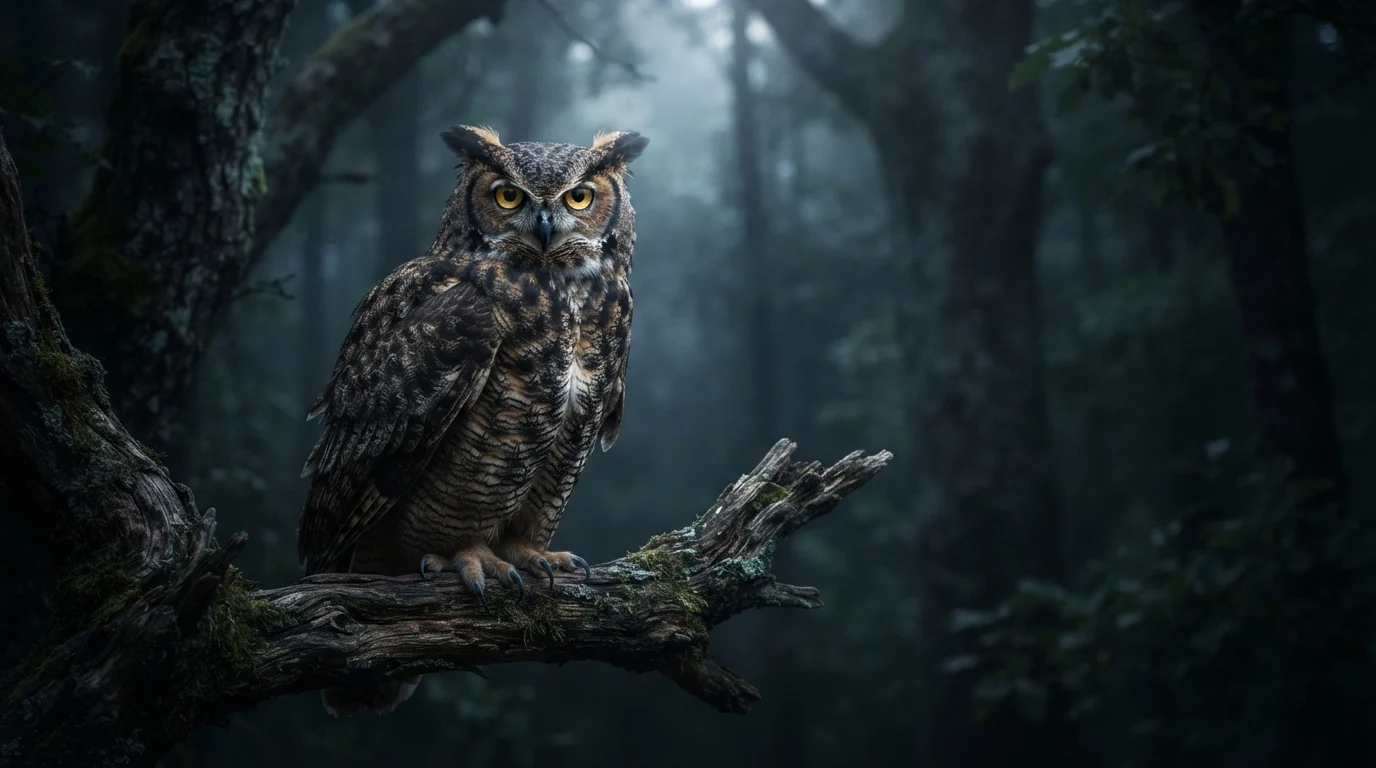
Owl symbolism has fascinated people for centuries because owls are mysterious, observant, and active when much of the world is asleep. Across different cultures, the owl can represent wisdom, intuition, mystery, protection, transformation, and hidden knowledge.
At the same time, owl symbolism is not universally positive or negative. Its meaning changes depending on the culture, religious tradition, personal experience, and situation in which the owl appears.
If you saw an owl in nature, dreamed about one, noticed owl imagery repeatedly, or simply want to understand its deeper meaning, this guide explores the most common interpretations.
Owl Symbolism Meaning (Clear Definition)
The simplest definition of owl symbolism is the use of the owl as a representation of wisdom, intuition, observation, mystery, and awareness.
Owls are often associated with wisdom because of their calm appearance and ability to observe their surroundings carefully. Their nocturnal nature also connects them with darkness, secrets, the unknown, and things that are not immediately visible.
In symbolic traditions, an owl may represent:
- Wisdom and knowledge
- Intuition and inner guidance
- Mystery and the unknown
- Observation and awareness
- Protection and vigilance
- Transformation and change
- Independence and self-reliance
- Hidden truth and deeper understanding
The meaning depends heavily on context. An owl appearing peacefully may symbolize guidance or wisdom, while an owl associated with fear or darkness may represent uncertainty, change, or something hidden.
What Does Owl Symbolism Represent?
Owl symbolism represents the ability to see beyond appearances and notice what others may overlook.
An owl’s exceptional nighttime vision makes it a natural symbol of seeing through darkness. Symbolically, this can mean finding clarity during confusing periods of life.
Wisdom
The owl is perhaps most famously connected with wisdom. This association suggests thoughtful decision-making, learning, patience, and the ability to understand situations deeply rather than reacting quickly.
Intuition
Because owls operate in darkness, they are often connected with instinct and inner perception. Owl symbolism can encourage you to trust your intuition when logic does not provide every answer.
Mystery
Owls are nocturnal creatures, so they naturally evoke the mysterious and unknown. Seeing an owl may symbolically represent unanswered questions, hidden information, or a journey into something unfamiliar.
Transformation
In some symbolic traditions, owls are connected with major transitions. Their relationship with darkness can represent moving through uncertainty before reaching greater understanding.
Protection
An owl’s alertness and sharp senses can symbolize vigilance. In this interpretation, the owl represents staying aware of your surroundings and recognizing potential dangers before they become obvious.
| Owl Symbolic Meaning | What It Can Represent |
|---|---|
| Wisdom | Knowledge, learning, good judgment |
| Intuition | Inner guidance and instinct |
| Mystery | The unknown and hidden truths |
| Protection | Awareness and vigilance |
| Transformation | Change and personal growth |
| Independence | Self-reliance and confidence |
| Vision | Seeing beyond appearances |
Spiritual Meaning of Owl Symbolism
The spiritual meaning of owls is often associated with intuition, awareness, inner wisdom, and the ability to move through uncertainty.
Spiritually, the owl can symbolize a period when you are being encouraged to look deeper. Instead of accepting everything at face value, you may be called to observe carefully and listen to your inner voice.
The owl’s connection with nighttime can also represent the spiritual journey through difficult or uncertain experiences. Darkness does not necessarily symbolize something bad. It can represent a stage in which important truths are developing beneath the surface.
For some people, owl symbolism may therefore suggest:
- Trust your intuition.
- Pay attention to what is not being said.
- Seek knowledge before making a decision.
- Do not fear periods of uncertainty.
- Look beneath appearances.
- Allow personal transformation to unfold naturally.
A recurring owl encounter can feel especially meaningful, but its personal significance depends on your own beliefs and circumstances.
Biblical / Religious Meaning of Owl Symbolism
The biblical meaning of owls is more complex than the modern idea that owls simply represent wisdom.
Several owl or owl like birds are mentioned in biblical passages, particularly in descriptions of desolate or abandoned places. In these contexts, owls can be associated with wilderness, loneliness, desolation, and places separated from ordinary human life.
This is different from the popular Western association between owls and wisdom.
Christian interpretations therefore should not assume that every owl automatically represents wisdom or spiritual guidance. Biblical symbolism depends on the specific passage, translation, and context.
In other religious and spiritual traditions, owls can have very different meanings. Some cultures view them as wise or protective beings, while others associate them with death, omens, or the supernatural.
This variety is important: there is no single religious meaning of the owl that applies to every faith or tradition.
Owl Symbolism in History and Culture
Owl symbolism has appeared in many civilizations, but its meaning has changed considerably across time.
One of the most famous examples comes from ancient Greece, where the little owl was associated with Athena, the goddess of wisdom and strategic thought. The owl consequently became strongly connected with wisdom, knowledge, and intellectual insight.
In other cultures, however, owls have carried darker associations.
Because owls are active at night, difficult to see, and capable of appearing suddenly from darkness, some traditional societies connected them with death, spirits, warnings, or supernatural forces.
Native American traditions are particularly diverse, and it is misleading to claim that all Indigenous peoples share one interpretation of the owl. Different nations and communities have their own stories, beliefs, and cultural relationships with owls.
This cultural diversity shows why owl symbolism should always be understood within its specific historical context.
Owl Symbolism in Literature and Art
Owls have long been powerful symbols in literature and visual art.
Writers often use the owl to represent a character who sees what others cannot. Its silence, nighttime activity, and unusual appearance make it especially effective for creating an atmosphere of mystery.
In poetry and fiction, an owl may symbolize:
- Wisdom
- Isolation
- Foreknowledge
- Mystery
- Death or mortality
- Secrets
- Observation
Artists also use owl imagery to create contrasts between light and darkness, knowledge and ignorance, or innocence and danger.
The owl’s large eyes are particularly symbolic. They can suggest a character or observer who notices everything but reveals very little.
Dream Meaning of Owl Symbolism
The owl dream meaning depends on what the owl was doing and, most importantly, how you felt during the dream.
Dream symbolism is personal rather than scientifically fixed, so the same owl dream can mean different things to different people.
Dreaming of a Calm Owl
A calm owl may symbolize wisdom, patience, observation, or a need to slow down and think carefully.
Dreaming of an Owl Watching You
An owl staring at you may represent self awareness or the feeling that something important requires your attention.
Dreaming of a Flying Owl
A flying owl can symbolize freedom, perspective, change, or the ability to rise above a difficult situation.
Dreaming of a White Owl
A white owl is sometimes interpreted as a symbol of purity, spiritual awareness, mystery, or transformation. Its meaning depends on the emotional atmosphere of the dream.
Dreaming of an Owl Attacking
An attacking owl may reflect fear, conflict, anxiety, or a situation you feel unable to understand. Rather than predicting an event, the dream may be expressing emotions already present in your waking life.
Modern Meaning of Owl Symbolism
Today, owl symbolism is commonly associated with wisdom, intelligence, intuition, independence, and mystery.
The owl has become especially popular in education, books, tattoos, jewelry, logos, home décor, and personal artwork. Its connection with learning makes it a natural image for schools, libraries, academic organizations, and educational themes.
Owl tattoos are also often chosen to represent knowledge, personal growth, independence, or a desire to see the truth clearly.
In modern spiritual culture, the owl may also represent paying attention to intuition and becoming more conscious of hidden aspects of life.
However, modern interpretations should not be confused with ancient or religious meanings. The same owl image can carry completely different symbolism depending on who is using it and why.
What Does It Mean When You See an Owl?
Seeing an owl can have an ordinary explanation: owls are wild animals following their natural behavior. There is no universal evidence that an owl sighting predicts a particular event.
Symbolically, however, some people interpret an owl encounter as an invitation to become more observant and reflective.
You might ask yourself:
- Is there something I have been overlooking?
- Am I ignoring my intuition?
- Do I need more information before making a decision?
- Am I entering a period of change?
- What truth might I need to recognize?
The most meaningful interpretation is often the one that connects naturally with your current circumstances without treating symbolism as a guaranteed prediction.
Owl Symbolism and Personal Growth
The owl can be a powerful metaphor for personal growth because it represents seeing clearly in situations that initially seem uncertain.
Its symbolism encourages patience rather than impulsiveness. Instead of immediately reacting to what is happening around you, the owl suggests watching, listening, learning, and then acting with greater awareness.
In this sense, the owl represents a valuable life lesson: clarity often comes from paying closer attention.
If you view the owl spiritually, culturally, psychologically, or simply as a fascinating animal, its symbolism can encourage curiosity and thoughtful reflection.
Frequently Asked Questions About Owl Symbolism
What is the main meaning of owl symbolism?
The main meaning of owl symbolism is wisdom, intuition, observation, and mystery. Depending on the culture, it can also represent protection, transformation, death, or the unknown.
What does an owl symbolize spiritually?
Spiritually, an owl can symbolize inner wisdom, intuition, awareness, and seeing beyond what is immediately visible. Some people also associate it with transformation and guidance through uncertain periods.
Is seeing an owl a good omen?
There is no universal rule that seeing an owl is either a good or bad omen. Different cultures interpret owls differently, so the meaning depends on cultural beliefs and personal circumstances.
What does an owl mean in a dream?
An owl in a dream may symbolize wisdom, intuition, mystery, awareness, or something hidden. Its meaning depends on the owl’s behavior and the emotions you experienced during the dream.
Why are owls associated with wisdom?
Owls became strongly associated with wisdom partly through ancient Greek culture, where the owl was connected with Athena, the goddess of wisdom. Their alert appearance and ability to navigate darkness have also reinforced the symbolism over time.
Conclusion
Owl symbolism is ultimately about seeing more deeply. If the owl represents wisdom, intuition, mystery, protection, or transformation, its enduring message is to observe carefully and look beyond appearances.
The owl reminds us that not everything important is immediately visible and sometimes, understanding begins when we learn to trust what we quietly notice.

I’m Sophia Brown, passionate about exploring symbols, their meanings, and cultural significance. I enjoy researching history, spirituality, and traditions, creating clear, engaging articles that inspire curiosity and deeper understanding for every reader.