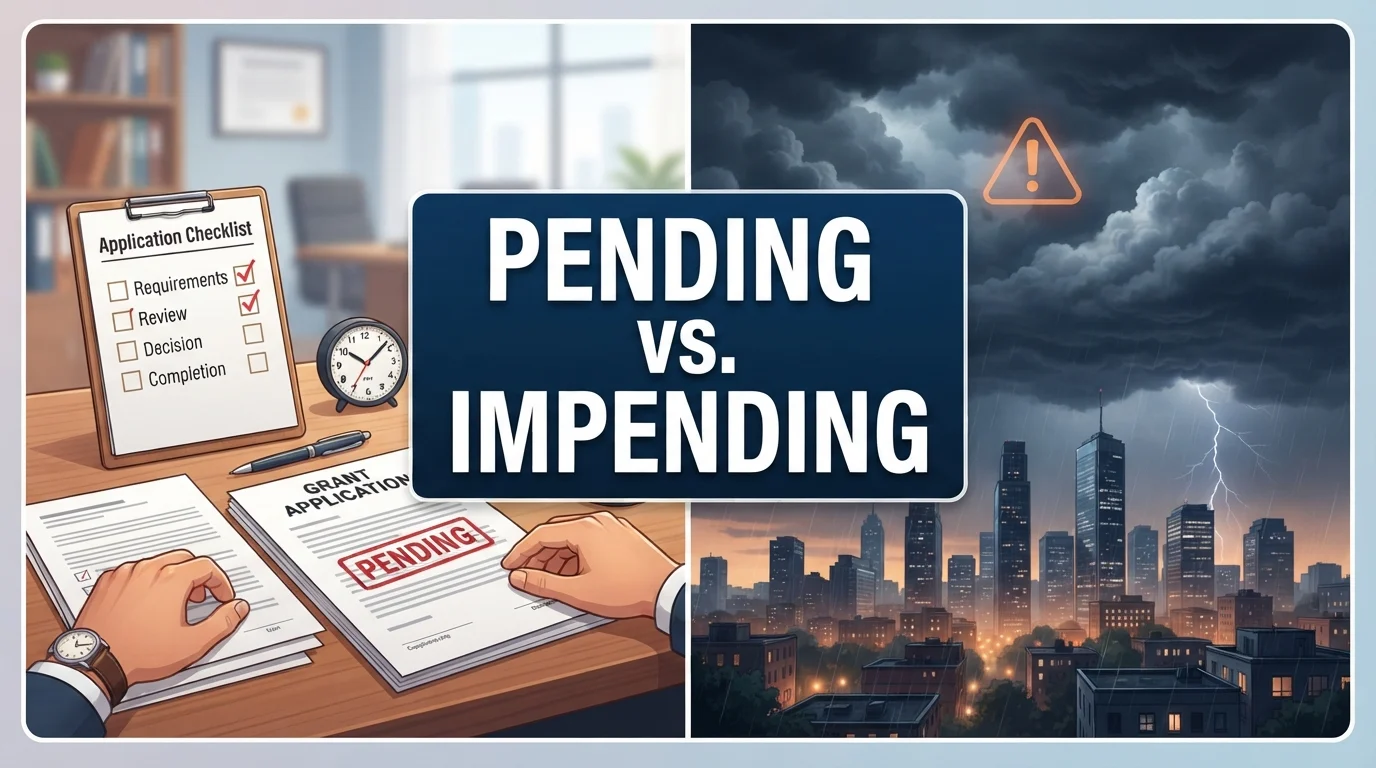
Understanding the difference between pending vs. impending can help you choose the right word when describing something that has not happened yet. Although both words relate to future events, they communicate different ideas.
Pending generally describes something that is waiting for a decision, completion, or resolution. Impending, on the other hand, describes something that is approaching or expected to happen soon, often suggesting urgency or concern.
These words sometimes confuse students, English learners, and even native speakers because they both refer to situations that are not yet finished or have not yet occurred. However, they are not interchangeable.
Knowing their meanings, grammatical roles, and common contexts will help you use them naturally in everyday conversations, professional writing, emails, and academic work.
Quick Answer: Pending vs. Impending
Pending means waiting for a decision, approval, action, or completion. Impending means approaching or about to happen soon.
For example, a pending application is awaiting approval, while an impending storm is approaching. The main difference is that pending emphasizes an unresolved situation, whereas impending emphasizes an approaching event.
Why Do People Confuse Pending and Impending?
People often confuse these words because both describe situations connected to something that has not happened or been completed.
For example:
- A pending decision has not been made yet.
- An impending decision is expected to happen soon.
Both expressions involve the future, but their emphasis is different.
Another reason for the confusion is that both words can appear before nouns and function as adjectives. Their similar appearance also makes them easy to mix up, especially for English learners.
The easiest way to distinguish them is to consider whether something is waiting to be resolved or approaching in time.
What Does Pending Mean?
Pending means awaiting a decision, approval, action, or completion. It describes something that has started or been submitted but remains unfinished or unresolved.
It is commonly used in business, legal matters, banking, applications, and everyday situations.
Pending as an Adjective
As an adjective, pending describes something that has not yet been settled or completed.
Examples:
- My job application is still pending.
- The court postponed the hearing because of a pending investigation.
- Your payment is pending approval.
- We cannot make a final decision while the proposal is pending.
- The company announced changes pending further review.
In these examples, pending indicates that an action or decision is still awaiting resolution.
Pending as a Preposition
Pending can also function as a preposition meaning until something happens or while waiting for a particular outcome.
Examples:
- The employee will remain suspended pending an investigation.
- The agreement is temporary pending final approval.
- The building will remain closed pending safety inspections.
In this usage, pending introduces something that must happen before a situation can be finalized.
Common Grammatical Forms of Pending
- Pending: adjective or preposition.
- Pending application: an application awaiting a decision.
- Pending approval: waiting for approval.
- Pending payment: a payment that has not been completed or confirmed.
Important: Pending is not normally used as a verb. Its base verb is pend, but this is uncommon in everyday English.
What Does Impending Mean?
Impending means approaching or about to happen soon. It describes an event or situation that is expected in the near future.
It often suggests urgency, concern, or the importance of preparing for something.
Examples include an impending storm, an impending deadline, or an impending crisis.
Impending as an Adjective
Impending is an adjective used to describe something approaching or expected to happen soon.
Examples:
- Dark clouds warned us of an impending storm.
- Everyone was nervous about the impending examination.
- The company prepared for an impending financial crisis.
- We discussed the impending changes to the policy.
- She felt anxious about her impending surgery.
In each example, impending describes an event that is approaching.
Impending as a Verb Form
Impending comes from the verb imp end? No. Its base verb is imp end? The correct spelling is imp end?
The correct base verb is imp end?
Actually, the word is formed from the verb imp end?
To avoid confusion, remember that the correct base verb is imp end?
Correction: The base verb is imp end?
The correct English verb is imp end?
The correct form is imp end?
The word impending comes from the verb imp end?
The correct verb is impend.
Impend means to be about to happen or threaten to occur. It is relatively uncommon in everyday English.
Its grammatical forms include:
- Impend: base form.
- Impends: third-person singular.
- Impended: simple past.
- Impending: present participle.
Examples:
- A major storm impends over the coastal region.
- The danger impended as the situation worsened.
- An impending crisis worried the entire community.
In ordinary writing, impending is much more common as an adjective than impend is as a verb.
Pending vs. Impending: Key Differences
Although these words are related to unfinished or future situations, they have different meanings and uses.
| Comparison | Pending | Impending |
|---|---|---|
| Meaning | Awaiting a decision or completion | Approaching or about to happen |
| Main idea | Unresolved situation | Future event |
| Grammatical role | Adjective and preposition | Adjective; also a participle |
| Time emphasis | Until something is settled | Something is expected soon |
| Common examples | Pending approval, pending payment | Impending storm, impending crisis |
| Common contexts | Applications, payments, legal cases | Deadlines, emergencies, events |
| Emotional tone | Usually neutral | Often suggests urgency or concern |
The Main Difference in Simple Words
Think about these two sentences:
- My application is pending.
- My examination is impending.
The first sentence means the application is waiting for a decision. The second means the examination is approaching.
This distinction makes it easier to choose the correct word.
When Should You Use Pending?
Use pending when describing something that is waiting for approval, a decision, an action, or completion.
Common situations include:
1. Applications and requests
- My university application is pending.
- Your membership request is pending approval.
2. Payments and transactions
- The bank shows my payment as pending.
- The transaction is pending verification.
3. Legal matters
- The case remains pending in court.
- The investigation is still pending.
4. Business decisions
- The merger is pending regulatory approval.
- The contract remains pending final review.
5. Unfinished arrangements
- The trip is pending confirmation.
- The project is pending management approval.
When Should You Use Impending?
Use impending when something is approaching and expected to happen soon.
Common situations include:
1. Weather events
- Residents prepared for the impending hurricane.
- The impending storm forced people indoors.
2. Deadlines and examinations
- Students were worried about the impending deadline.
- The impending final exam made everyone nervous.
3. Important changes
- Employees discussed the impending company restructuring.
- The impending policy changes created uncertainty.
4. Emergencies and difficult situations
- The warning alerted residents to impending danger.
- The community prepared for an impending crisis.
5. Personal events
- She was excited about her impending wedding.
- He felt nervous about his impending retirement.
Pending vs. Impending: 10 More Practical Examples
The following examples show how the words work in different situations.
Examples Using Pending
- The insurance claim is pending further investigation.
- Your order is pending confirmation from the seller.
- The school has several pending admission requests.
- The manager postponed the decision because the proposal is pending review.
- The court will address the pending legal matter next week.
Examples Using Impending
- The villagers received an alert about the impending flood.
- The approaching clouds suggested an impending thunderstorm.
- Everyone was preparing for the impending product launch.
- The country faced an impending economic crisis.
- She bought a new outfit for her impending graduation ceremony.
Compare Them in Similar Sentences
These examples make the difference even clearer:
- Pending approval: The request is waiting for approval.
- Impending approval: Approval is expected to happen soon.
- Pending deadline: A deadline is awaiting action or resolution, although this is less natural than upcoming deadline.
- Impending deadline: A deadline is approaching soon.
- Pending investigation: An investigation or related matter remains unresolved.
- Impending investigation: An investigation is about to begin.
Notice that the most natural expression depends on the situation and the noun being described.
Common Mistakes When Using Pending and Impending
Even though these words have different meanings, people sometimes use them incorrectly.
Here are some common mistakes and their corrections.
Mistake 1: Using Impending for an Unapproved Application
Incorrect: My university application is impending.
Correct: My university application is pending.
Why? The application is waiting for a decision, not approaching as an event.
Mistake 2: Using Pending for an Approaching Storm
Incorrect: An impending storm is approaching.
Correct: A storm is impending.
Why? Impending describes an approaching event. Pending does not communicate this meaning.
Mistake 3: Treating the Words as Exact Synonyms
Incorrect: My payment is impending.
Correct: My payment is pending.
Why? A payment awaiting processing is pending. If a payment is about to become due, a different expression such as upcoming payment may be more appropriate.
Mistake 4: Confusing Pending with Past Events
Incorrect: The pending storm happened yesterday.
Correct: The impending storm arrived yesterday.
Why? Impending describes an approaching event. Once it has happened, the event is no longer impending.
Mistake 5: Using Pending When You Mean Something Is About to Happen
Incorrect: The impending deadline is pending tomorrow.
Better: The deadline is approaching tomorrow.
Why? Pending and impending express different ideas, and combining them unnecessarily makes the sentence confusing.
Easy Memory Trick: How to Remember the Difference
You can remember the difference between pending and impending with two simple ideas:
- Pending = Pause: Something is waiting for a decision or completion.
- Impending = Incoming: Something is approaching or about to happen.
For example:
- A pending job application is waiting for approval.
- An impending job interview is approaching.
Whenever you are unsure which word to use, ask yourself:
Is something waiting for a decision, or is an event approaching?
If it is waiting, choose pending. If it is approaching, choose impending.
Are Pending and Impending Different in American and British English?
There is no significant difference between American and British English in the meanings of pending and impending.
Both varieties use pending for unresolved matters and impending for approaching events.
For example:
- American English: The payment is pending approval.
- British English: The payment is pending approval.
- American English: An impending storm caused concern.
- British English: An impending storm caused concern.
The spelling and basic grammatical usage are the same in both varieties.
Similar and Related Words
Understanding related vocabulary can help you choose more precise words.
Words Similar to Pending
- Awaiting: Waiting for something to happen.
- Unresolved: Not yet settled or solved.
- Outstanding: Not yet completed, paid, or dealt with.
- Unsettled: Not yet decided or resolved.
- Conditional: Depending on something else happening.
Examples:
- The request is awaiting approval.
- The issue remains unresolved.
- The outstanding payment must be completed.
Words Similar to Impending
- Approaching: Coming closer in time or distance.
- Upcoming: Scheduled or expected to happen in the near future.
- Forthcoming: Expected or planned to happen soon.
- Imminent: About to happen very soon.
- Near: Close in time or distance.
Examples:
- An approaching storm worried residents.
- The upcoming meeting requires preparation.
- An imminent threat forced an evacuation.
Important distinction: Imminent and impending are particularly close in meaning, but imminent often suggests that something is very close to happening. Upcoming is generally more neutral.
Frequently Asked Questions
1. What is the main difference between pending and impending?
Pending means something is waiting for a decision, approval, or completion. Impending means something is approaching or expected to happen soon. A pending application awaits a decision, while an impending storm is approaching.
2. Are pending and impending interchangeable?
No. Although both words relate to situations that have not been completed or have not happened yet, their meanings differ.
Pending describes an unresolved matter, whereas impending describes an approaching event. Using one instead of the other can change the meaning of a sentence.
3. Does pending mean something will happen soon?
Not necessarily. Pending means that something is awaiting a decision, action, or completion. It does not tell you exactly when the matter will be resolved. A pending application, for example, could remain under review for days or weeks.
4. Does impending always mean something bad?
No. Impending often appears in negative contexts, such as an impending disaster or crisis, but it can also describe positive or neutral events. An impending wedding, graduation, or retirement is simply an event that is approaching.
5. Is impending the same as imminent?
They have very similar meanings because both describe something expected to happen soon. However, imminent often emphasizes that an event is very close to happening. Impending also describes an approaching event and frequently carries a sense of urgency.
6. Is pending an adjective or a verb?
Pending is commonly used as an adjective and can also function as a preposition. For example, in “The application is pending,” it is an adjective. In “The building remains closed pending inspection,” it functions as a preposition.
7. What is the opposite of pending and impending?
The opposite of pending depends on the context. Words such as resolved, approved, or completed may work. The opposite of impending may be past, completed, or over, depending on the sentence.
8. Can I say an impending deadline?
Yes. An impending deadline is a deadline that is approaching soon. It is a correct and natural expression. For example, “The team worked late because of the impending deadline.”
Remember This: Pending vs. Impending
Keep these simple definitions in mind:
- Pending: Waiting for a decision, approval, action, or completion.
- Impending: Approaching or about to happen soon.
- Pending application: An application awaiting a decision.
- Impending event: An event expected to happen soon.
- Memory trick: Pending means pause; impending means incoming.
Conclusion
The difference between pending and impending is simple once you understand what each word describes. Pending refers to something that is waiting for a decision, approval, or completion.
Impending refers to something that is approaching or expected to happen soon. Although both words relate to unfinished or future situations, they are not interchangeable.
To use them correctly, remember that a pending application is waiting for approval, while an impending event is getting closer in time.
Pay attention to the context, choose the word that expresses your intended meaning, and practice using both in everyday sentences.
With a little practice, you can confidently distinguish pending vs. impending in conversations, academic writing, and professional communication.

I’m Camden Holland, a passionate writer at Symbolop, where I explore the meanings, history, and cultural significance of symbols. I enjoy creating clear, engaging content that helps readers discover the fascinating stories behind symbols from around the world.


