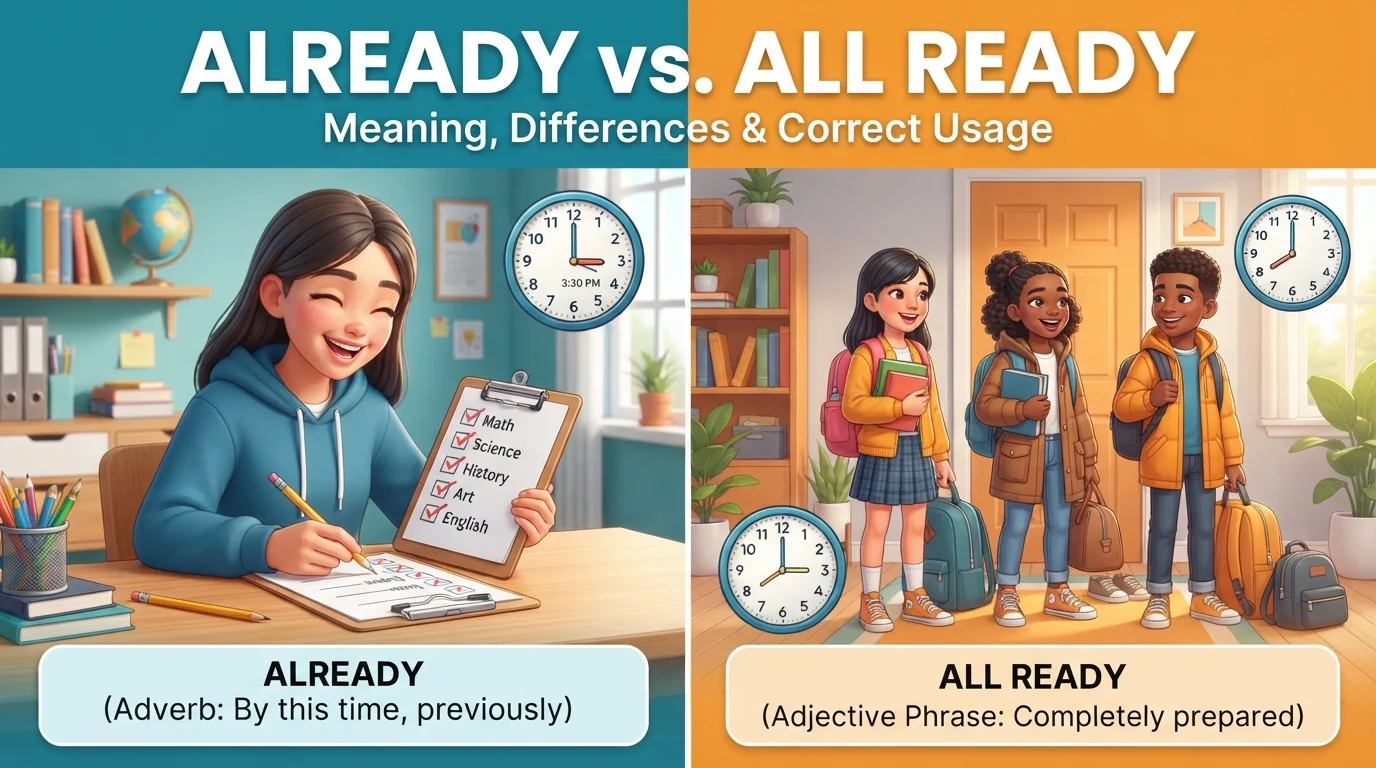
Understanding the difference between already vs. all ready can help you write more clearly and avoid common spelling and grammar mistakes.
Although these expressions sound almost identical, they have different meanings and serve different purposes in a sentence.
One describes something that has happened before a particular time, while the other indicates that everyone or everything is fully prepared.
The confusion often happens because both expressions contain the word ready or sound similar when spoken quickly. However, choosing the correct expression depends on what you want to communicate.
If you are writing an email, completing a school assignment, speaking English at work, or improving your everyday grammar, knowing when to use already and all ready will make your communication more accurate.
This guide explains their definitions, grammatical roles, differences, and practical examples so you can confidently choose the right expression.
Quick Answer: Already vs. All Ready
Already is one word that means something has happened before now or earlier than expected. All ready is a two word phrase meaning everyone or everything is fully prepared. For example, “I already ate” describes a completed action, while “We are all ready” describes a state of preparation.
Why Do People Confuse Already and All Ready?
People often confuse already and all ready because they sound nearly identical in everyday American English. When spoken naturally, the space between the two words in all ready may be difficult to notice.
Their similar sounds make it easy to use the wrong spelling when writing quickly. However, their meanings are quite different.
Consider these sentences:
- I am already at school.
- We are all ready for school.
In the first sentence, already tells us that someone has arrived at school earlier than expected or before the present moment.
In the second sentence, all ready means everyone is prepared to go to school.
The easiest way to avoid confusion is to identify if you are describing timing or preparation.
What Does Already Mean?
Already is an adverb that means something has happened, been completed, or become true before a particular time.
It can also describe an action that happens earlier than someone expected.
Already is written as one word and commonly appears in everyday conversations, emails, academic writing, and informal communication.
Examples of Already in Sentences
- I have already finished my homework.
- She already knows the answer.
- We have already booked our tickets.
- He is already waiting outside.
- The movie has already started.
In each example, already indicates that something has happened or become true before the present moment or an expected time.
Grammatical Role of Already
Already functions as an adverb. It modifies verbs, verb phrases, and sometimes entire clauses by providing information about timing.
It commonly appears in these grammatical structures:
1. With the present perfect tense
- I have already eaten lunch.
- They have already completed the project.
2. With the past tense
- She already called me.
- We already knew about the problem.
3. With the present tense
- He already understands the instructions.
- I already have a copy.
4. With the future perfect tense
– By tomorrow, I will have already finished the report.
Where Should You Place Already in a Sentence?
The position of already can vary depending on the verb and sentence structure.
Common placements include:
- Before the main verb: I already understand.
- After the auxiliary verb: She has already left.
- After the verb be: They are already here.
- At the end of a sentence for emphasis: I told you already.
These placements are all natural in appropriate contexts.
What Does All Ready Mean?
All ready is a two-word phrase that means everyone or everything is completely prepared.
The word all refers to the entire group or complete quantity, while ready describes a state of preparation.
Unlike already, all ready does not describe when something happened. It describes whether someone or something is prepared.
Examples of All Ready in Sentences
- We are all ready for the trip.
- The children are all ready for school.
- Is everyone all ready for dinner?
- The documents are all ready to submit.
- I am all ready for my presentation.
In these sentences, all ready communicates that the people or things mentioned are fully prepared.
Grammatical Role of All Ready
All ready is a two word expression rather than a single adverb.
- All: A determiner or pronoun indicating the whole group or quantity.
- Ready: An adjective describing a condition of preparedness.
Together, they communicate that everyone or everything is prepared.
How All Ready Works in Different Sentences
1. With people
- We are all ready to leave.
- The students are all ready for the examination.
2. With objects
- The packages are all ready for delivery.
- My clothes are all ready for tomorrow.
3. With questions
- Are you all ready?
- Is the team all ready for the competition?
4. With negative sentences
- We are not all ready yet.
- The rooms are not all ready for the guests.
Already vs. All Ready: Key Differences
Although these expressions sound similar, their meanings, grammatical functions, and sentence structures are different.
Here is a simple comparison:
| Feature | Already | All Ready |
|---|---|---|
| Spelling | One word | Two words |
| Meaning | Before now or earlier than expected | Completely prepared |
| Part of speech | Adverb | All + adjective |
| Main purpose | Describes timing | Describes preparation |
| Example | I already finished. | We are all ready. |
| Related idea | Completion or time | Readiness or preparation |
Difference in Meaning
The biggest difference is what each expression communicates.
- Already: Something has happened before now or sooner than expected.
- All ready: Someone or something is fully prepared.
For example:
- The guests have already arrived.
- The guests are all ready for dinner.
The first sentence describes an event that has happened. The second describes the guests’ preparation.
Difference in Spelling
Already is always written as one word when used in its standard adverbial meaning.
All ready is written as two separate words because each word contributes its own meaning.
Writing allready as one word is incorrect in standard English.
When to Use Already
Use already when you want to communicate that something has happened, been completed, or become true before a particular time.
It is especially useful when discussing completed activities, previous knowledge, unexpected events, and actions that happened sooner than anticipated.
Use Already for Completed Actions
- I have already washed the dishes.
- She has already submitted her application.
- They already finished their work.
Use Already for Earlier-Than-Expected Events
- You are already here!
- The store has already closed.
- He already knows about the surprise.
Use Already to Express Surprise
- Have you already finished the book?
- Is it already midnight?
- Are we leaving already?
In these examples, the word can express surprise that something happened sooner than expected.
When to Use All Ready
Use all ready when you want to explain that everyone or everything is prepared for an activity, event, or situation.
It is especially common when discussing travel, school, work, meetings, and special occasions.
Use All Ready for People
- We are all ready for the meeting.
- The players are all ready to compete.
- My family is all ready to travel.
Use All Ready for Things
- The meals are all ready to serve.
- The gifts are all ready for delivery.
- The presentation slides are all ready.
Use All Ready in Questions
- Are you all ready to go?
- Is everyone all ready for the event?
- Are the students all ready for the test?
Already vs. All Ready: 10 Additional Practical Examples
The following examples show how these expressions work in everyday situations.
| Already | All Ready |
|---|---|
| I already paid the bill. | We are all ready to pay. |
| She already knows my name. | The guests are all ready to leave. |
| He has already finished breakfast. | The children are all ready for breakfast. |
| They already purchased the tickets. | The tickets are all ready for collection. |
| The meeting has already started. | We are all ready for the meeting. |
| I already packed my suitcase. | Our bags are all ready for the trip. |
| She already sent the email. | The emails are all ready to send. |
| The teacher already explained the lesson. | The students are all ready to begin. |
| We already visited that museum. | We are all ready to visit the museum. |
| He already made dinner. | Dinner is all ready to serve. |
Notice how already communicates that something has happened, while all ready describes a prepared condition.
Common Mistakes With Already and All Ready
Even experienced English speakers sometimes confuse these expressions. Understanding the following mistakes can help you avoid incorrect usage.
Mistake 1: Writing All Ready as One Word
Incorrect: We are allready for the party.
Correct: We are all ready for the party.
Explanation: All ready is always written as two words when it means completely prepared.
Mistake 2: Using Already to Describe Preparation
Incorrect: We are already for the competition.
Correct: We are all ready for the competition.
Explanation: The sentence needs an expression describing preparation, not an adverb describing timing.
Mistake 3: Using All Ready for a Completed Action
Incorrect: I have all ready finished my homework.
Correct: I have already finished my homework.
Explanation: The sentence describes a completed action, so already is the correct choice.
Mistake 4: Confusing Readiness With Completion
Incorrect: The team has all ready won the match.
Correct: The team has already won the match.
Explanation: Winning is a completed event, not a state of preparation.
Mistake 5: Using the Wrong Expression in Questions
Incorrect: Are you already to leave?
Correct: Are you all ready to leave?
Explanation: The question asks whether someone is prepared to leave, so all ready is appropriate.
Easy Memory Trick to Remember Already vs. All Ready
A simple memory trick can help you choose the correct expression every time.
Remember:
- Already = Before now.
- All ready = Fully prepared.
Think about these two questions:
1. Has something happened before now?
Use already.
Example: I have already completed the assignment.
2. Is everyone or everything prepared?
Use all ready.
Example: We are all ready for the assignment.
Another helpful trick is to separate the words all and ready.
If you can replace all ready with “everyone prepared” or “everything prepared” without changing the basic meaning, you should write it as two words.
Already vs. All Ready in American and British English
There is no meaningful spelling or grammatical difference between already and all ready in standard American and British English.
Both varieties use:
- Already to describe something that has happened before now or earlier than expected.
- All ready to describe people or things that are completely prepared.
For example:
- American English: We are already home.
- British English: We are already home.
Similarly:
- American English: We are all ready to leave.
- British English: We are all ready to leave.
The spelling and meanings remain the same in both varieties. The difference is not regional but grammatical.
Similar and Related Words
Understanding related expressions can make it easier to distinguish already and all ready from other commonly confused English words.
Already vs. Yet
Both words can describe if something has happened, but they are used differently.
- Already: She has already arrived.
- Yet: She has not arrived yet.
Already often indicates completion, while yet commonly appears in negative statements and questions about something expected to happen.
Already vs. Before
Both expressions can refer to an earlier time.
- I have already seen this movie.
- I have seen this movie before.
Already often emphasizes that something has happened by a particular time, while before refers more generally to an earlier occasion.
Ready vs. All Ready
Ready means prepared, while all ready emphasizes that everyone or everything in a group is prepared.
- I am ready to go.
- We are all ready to go.
All Set vs. All Ready
Both expressions can communicate preparedness.
- We are all set for the trip.
- We are all ready for the trip.
They are often interchangeable in everyday conversation, although all set can also mean that everything is arranged or completed.
Frequently Asked Questions (FAQs)
1. Is it already or all ready?
Both are correct, but they have different meanings. Use already when something has happened before now or earlier than expected. Use all ready when everyone or everything is prepared. The correct choice depends on the meaning of your sentence.
2. Is already one word or two words?
Already is always written as one word when used as an adverb. It describes something that has happened before a particular time. Writing it as two words when you mean the adverb is incorrect.
3. Is all ready grammatically correct?
Yes, all ready is grammatically correct when it means completely prepared. For example, “The children are all ready for school” indicates that the children are prepared to go. It consists of the word all and the adjective ready.
4. Can I use already and all ready in the same sentence?
Yes, both expressions can appear in the same sentence when they communicate different ideas. For example, “We are already all ready for the trip.” Here, already describes the timing, while all ready describes the state of preparation.
5. What is the difference between already and ready?
Already is an adverb that describes when something has happened, usually before now or earlier than expected. Ready is an adjective meaning prepared.
For example, “I already finished” describes a completed action, while “I am ready” describes preparation.
6. Is all ready the same as all set?
In many everyday situations, yes. Both expressions can mean that someone or something is completely prepared. For example, “We are all ready to leave” and “We are all set to leave” communicate nearly the same idea.
7. Can already be used at the end of a sentence?
Yes. Already can appear at the end of a sentence for emphasis or to express impatience. For example, “I told you already!” is grammatically acceptable in conversational English. Its placement depends on the intended emphasis and sentence structure.
8. Is there a difference between already and all ready in British English?
No significant difference exists between American and British English regarding these expressions. Both varieties use already for something that has happened and all ready for a state of complete preparation.
Remember This: Already vs. All Ready
Keep these simple rules in mind:
- Already = One word meaning before now or earlier than expected.
- All ready = Two words meaning completely prepared.
- Use already for completed actions and events.
- Use all ready for people or things that are prepared.
- Both expressions are correct, but they cannot always replace each other.
When in doubt, ask yourself whether you are talking about timing or preparation. That simple question will usually help you choose the right expression.
Conclusion
The difference between already vs. all ready is simple once you understand their meanings. Already is a single word adverb used to describe something that has happened before now or sooner than expected.
All ready is a two word expression that describes people or things that are completely prepared. Although they sound similar, their grammatical functions and meanings are different.
To avoid mistakes, remember that already relates to time, while all ready relates to preparation.
Practice using both expressions in everyday conversations and writing. With a little attention to context, you can confidently choose the correct spelling and make your English clearer and more natural.

Hi, I’m Kingston Fox, the administrator of Symbolop. I manage our platform and enjoy exploring symbols, their meanings, and cultural significance while ensuring readers have a reliable, engaging experience.