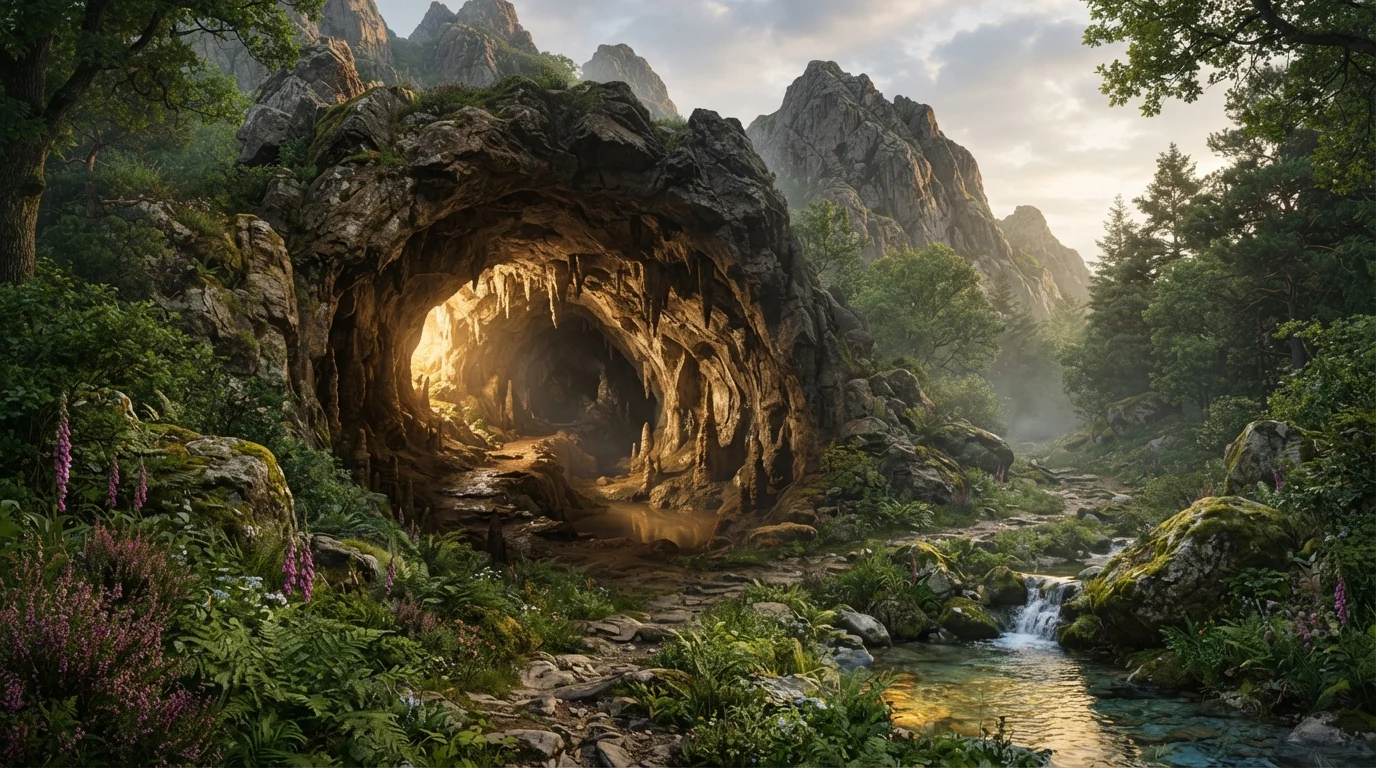
Cave symbolism is deeply connected to mystery, protection, transformation, introspection, and the journey into the unknown.
Throughout history, caves have served as shelters, sacred spaces, places of meditation, and powerful settings in myths and spiritual traditions.
Their darkness can represent hidden truths, while their enclosed spaces often symbolize safety, the subconscious mind, and the possibility of personal renewal.
If you encounter a cave in a dream, feel drawn to its quiet atmosphere, or explore its meaning in ancient stories, this natural formation offers rich symbolic lessons.
Cave symbolism encourages you to look beyond the surface, face your fears, and discover the wisdom that may emerge when you take time to understand yourself.
Cave Symbolism Meaning (Clear Definition)
Cave symbolism refers to the meanings associated with caves, including mystery, shelter, the subconscious mind, spiritual discovery, transformation, and hidden knowledge.
Depending on the context, a cave can represent either a safe refuge or a place where fears and uncertainties must be confronted.
Because caves are dark, enclosed, and often hidden from ordinary view, they naturally evoke the unknown. Entering a cave can symbolize moving inward to explore your emotions, beliefs, memories, and deeper sense of identity.
At the same time, caves have historically provided protection from harsh weather and danger. This makes them powerful symbols of security, retreat, and renewal.
The most common symbolic meanings of caves include:
- Mystery: A cave represents secrets, unanswered questions, and things that remain beyond immediate understanding.
- Protection: Its enclosed interior can symbolize safety, refuge, and emotional security.
- The subconscious mind: Darkness and hidden chambers can represent buried feelings, memories, and unexplored aspects of the self.
- Transformation: Entering and emerging from a cave can symbolize a personal journey that changes your perspective.
- Spiritual awakening: A cave may represent solitude, contemplation, and the search for deeper truth.
- Rebirth and renewal: The cave’s womb-like shape can symbolize returning to an inner source before beginning a new chapter.
- Fear and uncertainty: A dark or unfamiliar cave may represent challenges, suppressed concerns, or anxiety about the unknown.
The meaning of a cave depends on how it appears, the circumstances surrounding it, and the emotions it evokes.
What Does Cave Symbolism Represent?
Cave symbolism represents several important themes in human life, particularly the relationship between the visible world and the hidden dimensions of experience.
1. Mystery and Hidden Knowledge
Caves often contain passages, chambers, and formations that remain concealed until someone explores them. This makes them natural symbols of secrets, discovery, and knowledge waiting to be uncovered.
In everyday life, a cave may represent a question you have not yet answered or an aspect of yourself you have not fully understood.
Its symbolism encourages curiosity and reminds you that meaningful discoveries sometimes require patience and a willingness to explore unfamiliar territory.
2. Safety and Protection
For thousands of years, caves have offered humans and animals shelter from weather and other dangers. Their enclosed spaces can create a sense of separation from the outside world.
Symbolically, a cave may represent a safe place where you can rest, recover, and gather strength.
This meaning is especially relevant when you feel overwhelmed by responsibilities or social expectations. Sometimes, stepping away from noise and pressure is necessary before you can move forward.
3. The Subconscious Mind
A cave’s hidden interior is often compared to the subconscious mind, where emotions, memories, fears, and desires may remain outside immediate awareness.
Exploring a cave can therefore symbolize examining parts of yourself that you usually avoid or overlook.
This interpretation is common in psychological and literary symbolism, although it is not a universal rule. The cave may invite you to ask what lies beneath your everyday thoughts and reactions.
4. Transformation and Personal Growth
A journey into a cave frequently involves darkness, uncertainty, and the need to find a way forward. These experiences make caves powerful symbols of personal transformation.
You may enter the cave feeling uncertain and emerge with a different perspective. In stories, this journey often represents a character’s movement from ignorance toward understanding.
In your own life, cave symbolism can reflect a difficult period that encourages self-reflection, resilience, and change.
5. Isolation and Solitude
Caves are separated from ordinary activity, making them symbols of solitude and withdrawal.
Solitude can be beneficial when it gives you space to think, heal, or develop creative ideas. However, a cave may also symbolize loneliness when its darkness feels oppressive or its entrance appears impossible to find.
The distinction often depends on whether the cave feels peaceful or frightening.
6. Rebirth and New Beginnings
The enclosed, womb-like shape of some caves has led to associations with birth, gestation, and renewal.
In symbolic narratives, entering a cave can represent a return to the beginning, while leaving it suggests the emergence of a renewed identity.
This interpretation can be especially meaningful during major life transitions, such as changing careers, recovering from disappointment, or developing a new understanding of yourself.
7. Fear and the Unknown
Dark caves can trigger fear because their interiors conceal what lies ahead. This makes them effective symbols of uncertainty, vulnerability, and unresolved problems.
A cave does not necessarily represent something negative, however. It may simply reflect a situation you have not yet learned to navigate.
Its deeper lesson is that uncertainty does not always mean danger. Sometimes, it marks the beginning of discovery.
Spiritual Meaning of Cave Symbolism
The spiritual meaning of cave symbolism often centers on inner wisdom, sacred solitude, reflection, transformation, and the search for truth.
Across various spiritual traditions, caves have served as places for retreat, prayer, meditation, and encounters with the sacred.
Their separation from ordinary surroundings can help create an atmosphere of stillness and contemplation.
The Cave as a Place of Inner Wisdom
A cave’s darkness can symbolize the inward journey required to understand yourself more deeply.
Rather than seeking every answer through external advice or recognition, you may need quiet time to examine your beliefs, emotions, and priorities.
Spiritually, this interpretation encourages you to listen carefully to your inner experience while remaining open to reason, guidance, and new perspectives.
The Cave as a Sacred Space
Caves have held spiritual significance in many cultures. Some contain ancient paintings, ritual objects, shrines, or evidence of ceremonial activity.
Their enclosed interiors may create a feeling of separation from everyday life, making them meaningful settings for worship or contemplation.
A cave can therefore symbolize a personal sanctuary: a place, whether physical or metaphorical, where you reconnect with what you consider sacred.
The Cave as a Symbol of Transformation
Spiritual transformation is often described as a journey through uncertainty before reaching greater clarity.
In this interpretation, entering a cave represents a willingness to confront difficult questions. Moving through its darkness symbolizes patience and perseverance, while emerging into daylight represents a new understanding.
The process is not always comfortable, but it may help you recognize patterns that no longer serve you.
The Cave and Spiritual Rebirth
The womb-like qualities associated with caves make them symbols of gestation and renewal in some interpretive traditions.
A period of withdrawal may provide the space needed for new ideas, values, or commitments to develop.
This symbolism reminds you that growth is not always visible. Sometimes, the most important changes begin quietly before they appear in your actions.
The Cave as a Reminder to Face Your Fears
Spiritual growth does not necessarily mean eliminating fear. It may involve learning to acknowledge fear without allowing it to make every decision.
A dark cave can represent an uncomfortable truth, a difficult memory, or an unfamiliar path.
Approached thoughtfully, this symbolism encourages courage, self-compassion, and a willingness to discover what lies beyond your immediate assumptions.
Biblical / Religious Meaning of Cave Symbolism
In the Bible, caves appear in stories involving refuge, danger, prayer, mourning, burial, and significant encounters with God. Their meanings depend on the passage, so a cave should not be assigned one universal religious interpretation.
Caves as Places of Refuge
In 1 Samuel 22:1, David takes refuge in the cave of Adullam while fleeing King Saul.
The cave becomes a place of protection during a period of uncertainty and danger. This story connects cave symbolism with survival, shelter, and the gathering of people who share difficult circumstances.
For religious readers, it can serve as a reminder that periods of hardship may also become opportunities to find support and prepare for what comes next.
Elijah in the Cave
In 1 Kings 19, the prophet Elijah takes shelter in a cave at Mount Horeb during a time of fear and exhaustion.
The narrative then describes his encounter with God, including the famous passage in which God’s presence is associated not with powerful natural displays but with a gentle whisper or quiet voice, depending on the translation.
This story makes the cave a meaningful setting for vulnerability, spiritual reflection, and renewed direction.
It can remind readers that quietness and rest may create space to listen, reflect, and regain strength.
The Cave and the Resurrection of Jesus
The Gospel accounts describe Jesus being placed in a tomb after his crucifixion. Some traditional depictions and historical interpretations associate the burial setting with a rock-cut tomb or cave-like chamber.
In Christian symbolism, the tomb is closely connected with death, the resurrection, and the promise of new life.
The image of a sealed burial place becoming empty therefore offers a powerful contrast between apparent finality and unexpected renewal.
Caves in Other Religious Traditions
Caves also appear in the sacred histories of other religions.
In Islamic tradition, the Cave of Hira is associated with the beginning of Muhammad’s prophetic revelations, while the Cave of Thawr is associated with his migration from Mecca to Medina.
In Hindu and Buddhist traditions, caves have served as places for meditation, worship, and monastic life. Some cave complexes contain temples, sculptures, and sacred artwork.
These examples show that caves can represent refuge, revelation, devotion, and the search for spiritual understanding, although the meanings differ between traditions.
Cave Symbolism in History and Culture
Caves have played important roles in human survival, artistic expression, religious practice, and cultural storytelling for thousands of years.
Their symbolism developed partly from their physical characteristics: caves provide shelter, conceal their interiors, and create a clear boundary between the outside world and an enclosed space.
Prehistoric Caves and Human Creativity
Prehistoric cave art offers evidence of early human artistic expression and symbolic activity. Sites such as Lascaux in France and Altamira in Spain contain remarkable paintings of animals and other figures.
Researchers continue to investigate the purposes of these images. Possible interpretations include ritual, social meaning, storytelling, or other cultural practices, but their exact significance is not fully known.
Symbolically, decorated caves can represent the human desire to record experience, communicate meaning, and connect with the world through art.
Caves as Ancient Shelters
For many early communities, caves provided protection from weather and potential threats. Their usefulness helped establish an enduring association with survival and security.
This historical function continues to influence how caves are represented in stories and modern imagery.
A cave can suggest a place to hide during danger, recover after hardship, or preserve something valuable.
Caves as Sacred Places
Many cultures have treated particular caves as sacred or spiritually significant. Some became sites of pilgrimage, worship, meditation, or ceremonies.
Their darkness and stillness can create an atmosphere that feels distinct from the ordinary world.
The cave’s sacred meaning, however, depends on the community and tradition associated with it rather than on its physical structure alone.
Caves in Mythology and Folklore
In myths and folk tales, caves often house treasures, monsters, wise figures, hidden passages, or supernatural forces.
A cave may be the entrance to an underworld, the hiding place of a hero, or the location of a challenge that tests courage.
These stories use the cave as a boundary between familiar reality and a world of uncertainty. The hero who enters must often overcome obstacles before gaining knowledge, treasure, or a changed identity.
Caves as Symbols of the Unknown
Even with modern exploration technology, caves can contain passages that are difficult to access and environments that are challenging to understand.
Their physical mystery continues to inspire stories about exploration and discovery.
Culturally, caves remind us that not everything is immediately visible. Some discoveries require careful investigation, preparation, and respect for the unknown.
Cave Symbolism in Literature and Art
In literature and art, caves often function as powerful settings for encounters with hidden truths, psychological struggles, and transformative experiences.
Their enclosed darkness allows writers and artists to explore themes that may be difficult to represent directly.
Plato’s Allegory of the Cave
One of the most influential examples of cave symbolism appears in Plato’s Republic.
In the allegory, prisoners are confined in a cave and mistake shadows on a wall for reality. One prisoner eventually escapes and discovers a world beyond the shadows.
The story explores the difference between appearance and reality, the limitations of perception, and the difficult process of gaining knowledge.
In this context, the cave represents ignorance or a restricted understanding of the world, while leaving it symbolizes intellectual awakening.
The allegory also highlights an uncomfortable truth: discovering a new perspective can be challenging, and people may resist ideas that disrupt familiar beliefs.
Caves as Places of Personal Discovery
In adventure stories, a cave often contains a secret, a challenge, or a discovery that changes the protagonist’s understanding.
Entering the cave can represent a willingness to take risks and move beyond familiar boundaries.
The character may encounter danger, but the experience can also lead to courage, wisdom, or a stronger sense of identity.
Caves as Symbols of the Subconscious
Writers sometimes use caves to represent hidden emotions, suppressed memories, or aspects of the self that a character refuses to acknowledge.
A character who descends into a dark cave may be confronting guilt, grief, anger, or uncertainty.
This literary device turns a physical journey into a psychological one, allowing the setting to reflect the character’s internal struggles.
Caves in Visual Art
Artists can use caves to create contrasts between light and darkness, openness and confinement, or safety and danger.
A beam of sunlight entering a dark cave may suggest hope or revelation. An empty, shadowy cavern may evoke loneliness, mystery, or the limits of human knowledge.
The meaning depends on the artist’s choices, including composition, color, lighting, and the figures or objects placed within the scene.
Dream Meaning of Cave Symbolism
Dreaming about a cave can be interpreted as a reflection of your emotions, uncertainty, desire for privacy, or interest in exploring parts of yourself that remain unclear.
Dreams do not have universally established meanings, and there is no reliable evidence that a cave dream predicts a specific future event. However, reflecting on the dream’s details may help you identify concerns or feelings that deserve attention.
Dreaming of Entering a Cave
Entering a cave may symbolize curiosity, self-exploration, or a willingness to face something unfamiliar.
If you feel calm as you enter, the dream might reflect a desire for privacy or deeper understanding. If you feel afraid, it may mirror uncertainty about a current decision or situation.
Dreaming of a Dark Cave
A dark cave may represent confusion, hidden concerns, or a situation in which you cannot yet see a clear path forward.
Consider whether something in your waking life feels unresolved. The dream may provide a useful prompt for reflection without necessarily indicating danger.
Dreaming of Escaping a Cave
Finding your way out of a cave can symbolize relief, growing confidence, or the resolution of a difficult period.
It may reflect a feeling that you are beginning to understand a problem or regain control of a situation.
Dreaming of Being Trapped in a Cave
Being trapped may reflect feelings of restriction, isolation, or helplessness.
You might be facing responsibilities that seem difficult to manage or a situation in which your choices feel limited.
Rather than treating the dream as a prediction, consider what practical changes or support might help you feel less confined.
Dreaming of Discovering a Hidden Cave
Discovering an unknown cave may symbolize curiosity, new opportunities, or the realization that there is more to a situation than you first assumed.
The dream may encourage you to explore an interest, ask new questions, or reconsider an old belief.
Dreaming of a Beautiful Cave
A beautiful cave filled with crystals, flowing water, or gentle light may evoke wonder, peace, or a sense of discovery.
Its personal meaning may relate to creativity, inner resources, or the desire to find calm away from everyday pressures.
Dreaming of a Cave Full of Water
Water is often used symbolically to represent emotion, change, or renewal. A cave filled with water may therefore invite reflection on feelings that seem difficult to access or understand.
Clear water might feel peaceful, while flooding or turbulent water might reflect a sense of emotional overwhelm. These interpretations depend on the dreamer’s experiences and associations.
Modern Meaning of Cave Symbolism
Today, cave symbolism appears in psychology, personal development, environmental awareness, adventure culture, and discussions about privacy and solitude.
The cave remains a versatile image because it can represent both a retreat from the world and an encounter with something previously hidden.
Cave Symbolism and Mental Reflection
In modern life, the cave can serve as a metaphor for taking time away from constant demands and distractions.
Quiet reflection may help you identify your priorities, recognize emotional patterns, and consider decisions more carefully.
However, healthy solitude is different from prolonged isolation. A retreat should support well-being rather than prevent you from seeking help or maintaining important relationships.
Cave Symbolism and Personal Transformation
Many personal-growth narratives describe difficult periods as journeys through darkness before reaching clarity.
A cave fits this metaphor because its path may be uncertain, yet exploration can reveal something new.
This symbolism encourages patience during periods when progress is difficult to measure. You may be learning, adapting, or developing resilience even when the next step is not yet obvious.
Cave Symbolism and Environmental Awareness
Caves are important natural environments that can contain unusual geological formations, specialized wildlife, archaeological remains, and valuable records of Earth’s history.
Modern cave symbolism can therefore extend to conservation, respect for nature, and the responsibility to protect places that cannot easily be restored once damaged.
A cave is not simply an empty space waiting to be explored. It may be a delicate ecosystem or a site of significant cultural heritage.
Cave Symbolism and Adventure
For explorers, climbers, and cavers, caves can represent curiosity, preparation, courage, and discovery.
Their challenging environments demand respect, knowledge, and appropriate safety precautions.
Symbolically, this balance between exploration and caution reflects a broader life lesson: courage is most effective when combined with preparation and sound judgment.
Cave Symbolism and Privacy
A cave can also represent the desire to create a private space away from social expectations.
In a world where people are frequently connected through digital devices, this image may symbolize the need for boundaries, quiet, and time to think independently.
The cave reminds us that stepping back can be valuable when it allows us to return to the world with greater clarity and purpose.
Common Cave Symbolism Meanings at a Glance
| Cave image or setting | Common symbolic meaning |
|---|---|
| Dark cave | Mystery, uncertainty, or hidden emotions |
| Safe cave | Protection, refuge, and security |
| Cave entrance | Transition, opportunity, or a new journey |
| Deep underground cave | Inner exploration and the subconscious |
| Cave with sunlight | Hope, understanding, and revelation |
| Cave filled with water | Emotion, reflection, or renewal |
| Sacred cave | Prayer, contemplation, and spiritual discovery |
| Cave with treasure | Hidden potential, knowledge, or achievement |
| Narrow cave passage | Challenge, persistence, and personal growth |
| Emerging from a cave | Change, clarity, and a fresh beginning |
These meanings are interpretive rather than universal. The same cave may symbolize comfort to one person and fear to another.
Frequently Asked Questions About Cave Symbolism
1. What does a cave symbolize spiritually?
A cave often symbolizes inner wisdom, spiritual reflection, protection, transformation, and the search for deeper truth. Its meaning depends on the spiritual tradition and the context in which it appears.
2. What does a cave symbolize in the Bible?
Biblical caves can represent refuge, vulnerability, prayer, and significant spiritual experiences. David’s refuge in the cave of Adullam and Elijah’s experience at Mount Horeb are notable examples.
3. What does a cave represent in dreams?
A cave dream may reflect a desire for privacy, uncertainty, hidden emotions, or a process of self discovery. Its interpretation depends on the dream’s details and your personal circumstances rather than a fixed prediction.
4. Why are caves associated with transformation?
Caves create a natural metaphor for moving from the familiar into the unknown and emerging with new understanding. This journey is often used in myths, literature, and spiritual interpretations to represent personal change.
5. What does Plato’s cave symbolize?
In Plato’s Republic, the cave represents limited perception and mistaken beliefs, while the journey outside represents the difficult process of gaining knowledge and understanding reality more clearly.
Conclusion: The Deeper Meaning of Cave Symbolism
Cave symbolism reminds us that mystery, darkness, and uncertainty can be part of discovery rather than signs of failure.
A cave may represent shelter, hidden knowledge, spiritual reflection, or the courage required to confront unfamiliar truths.
If viewed through religion, mythology, dreams, literature, or modern life, the cave invites you to pause, look inward, and explore what lies beyond the surface.
Sometimes, entering the unknown is the first step toward finding greater clarity, strength, and a renewed sense of purpose.

I’m Beau Warren, a passionate writer exploring the meanings behind symbols, dreams, colors, animals, and traditions. I enjoy creating well-researched, engaging content that inspires curiosity and deeper understanding every day.


