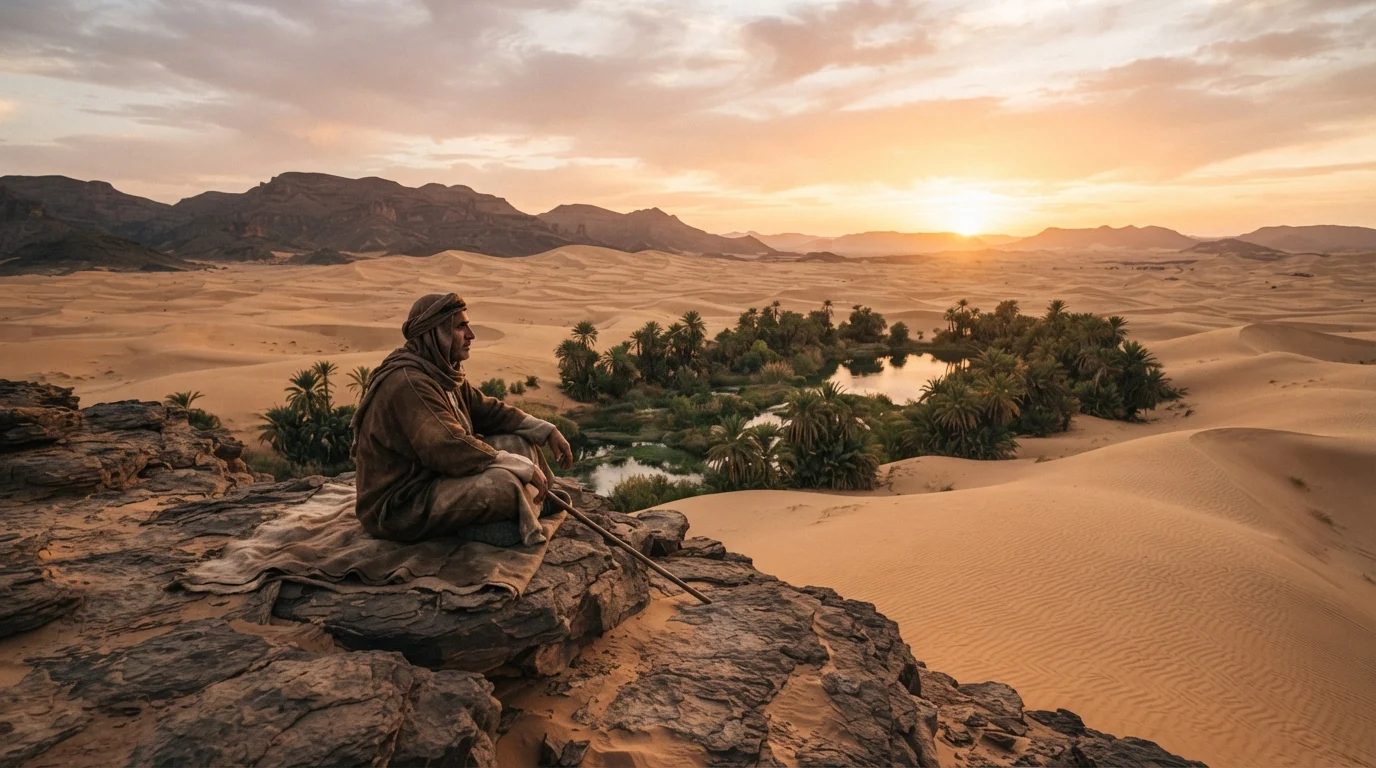
Desert symbolism is deeply connected to solitude, endurance, spiritual awakening, transformation, and inner strength.
Vast stretches of sand, intense sunlight, and seemingly endless horizons often represent life’s challenges and the personal growth that can emerge from difficult experiences.
Across different cultures, religions, and literary traditions, the desert has served as a place of testing, reflection, renewal, and discovery.
Its emptiness can symbolize loneliness, but it can also represent freedom from distractions and the opportunity to reconnect with what truly matters.
If you dream of a desert, feel drawn to its mysterious beauty, or want to understand its spiritual significance, desert symbolism offers powerful lessons about patience, resilience, faith, and the journey toward self discovery.
Desert Symbolism Meaning (Clear Definition)
Desert symbolism refers to the meanings associated with deserts, including endurance, isolation, spiritual growth, survival, freedom, transformation, and the search for truth.
A desert’s harsh conditions make it a natural symbol of life’s difficult seasons. Its wide-open spaces can also represent peace, simplicity, and the freedom to explore one’s inner world.
The desert does not always symbolize hardship. In many traditions, it is also a place where distractions disappear and deeper understanding becomes possible.
Common meanings of desert symbolism include:
- Endurance: Surviving difficult circumstances through patience and determination.
- Solitude: Spending time alone to understand yourself more deeply.
- Spiritual awakening: Searching for faith, purpose, or a stronger connection with the sacred.
- Transformation: Moving through challenges that change your perspective.
- Freedom: Escaping unnecessary distractions and social expectations.
- Scarcity: Facing limited resources, emotional emptiness, or uncertainty.
- Hope and renewal: Discovering water, shade, or life in a seemingly barren environment.
The exact meaning depends on the context. A peaceful desert sunset may suggest reflection and freedom, while a vast, waterless desert may represent uncertainty or emotional exhaustion.
What Does Desert Symbolism Represent?
Desert symbolism represents the different ways people experience hardship, solitude, freedom, and personal change. Its most meaningful interpretations often emerge from the contrast between a harsh landscape and the possibility of finding life within it.
1. Endurance and Inner Strength
Deserts are environments where survival depends on adaptation, patience, and careful use of resources. For this reason, they often symbolize the ability to withstand difficult circumstances.
A desert can represent a period when progress feels slow or the future seems uncertain. Its symbolism reminds us that strength is not always about moving quickly. Sometimes, it means continuing one careful step at a time.
The desert teaches that resilience develops through experience, especially when circumstances demand perseverance.
2. Solitude and Self Discovery
The vast emptiness of a desert creates an image of isolation and quiet. Without the noise of busy cities or crowded environments, the landscape can symbolize an opportunity to reflect.
Desert solitude may represent a desire to understand your values, reconsider your priorities, or spend time away from outside expectations.
Although solitude can sometimes feel painful, it can also create space for clarity and personal growth.
3. Transformation and Renewal
A desert journey often involves leaving familiar surroundings and entering an unfamiliar environment. Symbolically, this can represent a major life transition.
You may experience a desert like period when an old relationship ends, a career changes, or a familiar sense of identity begins to shift.
These experiences can feel uncomfortable, but they may also create opportunities to develop new strengths and discover a different direction.
4. Freedom and Simplicity
The desert’s open horizon can symbolize freedom from unnecessary obligations, distractions, and material excess.
Unlike a crowded environment filled with constant demands, a desert appears spacious and uncomplicated. This imagery can encourage you to focus on what is genuinely important.
Its lesson is not that possessions or relationships lack value, but that a meaningful life often depends on knowing which things deserve your attention.
5. Scarcity and Emotional Emptiness
A dry, barren desert may represent a lack of resources, affection, inspiration, or direction.
In personal reflection, this imagery can describe a period when life feels emotionally empty or when your efforts seem to produce few results.
However, scarcity does not necessarily mean permanent loss. It can encourage you to recognize unmet needs and seek the support or resources required to move forward.
6. Patience and Adaptability
Desert life depends on adapting to changing temperatures, conserving water, and responding to environmental conditions.
Symbolically, the desert represents the importance of patience and flexibility. Not every situation can be controlled, but many can be approached more wisely with preparation and a willingness to adjust.
Sometimes, success comes not from forcing an outcome but from understanding when to conserve energy and when to act.
7. Hope in Unexpected Places
Although deserts may appear lifeless, many contain remarkable biodiversity, hidden water sources, and plants adapted to extreme conditions.
This contrast makes the desert a powerful symbol of hope.
It reminds us that something valuable may exist beneath an unpromising surface. Difficult circumstances can conceal opportunities, relationships, and strengths that are not immediately visible.
Spiritual Meaning of Desert Symbolism
The spiritual meaning of desert symbolism often centers on inner purification, faith, silence, spiritual testing, and the search for deeper truth.
For many people, the desert represents a place where external distractions become less important and inner questions become harder to ignore.
Desert as a Place of Spiritual Awakening
The desert’s quiet environment makes it a natural symbol of reflection and spiritual awareness.
In a symbolic sense, entering a desert may represent stepping away from everyday routines to reconsider your beliefs, values, and purpose.
This experience does not have to involve physically traveling to a desert. It may happen during a period of solitude, personal change, or thoughtful reflection.
Desert as a Spiritual Test
The desert’s harsh conditions can symbolize experiences that test a person’s patience, faith, or commitment.
A challenging season may force you to examine what you truly believe and whether your values remain meaningful when life becomes uncomfortable.
In this interpretation, the desert is not necessarily a punishment. It can represent a difficult period in which important lessons become clearer.
Desert as a Symbol of Inner Purification
In some spiritual traditions, withdrawing from comfort and excess creates an opportunity to examine desires, habits, and attachments.
The desert can therefore represent the process of simplifying life and releasing what no longer serves a meaningful purpose.
This symbolism encourages honest self-reflection rather than the pursuit of perfection.
Desert as a Place of Hidden Wisdom
A desert’s apparent emptiness can be misleading. Beneath the surface, life continues through complex relationships between plants, animals, soil, and water.
Spiritually, this can symbolize the possibility of discovering wisdom in quiet or overlooked places.
When life becomes less crowded with distractions, you may notice thoughts and feelings that previously went unexamined.
Desert as a Symbol of Hope
Finding water in a dry landscape is a powerful image of relief, restoration, and renewed possibility.
In spiritual reflection, an oasis may represent comfort after hardship, guidance during uncertainty, or the rediscovery of hope after disappointment.
This symbolism reminds us that difficult periods can change and that seeking help is a meaningful part of resilience.
Biblical / Religious Meaning of Desert Symbolism
Desert symbolism has an important place in the Bible and several other religious traditions. It is often associated with testing, dependence on God, spiritual preparation, revelation, and transformation.
Religious interpretations vary, but the desert frequently serves as a setting where people confront uncertainty and discover what matters most.
The Wilderness as a Place of Testing
In the Bible, the Israelites travel through the wilderness after leaving Egypt. Their journey, described in books such as Exodus and Numbers, includes hardship, uncertainty, and dependence on divine provision.
The wilderness becomes a setting in which their faith and obedience are tested.
This story contributes to the biblical association between desert landscapes and spiritual challenges. It also emphasizes the importance of perseverance during periods when the destination remains distant.
Moses and the Desert
Moses encounters God at the burning bush while tending sheep near Horeb, described in Exodus 3.
The setting connects the wilderness with divine revelation and a turning point in Moses’ life. An ordinary period of isolation becomes the beginning of an extraordinary responsibility.
Symbolically, this story suggests that important changes can emerge from quiet and unexpected circumstances.
Jesus in the Wilderness
Matthew 4:111 and Luke 4:113 describe Jesus spending forty days in the wilderness, where he faces temptation.
In Christian interpretation, this episode is associated with spiritual discipline, faithfulness, and resisting temptation.
The wilderness becomes a place of testing before Jesus begins his public ministry. Its symbolism emphasizes the importance of remaining committed to one’s values under pressure.
The Desert as a Place of Divine Provision
Despite the hardships of the wilderness, biblical narratives also describe God providing food, water, and guidance.
For example, Exodus 16 recounts the provision of manna, while Exodus 17 describes water coming from a rock.
These stories present the wilderness not only as a place of struggle but also as a setting where unexpected provision becomes possible.
Desert Symbolism in Islam
Desert landscapes have significant historical and cultural importance in Islam, particularly because of the Arabian Peninsula’s geography and the early history of Muslim communities.
The Qur’an refers to the natural world as a setting for reflection on God’s creation, signs, and human dependence. Specific desert symbolism, however, should not be reduced to one universal Islamic interpretation.
In broader spiritual reflection, the desert’s vastness can inspire humility, awareness of human limitations, and contemplation of the natural world.
The Desert in Other Religious Traditions
Desert environments have also been important to Christian monastic communities, Jewish historical experience, and various contemplative traditions.
Early Christian desert monastics, for example, withdrew into remote environments to pursue prayer, simplicity, and spiritual discipline.
Across these different settings, the desert can symbolize withdrawal from worldly distractions and a search for a more focused spiritual life.
Desert Symbolism in History and Culture
Deserts have shaped human history through migration, trade, settlement, exploration, and cultural exchange.
Their symbolic meanings reflect both the challenges of living in harsh environments and the remarkable ways communities have adapted to them.
Ancient Egypt and the Desert
In ancient Egypt, the desert held associations with danger, distance, and the world beyond fertile settlements.
The contrast between the life-giving Nile Valley and surrounding arid lands influenced Egyptian geography, settlement, and religious imagination. Deserts also contained valuable minerals, stone quarries, and important routes.
This relationship demonstrates that desert symbolism can involve both threat and opportunity.
The Sahara and Trade
The Sahara Desert was historically crossed by trading communities connecting North Africa with regions farther south.
Caravans transported goods such as salt, gold, and other commodities across demanding routes. These journeys depended on knowledge of terrain, access to water, and cooperation.
As a result, the Sahara can symbolize endurance, navigation, cultural exchange, and the ability to create connections across seemingly separating landscapes.
Indigenous Desert Cultures
Indigenous peoples in Australia and the Americas have developed diverse relationships with desert environments over many generations.
These landscapes may hold cultural, spiritual, ancestral, and practical significance, depending on the specific people and tradition.
Deserts are not simply empty spaces. They can be homelands filled with knowledge, histories, relationships, and responsibilities.
It is important to recognize that Indigenous desert traditions are diverse and cannot be represented by a single universal interpretation.
The Desert in Bedouin Culture
For Bedouin communities across parts of the Middle East and North Africa, desert environments have historically shaped pastoralism, travel, hospitality, and social relationships.
Knowledge of water sources, if, animals, and routes has been essential to survival.
In this context, the desert can represent both hardship and home, as well as hospitality, resourcefulness, and a deep understanding of the natural environment.
Deserts as Symbols of Exploration
Throughout history, deserts have attracted travelers, explorers, researchers, and adventurers.
Their vast horizons and difficult conditions have made them symbols of discovery and the desire to venture beyond familiar boundaries.
At the same time, desert exploration demonstrates that courage must be balanced with preparation, local knowledge, and respect for environmental limits.
Desert Symbolism in Literature and Art
In literature and art, deserts often function as more than physical settings. They can reflect a character’s emotional state, represent spiritual challenges, or provide a landscape in which transformation becomes possible.
Their striking visual qualities make them especially effective symbols of loneliness, mystery, freedom, and the unknown.
The Desert as a Symbol of Isolation
Writers frequently use deserts to represent separation from society or emotional distance from other people.
A lone traveler crossing an enormous landscape can mirror a character who feels disconnected, uncertain, or misunderstood.
However, isolation in literature does not always produce suffering. It may also create an opportunity for reflection and self-discovery.
The Desert as a Journey of Transformation
A character traveling through a desert often faces obstacles that reveal their true nature.
Limited resources, uncertainty, and physical exhaustion can expose weaknesses while developing courage and determination.
The journey may therefore symbolize a personal transformation in which the traveler emerges with a different understanding of themselves or the world.
The Desert in The Little Prince
In Antoine de Saint-Exupéry’s The Little Prince, the desert is the setting for the narrator’s encounter with the young prince.
The landscape creates a sense of isolation while providing space for reflection, imagination, and meaningful conversations.
The desert’s apparent emptiness contrasts with the emotional and philosophical richness of the story, reinforcing the idea that important truths are not always immediately visible.
The Desert as a Symbol of Mystery
In paintings, photography, and film, deserts can create an atmosphere of mystery through expansive skies, shifting sand, unusual rock formations, and distant horizons.
Artists may use these features to suggest uncertainty, timelessness, or the vastness of human existence.
The landscape can appear peaceful in one image and threatening in another, depending on light, composition, and perspective.
The Desert as a Symbol of Freedom
Open desert landscapes can suggest the possibility of escaping restrictive environments and discovering a new direction.
In stories about travel and reinvention, the desert may represent a break from familiar expectations.
Its symbolism is especially powerful when a character must decide what to leave behind and what to carry into the future.
Dream Meaning of Desert Symbolism
Dreaming about a desert may reflect feelings of loneliness, uncertainty, exhaustion, independence, or a desire for personal change.
Dreams do not have universally established symbolic meanings, and a desert dream does not reliably predict future events. Its possible significance depends on your personal experiences and emotions.
Dreaming of Walking Alone in a Desert
Walking alone through a desert may reflect a period of independence or a feeling that you must face a challenge without enough support.
Consider whether you are comfortable with your current level of solitude or whether you would benefit from reconnecting with people you trust.
Dreaming of Being Lost in a Desert
Being lost in a desert may reflect uncertainty about a decision, relationship, or long-term goal.
The dream could provide an opportunity to consider where you feel directionless and what information or support might help you move forward.
Dreaming of Finding Water in a Desert
Finding water may represent relief, emotional renewal, or the discovery of a helpful solution.
If you have been dealing with a stressful situation, the dream may reflect your desire for comfort or your growing belief that circumstances can improve.
Dreaming of a Desert Oasis
An oasis can symbolize rest, hope, and emotional nourishment.
It may reflect a need to slow down, restore your energy, or recognize a source of support that you have overlooked.
Dreaming of a Sandstorm
A sandstorm may reflect confusion, conflict, or the feeling that circumstances are temporarily beyond your control.
It can prompt you to consider which parts of your life feel overwhelming and whether taking a pause would help you respond more thoughtfully.
Dreaming of a Green Desert
A desert filled with plants, flowers, or unexpected greenery may symbolize renewal, possibility, or a change in perspective.
The contrast between the dry landscape and new growth can reflect the feeling that something promising is developing in a difficult situation.
Modern Meaning of Desert Symbolism
In modern life, desert symbolism often appears in discussions about personal development, mental clarity, environmental awareness, and the search for meaning in a busy world.
The desert can serve as a reminder that periods of difficulty and quiet are not necessarily signs of failure.
Desert Symbolism and Personal Growth
A desert can represent a stage of life when familiar sources of motivation no longer provide the same satisfaction.
You might be reconsidering your career, changing relationships, or questioning goals that once seemed important.
This symbolic desert encourages patience during transitions and reminds you that uncertainty can be part of discovering a more authentic direction.
Desert Symbolism and Minimalism
The desert’s sparse landscape is often used as a metaphor for simplicity.
In modern interpretations, this can mean reducing unnecessary commitments, reconsidering material priorities, and creating room for meaningful experiences.
The central lesson is not to reject everything but to become more intentional about what you allow into your life.
Desert Symbolism and Emotional Resilience
A difficult season may feel like crossing an empty landscape without knowing how long the journey will last.
Desert symbolism can help describe the need to preserve energy, seek support, and keep moving without expecting immediate results.
Resilience does not mean enduring every hardship alone. Recognizing when you need help is also a form of strength.
Desert Symbolism and Environmental Awareness
Modern desert symbolism also draws attention to climate, water scarcity, desertification, and the delicate balance of arid ecosystems.
Deserts are not lifeless wastelands. They contain specialized plants, animals, and ecological relationships that can be damaged by environmental changes.
This perspective encourages respect for nature and a greater understanding of the importance of conserving water and protecting fragile habitats.
Desert Symbolism and the Search for Purpose
The desert’s open horizon can represent the search for direction in a world filled with competing demands.
Its symbolism invites you to step back, question automatic habits, and identify the values that guide your decisions.
Sometimes, finding purpose begins not with adding something new but with understanding what truly deserves your attention.
Desert Symbolism Meanings at a Glance
| Desert symbol | Common symbolic meaning |
|---|---|
| Endless sand dunes | Uncertainty, freedom, or life’s journey |
| Desert oasis | Hope, relief, and renewal |
| Water in the desert | Nourishment, discovery, and emotional restoration |
| Desert sunset | Transition, reflection, and the end of a phase |
| Sandstorm | Confusion, instability, or obstacles |
| Desert mountains | Challenges, ambition, and endurance |
| Green plants in a desert | Resilience, growth, and unexpected possibility |
| Walking alone in a desert | Independence, solitude, or self discovery |
| Desert night sky | Mystery, contemplation, and perspective |
| Desert wilderness in scripture | Testing, faith, and spiritual preparation |
These meanings are general interpretations rather than universal rules. The same desert image may communicate different ideas depending on its cultural, religious, artistic, or personal context.
Frequently Asked Questions About Desert Symbolism
1. What does a desert symbolize spiritually?
A desert often symbolizes spiritual growth, solitude, faith, endurance, and the search for truth. It can represent a period of testing that encourages deeper reflection and a renewed sense of purpose.
2. Is a desert a symbol of transformation?
Yes, deserts often symbolize transformation because journeys through harsh or unfamiliar environments can represent personal change.
The symbolism emphasizes learning, adaptability, and the possibility of emerging from difficulties with greater understanding.
3. What does the desert symbolize in the Bible?
In the Bible, the wilderness is associated with testing, divine guidance, spiritual preparation, and dependence on God.
The experiences of the Israelites, Moses, and Jesus provide important examples of these themes.
4. What does dreaming about a desert mean?
A desert dream may reflect loneliness, uncertainty, independence, or a need for renewal. Its personal meaning depends on the dream’s details and how you feel about your current circumstances.
5. Does a desert symbolize hope or loneliness?
A desert can symbolize both. Its vast emptiness may suggest isolation, while an oasis or unexpected signs of life can represent hope, renewal, and the possibility of finding support in difficult circumstances.
Conclusion: The Deeper Meaning of Desert Symbolism
Desert symbolism reminds us that emptiness does not always mean absence and that hardship does not have to define the future.
Through its associations with endurance, solitude, faith, and transformation, the desert offers a powerful image of the human journey.
Like a traveler searching for water across a vast landscape, we sometimes need patience, courage, and a willingness to change direction.
The desert teaches us to recognize our inner strength, appreciate unexpected sources of hope, and trust that even challenging seasons can lead to greater clarity and understanding.

I’m Sophia Brown, passionate about exploring symbols, their meanings, and cultural significance. I enjoy researching history, spirituality, and traditions, creating clear, engaging articles that inspire curiosity and deeper understanding for every reader.


