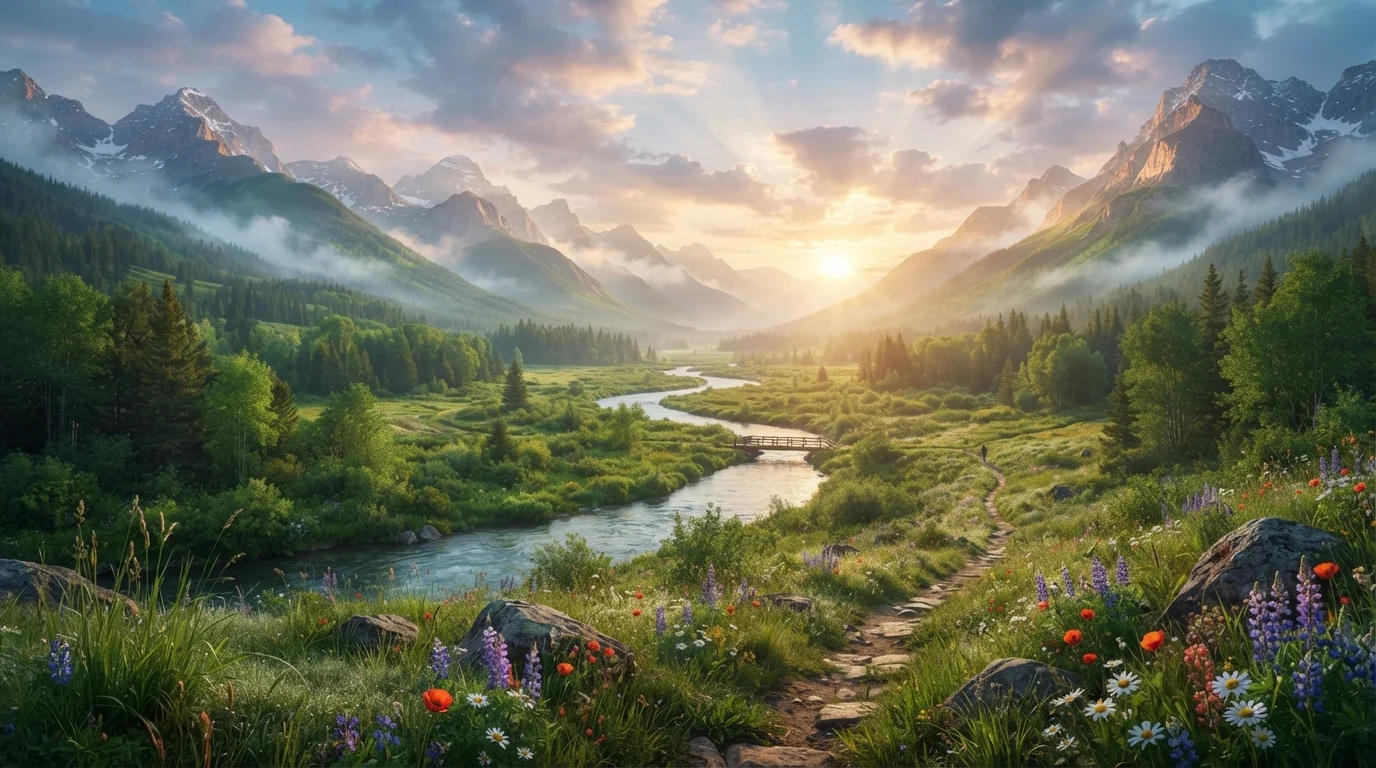
Valley symbolism is deeply connected to humility, peace, personal growth, renewal, and the journey through life’s difficult seasons.
A valley is a low area of land between hills or mountains, often shaped by rivers, glaciers, and the passage of time. Symbolically, it can represent both a place of refuge and a period of struggle that prepares us for a new beginning.
Across spiritual traditions, literature, and cultural beliefs, valleys often remind us that life is not a straight path toward success. There are moments of uncertainty, quiet reflection, and hardship that help us discover our strength and purpose.
If you encounter a valley in a dream, explore its spiritual significance, or simply feel drawn to its peaceful landscape, its symbolism offers a meaningful reminder: even the lowest places can hold beauty, wisdom, and the promise of renewal.
Valley Symbolism Meaning (Clear Definition)
Valley symbolism refers to the ideas and emotions associated with valleys, including humility, shelter, emotional depth, transformation, peace, and hope.
Depending on the context, a valley may represent a challenging period in life or a safe place where healing and growth can begin.
Unlike a mountain, which often symbolizes achievement and ambition, a valley can represent the quieter experiences that shape our character.
It is a place where water gathers, plants flourish, and life finds protection from the exposed heights.
The most common symbolic meanings of valleys include:
- Humility: A valley represents modesty, groundedness, and freedom from excessive pride.
- Refuge and safety: Sheltered landscapes symbolize protection, comfort, and belonging.
- Hardship and adversity: A dark or difficult valley may reflect emotional struggles or uncertain circumstances.
- Renewal and growth: Fertile valleys represent fresh opportunities, healing, and new beginnings.
- Peace and reflection: Quiet valleys symbolize solitude, balance, and inner calm.
- Transition: Traveling through a valley can represent moving from one stage of life to another.
- Hope and perseverance: A valley journey reminds us that difficult seasons can eventually give way to brighter possibilities.
The meaning depends on the valley’s appearance, the surrounding landscape, and the feelings it evokes.
What Does Valley Symbolism Represent?
Valley symbolism represents the experiences that encourage us to slow down, reflect, recover, and develop a deeper understanding of ourselves. Its meanings often emerge from the contrast between low ground and towering mountains.
1. Humility and Groundedness
Valleys lie below surrounding hills and mountains, making them natural symbols of humility.
This does not mean that being low or modest makes someone less valuable. Instead, valley symbolism encourages us to remain grounded, recognize our limitations, and appreciate the contributions of others.
In everyday life, this meaning can remind us that genuine confidence does not require constant recognition or superiority.
2. Safety and Protection
Many valleys are surrounded by mountains, cliffs, or wooded slopes that provide shelter from strong winds and harsh conditions.
Symbolically, this landscape can represent a place where you feel protected and accepted. It may reflect the comfort of home, the support of trusted friends, or the emotional security needed to recover from difficult experiences.
A sheltered valley reminds us that safety can create the conditions for growth.
3. Struggle and Adversity
The phrase “going through a valley” is often used metaphorically to describe a difficult period.
A valley may symbolize grief, uncertainty, disappointment, loneliness, or a challenge that tests your patience. Yet this interpretation does not make the valley a symbol of permanent defeat.
Instead, it can represent a temporary stage in a larger journey, encouraging perseverance without pretending that hardship is easy.
4. Fertility and Abundance
Valleys often contain rivers, fertile soil, and vegetation. These features connect them with nourishment, prosperity, and the ability to sustain life.
As a symbol, a fertile valley can represent an environment where your talents, relationships, or plans have room to develop.
It encourages you to notice the resources already available to you and use them wisely.
5. Peace and Emotional Balance
A quiet valley surrounded by mountains can evoke stillness and harmony.
This symbolism may reflect a desire to escape constant demands, reconnect with nature, or find a healthier balance between work and rest.
A peaceful valley reminds us that not every stage of life needs to be filled with activity. Sometimes, clarity develops when we allow ourselves to slow down.
6. Transition and Personal Growth
A path through a valley often leads toward another landscape, making the valley a natural metaphor for transition.
You may associate this image with leaving an old identity behind, adjusting to a new responsibility, or learning to live with uncertainty.
The lesson is that transitions are not necessarily signs of failure. They can be essential parts of becoming more resilient and self-aware.
Spiritual Meaning of Valley Symbolism
The spiritual meaning of valley symbolism often centers on humility, inner healing, surrender, patience, and hope during difficult times.
For many people, valleys represent the periods when outward success becomes less important than inner understanding. These quieter seasons may encourage a deeper connection with personal values, faith, nature, or a sense of purpose.
The Valley as a Place of Spiritual Growth
In spiritual interpretation, a valley can represent a period when life encourages you to look inward.
When plans fail or familiar sources of comfort disappear, you may begin asking questions about what truly matters. Such experiences can prompt reflection, although hardship does not automatically lead to wisdom.
The symbolic lesson is to remain open to learning, even when the path ahead is unclear.
The Valley as a Symbol of Humility
A valley’s position below surrounding mountains makes it a powerful image of modesty and surrender.
Spiritually, this may mean accepting that you cannot control every outcome. It can also mean releasing the need to prove yourself and becoming more willing to receive help.
Humility is not the same as weakness. It allows you to recognize your needs while remaining confident in your inherent worth.
The Valley as a Place of Healing
Valleys can offer a sense of shelter and stillness. In spiritual contexts, this makes them symbols of restoration and emotional renewal.
Imagine entering a quiet green valley after a long journey through rough terrain. The landscape invites you to rest, breathe, and regain your strength.
This image can serve as a reminder that healing often requires time, patience, and supportive surroundings.
The Valley as a Test of Faith
Some spiritual traditions use valleys as metaphors for periods when hope feels distant.
During such seasons, valley symbolism can encourage trust, perseverance, and the willingness to take one manageable step at a time.
It does not promise that every difficulty will end quickly. Rather, it offers a way to find meaning and maintain hope while navigating uncertainty.
The Valley and Inner Transformation
A journey through a valley may symbolize the process of letting go of old habits and developing a more grounded outlook.
You might emerge from a challenging period with greater compassion, clearer priorities, or a better understanding of your limits.
The valley becomes meaningful not because suffering is desirable, but because difficult experiences can sometimes reveal what matters most.
Biblical / Religious Meaning of Valley Symbolism
Valleys carry important meanings in the Bible, where they appear as places of danger, refuge, judgment, abundance, and spiritual renewal.
Their significance depends on the specific passage. A valley may be associated with fear and hardship in one context and victory or fertility in another.
The Valley of the Shadow of Death
One of the best-known biblical references appears in Psalm 23:4:
“Even though I walk through the darkest valley, I will fear no evil, for you are with me.”
The wording varies slightly among Bible translations, but the central message is consistent: the speaker finds comfort in God’s presence while moving through danger and uncertainty.
The valley symbolizes a frightening or painful experience, while the journey through it emphasizes that the experience is not necessarily permanent.
For Christians, this passage is often a reminder of divine guidance, protection, and comfort during suffering.
The Valley as a Place of Spiritual Renewal
In Ezekiel 37, the prophet Ezekiel sees a valley filled with dry bones. God commands him to speak to the bones, and the vision describes them coming together and receiving life.
This powerful image is commonly interpreted as a message of restoration and renewed hope for a people who feel spiritually or nationally defeated.
The valley of dry bones demonstrates that a landscape associated with death and desolation can also become a setting for transformation.
The Valley of Decision
Joel 3:14 describes multitudes in the “valley of decision” in many English translations.
In its biblical context, the passage concerns divine judgment and the gathering of nations. In modern devotional language, the expression is sometimes used more broadly to describe a moment when an important choice must be made.
This distinction matters: the contemporary metaphor draws inspiration from the passage but does not encompass its entire original meaning.
Valleys as Places of Abundance
The Bible also describes valleys in connection with fertile land and agricultural prosperity.
For example, Psalm 65:13 poetically portrays pastures and valleys covered with grain, expressing the abundance of the natural world.
In this context, a valley can symbolize provision, fruitfulness, and gratitude for the resources that sustain life.
Valley Symbolism in Other Religious and Spiritual Traditions
Beyond Christianity, valleys can hold significance as places of retreat, pilgrimage, contemplation, and connection with nature.
In various Hindu and Buddhist settings, mountainous landscapes and secluded valleys may be associated with spiritual practice, meditation, or sacred geography. The meaning depends on the particular tradition, location, and religious community.
There is no single interpretation shared by all religions. Understanding a valley’s religious symbolism requires attention to the beliefs and stories in which it appears.
Valley Symbolism in History and Culture
Throughout history, valleys have influenced where people settled, how communities developed, and which landscapes became associated with sacred or cultural meaning.
Their symbolism often grows from their practical role as places where water, fertile soil, and shelter are available.
Valleys as Cradles of Civilization
Many historic civilizations developed near river valleys because rivers provided water, fertile land, transportation, and opportunities for trade.
The Nile Valley in ancient Egypt and the Tigris-Euphrates region in Mesopotamia are notable examples of landscapes that supported complex societies.
These connections helped valleys become symbols of nourishment, prosperity, stability, and the foundations of community life.
Valleys as Sacred Landscapes
Some valleys have become important spiritual destinations because of their association with religious stories, pilgrimage routes, temples, monasteries, or revered natural features.
Their enclosed landscapes can create a feeling of separation from ordinary life, making them suitable settings for reflection and worship.
In these contexts, a valley may represent a meeting point between the human world and what a community considers sacred.
The Valley as a Place of Exile or Conflict
Not every cultural association with valleys is peaceful. Certain valleys have been remembered as sites of battles, displacement, hardship, or historical tragedy.
A valley’s meaning can therefore be shaped by collective memory as much as by its physical characteristics.
The same landscape that sustains a community may also become a reminder of loss or struggle.
Valleys and Rural Traditions
In rural communities, valleys often symbolize the rhythms of farming, seasonal change, and shared labor.
Fields, streams, orchards, and grazing land connect valleys with livelihoods and intergenerational knowledge.
These associations emphasize the relationship between human well-being and the natural environment.
Valleys as Symbols of Belonging
A valley surrounded by familiar hills can feel like a distinct home landscape. In cultural storytelling, this setting may represent roots, ancestry, identity, and attachment to a particular place.
For people who have moved away from their homeland, the image of a valley may evoke nostalgia and the desire to reconnect with their origins.
Valley Symbolism in Literature and Art
Writers and artists often use valleys to communicate emotional states, stages of life, and contrasts between hardship and hope.
Because a valley can appear peaceful, threatening, fertile, or desolate, it offers a flexible symbol that can support many different stories.
The Valley as a Journey Through Hardship
In literature, a character traveling through a valley may be experiencing a difficult transition.
The landscape can mirror feelings of uncertainty, grief, or isolation while suggesting that the character is still moving toward a destination.
A valley journey may also slow the story down, giving a character time to reflect and change.
The Valley as a Symbol of Peace
Artists frequently depict valleys as green landscapes with flowing rivers, open meadows, and distant mountains.
Such scenes can communicate tranquility, harmony, and a sense of belonging within nature.
A peaceful valley painting may invite viewers to pause and appreciate the beauty of the natural world.
The Valley as a Place of Mystery
A valley hidden by mist or surrounded by steep cliffs can create a sense of secrecy and uncertainty.
In fantasy, adventure stories, and folklore, such a landscape may contain lost settlements, forgotten histories, or unexplored possibilities.
The valley becomes a threshold between the familiar world and the unknown.
Valleys as Contrasts to Mountains
Literary and artistic landscapes often place valleys and mountains in opposition.
Mountains may represent ambition, achievement, or a difficult goal, while valleys can symbolize rest, vulnerability, or the experiences that happen between major accomplishments.
Neither landscape is inherently better. Their contrast reveals that growth involves both reaching upward and learning to live meaningfully in quieter places.
The Valley as an Image of Hope
A valley that opens toward sunlight or a distant horizon can suggest renewal after hardship.
The light does not erase the difficult journey; it changes the way the journey is understood.
This makes valley imagery especially powerful in stories about recovery, reconciliation, and the possibility of beginning again.
Dream Meaning of Valley Symbolism
Dreaming about a valley may reflect your feelings about change, emotional security, personal challenges, or the direction of your life.
Dreams do not have universally established meanings, and there is no reliable scientific evidence that a particular valley dream predicts future events. However, exploring the landscape and your emotional response can help you reflect on your waking experiences.
Dreaming of a Green Valley
A green, fertile valley may bring to mind peace, growth, security, and renewed energy.
If the dream feels comforting, consider whether you are entering a more stable period or longing for a supportive environment.
Dreaming of a Dark or Deep Valley
A dark valley may reflect uncertainty, fear, emotional pressure, or a situation that feels difficult to understand.
Rather than assuming it predicts something bad, consider whether you are facing a problem that needs patience or additional support.
Dreaming of Walking Through a Valley
Walking through a valley can symbolize transition, persistence, or the process of working through an unresolved issue.
The direction of travel may be personally significant. Focus on how you felt during the journey and whether you felt lost, hopeful, calm, or determined.
Dreaming of Being Trapped in a Valley
Feeling trapped in a valley may reflect frustration, limited choices, or the sense that you cannot move beyond a difficult situation.
The dream may prompt you to consider what resources, relationships, or practical changes could help you regain a sense of direction.
Dreaming of a Valley Filled With Water
Water flowing through a valley may bring associations with emotion, renewal, and the movement of life.
Clear water might feel peaceful, while flooding or turbulent water might mirror a sense of being overwhelmed. These are possible personal associations rather than fixed interpretations.
Dreaming of Reaching the End of a Valley
Emerging from a valley into a brighter or more open landscape may symbolize relief, resolution, or readiness for a new stage.
If this interpretation resonates with you, consider what you have learned from a recent challenge and what you would like to carry forward.
Modern Meaning of Valley Symbolism
In modern life, valley symbolism remains relevant because it offers a way to understand setbacks, personal transitions, emotional well-being, and the relationship between people and nature.
Its message is not that every hardship happens for a reason. Rather, it suggests that difficult periods can be approached with patience, support, and a willingness to discover what is still possible.
The Valley as a Metaphor for Life’s Low Points
People often describe a difficult season as being “in a valley.”
This expression can refer to disappointment, professional setbacks, relationship difficulties, grief, or a period when motivation feels low.
The metaphor encourages perspective: your current circumstances are one part of your life, not a complete definition of who you are.
Valley Symbolism and Mental Well-Being
Quiet valleys can represent the need for rest, reflection, and distance from constant demands.
In a culture that often celebrates productivity and achievement, the valley offers an alternative image of well-being: a place where slowing down is valuable.
It can remind us to respect our limits, seek support when needed, and create space for recovery.
Valleys as Symbols of Resilience
A valley’s landscape is shaped by natural forces over long periods. Rivers carve channels, vegetation takes root, and ecosystems adapt to changing conditions.
This makes valleys useful metaphors for resilience and gradual change.
Personal growth also takes time. Progress may involve adapting to circumstances, learning from mistakes, and continuing even when results are not immediately visible.
Valley Symbolism and Environmental Awareness
Valleys support diverse ecosystems, agricultural communities, and water systems. Their modern symbolism can therefore extend to conservation, environmental responsibility, and the interconnectedness of living things.
Protecting valley landscapes helps preserve habitats, water resources, and the livelihoods of communities that depend on them.
This interpretation connects the valley’s traditional association with abundance to the modern responsibility of caring for the natural world.
The Valley as a Symbol of Balance
A meaningful life includes periods of ambition and achievement as well as rest, uncertainty, and reflection.
The valley reminds us that lower points are not automatically failures. They can offer opportunities to reconsider priorities and build a more balanced approach to life.
Sometimes, the most important progress happens away from the spotlight.
Valley Symbolism Meanings at a Glance
| Valley image | Symbolic meaning |
|---|---|
| Green, fertile valley | Abundance, renewal, and growth |
| Deep, shadowy valley | Hardship, uncertainty, and introspection |
| Sheltered valley | Safety, comfort, and belonging |
| River flowing through a valley | Emotional movement, life, and continuity |
| Valley surrounded by mountains | Humility, protection, and perspective |
| Valley filled with flowers | Hope, beauty, and new beginnings |
| Dry or barren valley | Depletion, difficulty, or the possibility of restoration |
| Path leading out of a valley | Perseverance, transition, and renewed direction |
| Valley in biblical imagery | Depending on the passage, danger, divine presence, judgment, or abundance |
These meanings are interpretive rather than universal. A valley’s significance can change depending on its cultural context and the personal experiences connected with it.
Frequently Asked Questions About Valley Symbolism
1. What does a valley symbolize spiritually?
A valley often symbolizes humility, healing, inner reflection, and hope during difficult seasons. It can also represent a sheltered place where spiritual growth and renewal become possible.
2. What does a valley represent in the Bible?
In the Bible, valleys can represent danger, divine protection, spiritual renewal, judgment, or abundance. Psalm 23:4 uses the image of a dark valley to express trust in God’s presence during hardship.
3. What does dreaming about a valley mean?
Dreaming about a valley may reflect your feelings about personal challenges, security, change, or emotional well-being. The dream’s atmosphere and your personal circumstances are more useful guides than assuming it predicts the future.
4. Is a valley a symbol of hardship or hope?
A valley can symbolize both hardship and hope. Its low position may represent a difficult season, while its sheltered and fertile qualities can suggest recovery, nourishment, and new opportunities.
5. What does a green valley symbolize?
A green valley commonly represents fertility, peace, abundance, and renewal. It may also evoke a sense of belonging and harmony with nature.
Conclusion: Finding Meaning in Valley Symbolism
Valley symbolism reminds us that life includes both challenging low points and places of shelter, beauty, and renewal.
If viewed through spirituality, biblical imagery, cultural history, dreams, or modern life, a valley can represent humility, resilience, reflection, and the possibility of growth.
The deeper lesson is that a difficult season does not define your entire journey. Like a path winding through a valley, life continues to unfold, offering opportunities to rest, learn, and move forward with renewed hope.

I’m Beau Warren, a passionate writer exploring the meanings behind symbols, dreams, colors, animals, and traditions. I enjoy creating well-researched, engaging content that inspires curiosity and deeper understanding every day.


