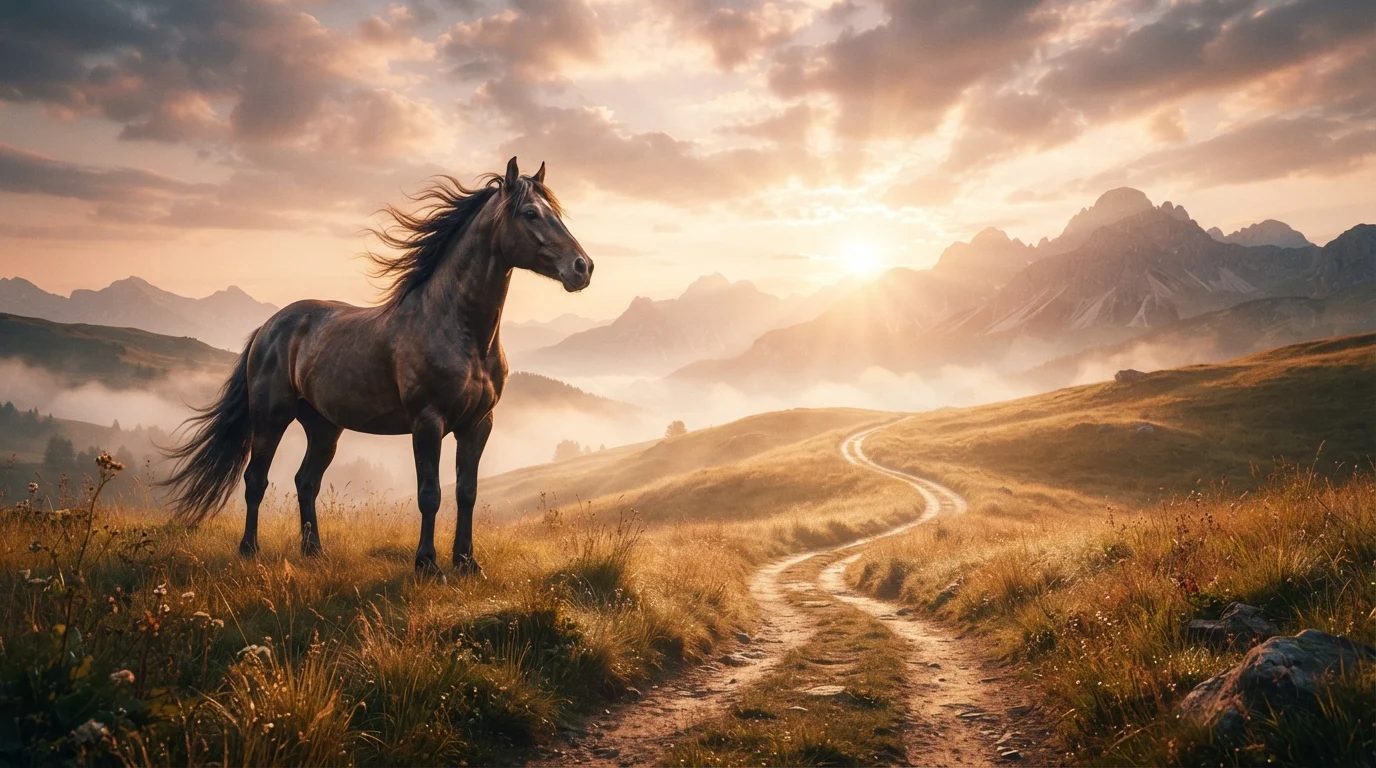
Horses have carried powerful symbolic meanings across human history. Horse symbolism is often associated with freedom, strength, movement, courage, loyalty, and personal power.
From ancient myths and religious traditions to dreams and modern culture, the horse can represent both physical energy and the deeper desire to move forward in life.
Because horses have lived and worked alongside humans for thousands of years, their symbolism is especially rich. A horse may symbolize independence in one context, while in another it can represent endurance, transformation, status, or spiritual guidance.
Horse Symbolism Meaning (Clear Definition)
Horse symbolism refers to the meanings and ideas traditionally associated with horses, including freedom, strength, courage, endurance, instinct, movement, and transformation.
The horse is a creature of remarkable physical power, yet it can also be responsive, sensitive, and deeply connected to its environment. This combination gives it a unique symbolic role.
Common horse meanings include:
| Horse Symbolism | Meaning |
|---|---|
| Freedom | Independence and the desire to live without unnecessary restrictions |
| Strength | Physical, emotional, and inner power |
| Courage | Bravery when facing challenges or uncertainty |
| Movement | Progress, change, travel, and personal development |
| Endurance | Persistence through difficult circumstances |
| Loyalty | Trust, companionship, and partnership |
| Instinct | Intuition, sensitivity, and natural wisdom |
| Transformation | Entering a new stage of life |
The exact meaning depends on the horse’s appearance, behavior, color, and context.
What Does Horse Symbolism Represent?
Horse symbolism commonly represents freedom, personal power, determination, and forward movement.
A running horse can suggest momentum and liberation, while a calm horse may represent balance, trust, and emotional stability. A powerful or wild horse can symbolize untamed instincts and a strong desire for independence.
Several important themes appear repeatedly in horse symbolism:
- Freedom: Horses are strongly associated with open spaces and unrestricted movement.
- Strength: Their physical power makes them natural symbols of resilience and capability.
- Courage: Horses can represent the confidence needed to face difficult situations.
- Endurance: Their ability to travel and work for long periods connects them with persistence.
- Loyalty: Domesticated horses have historically formed strong working relationships with humans.
- Adventure: Horses can symbolize journeys, exploration, and new experiences.
- Instinct: Their sensitivity can represent intuition and awareness of subtle changes.
- Progress: A horse moving forward can symbolize personal growth and momentum.
At a deeper level, the horse can represent the relationship between freedom and control. It may encourage you to use your power wisely without allowing fear, impulse, or external pressure to control your direction.
Spiritual Meaning of Horse Symbolism
Spiritually, horses are often viewed as symbols of life force, freedom, inner strength, intuition, and spiritual movement.
A horse can represent the energy that carries a person through periods of change. Its movement may symbolize a journey from one stage of life to another.
In spiritual interpretations, a horse may encourage you to:
- Trust your instincts.
- Move beyond unnecessary limitations.
- Develop confidence in your abilities.
- Stay connected to your inner strength.
- Accept change instead of resisting it.
- Pursue a meaningful direction with courage.
The horse can also symbolize harmony between instinct and conscious choice. Its power is most useful when guided rather than suppressed.
Horse as a Spirit Animal
When the horse is interpreted as a spirit animal, it is commonly associated with freedom, vitality, independence, and forward movement.
This symbolism can be especially meaningful when someone feels stuck or restricted. The horse’s message may be interpreted as an invitation to reclaim personal power and move toward a more authentic life.
Biblical / Religious Meaning of Horse Symbolism
Horses have significant symbolic roles in the Bible and other religious traditions. In biblical literature, their meaning varies considerably according to context.
One of the most famous examples appears in the Book of Revelation, where horses are associated with dramatic prophetic imagery. The Four Horsemen are connected with conquest, warfare, famine, and death.
However, horses in biblical passages are not always negative. They can also represent strength, military power, speed, majesty, and readiness.
The symbolism of a horse therefore depends strongly on the passage and surrounding imagery.
In Christianity, the white horse has also become associated with victory and righteousness in particular biblical interpretations, while other horse imagery carries themes of judgment and upheaval.
Rather than having one fixed religious meaning, horses demonstrate how symbolism changes according to spiritual and literary context.
Horse Symbolism in History and Culture
Horses have played an extraordinary role in human civilization. They transformed transportation, agriculture, warfare, communication, trade, and travel.
Because of this close relationship, horses became symbols of power, wealth, social status, military strength, and freedom in many societies.
Ancient Cultures
In Greek mythology, horses appear in stories involving gods, heroes, and legendary creatures. The winged horse Pegasus became an enduring symbol of inspiration, imagination, and transcendence.
In Roman culture, horses were closely associated with military achievement and status. Chariot races also made horses important symbols of spectacle and public life.
Across parts of Eurasia, horses were essential to nomadic cultures and became connected with mobility, survival, independence, and prestige.
Celtic Traditions
Horse imagery held an important place in Celtic traditions. The horse could be connected with sovereignty, fertility, travel, and the supernatural.
The Celtic goddess Epona, associated with horses, became particularly notable as a divine protector of horses and riders.
Native American Traditions
Horses became deeply significant to many Indigenous peoples of North America after their introduction to the continent. Their meanings varied considerably between nations and communities, but horses could become associated with travel, hunting, warfare, freedom, and spiritual power.
It is important to remember that there is no single universal “Native American horse meaning.” Different Indigenous cultures have distinct histories and traditions.
Horse Symbolism in Literature and Art
Horses have been powerful subjects in literature and visual art because they combine beauty, movement, danger, and emotional intensity.
In literature, the horse can function as more than an animal. It may become a companion, a symbol of freedom, a vehicle for adventure, or a reflection of its rider’s character.
Famous literary and artistic horse imagery often explores themes such as:
- Freedom versus control
- Civilization versus nature
- Courage and heroism
- Loyalty and companionship
- War and destruction
- Adventure and exploration
- Youth and vitality
- Loss and transformation
Artists have also used horses to capture movement and power. A running horse can create a strong sense of freedom, while a restrained or wounded horse may communicate suffering, conflict, or oppression.
Dream Meaning of Horse Symbolism
Dreaming about a horse is often interpreted in relation to freedom, emotional energy, personal power, and the direction of your life.
The details of the dream matter greatly.
Dreaming of a Running Horse
A running horse may symbolize freedom, progress, ambition, or a strong desire to escape restrictions.
Riding a Horse in a Dream
Riding a horse can represent confidence and control over your direction. It may suggest that you are learning to guide your energy toward an important goal.
A Wild Horse
A wild horse can symbolize independence, untamed emotions, instinct, or a desire to break away from expectations.
A Calm Horse
A calm horse may represent emotional balance, trust, stability, and peaceful cooperation.
An Injured Horse
An injured horse may symbolize exhausted personal strength or a part of your life that needs care and restoration.
A White Horse
A white horse is often associated with purity, victory, spiritual themes, hope, or transformation, although the meaning depends on the dream’s emotional atmosphere.
Dream symbolism is personal rather than universal. Your feelings during the dream and your real life circumstances can be more important than any standard interpretation.
Modern Meaning of Horse Symbolism
Today, horse symbolism continues to appear in fashion, tattoos, branding, films, literature, spiritual practices, and personal artwork.
Modern interpretations frequently focus on freedom, authenticity, resilience, independence, and personal growth.
For someone facing a major life transition, the horse can represent the courage to keep moving. For someone feeling controlled by circumstances, it may represent the desire for greater independence.
Horse tattoos, for example, are often chosen to express strength, freedom, remembrance, adventure, or a deep personal connection with horses.
The symbolism can also be highly individual. A horse may remind one person of childhood, another of family, another of achievement, and someone else of an important period of personal transformation.
What Does a White Horse Symbolize?
A white horse commonly symbolizes purity, freedom, victory, spiritual transformation, and hope.
Its meaning can change depending on cultural or religious context. In some traditions, white horses represent triumph and nobility, while religious imagery can give them additional prophetic or spiritual meanings.
What Does a Black Horse Symbolize?
A black horse can represent mystery, power, independence, transformation, or the unknown.
In some contexts, it may carry darker associations such as fear, death, or uncertainty. Its meaning depends heavily on the surrounding symbolism.
What Does a Wild Horse Symbolize?
A wild horse often symbolizes freedom, independence, instinct, and an untamed spirit.
It can represent the desire to live authentically rather than conforming to external expectations.
Is Seeing a Horse a Spiritual Sign?
A horse may have spiritual significance for someone who personally associates it with freedom, strength, guidance, or transformation.
However, there is no single universal interpretation. The meaning is best understood by considering the circumstances, emotions, and personal associations surrounding the experience.
Conclusion
Horse symbolism brings together some of the most enduring human themes: freedom, strength, courage, movement, instinct, and transformation.
If appearing in mythology, religion, dreams, art, or everyday life, the horse often reminds us of our ability to move forward while staying connected to our inner power.
At its heart, the horse symbolizes the courage to embrace freedom and the wisdom to guide that freedom toward a meaningful destination.

I’m Beau Warren, a passionate writer exploring the meanings behind symbols, dreams, colors, animals, and traditions. I enjoy creating well-researched, engaging content that inspires curiosity and deeper understanding every day.