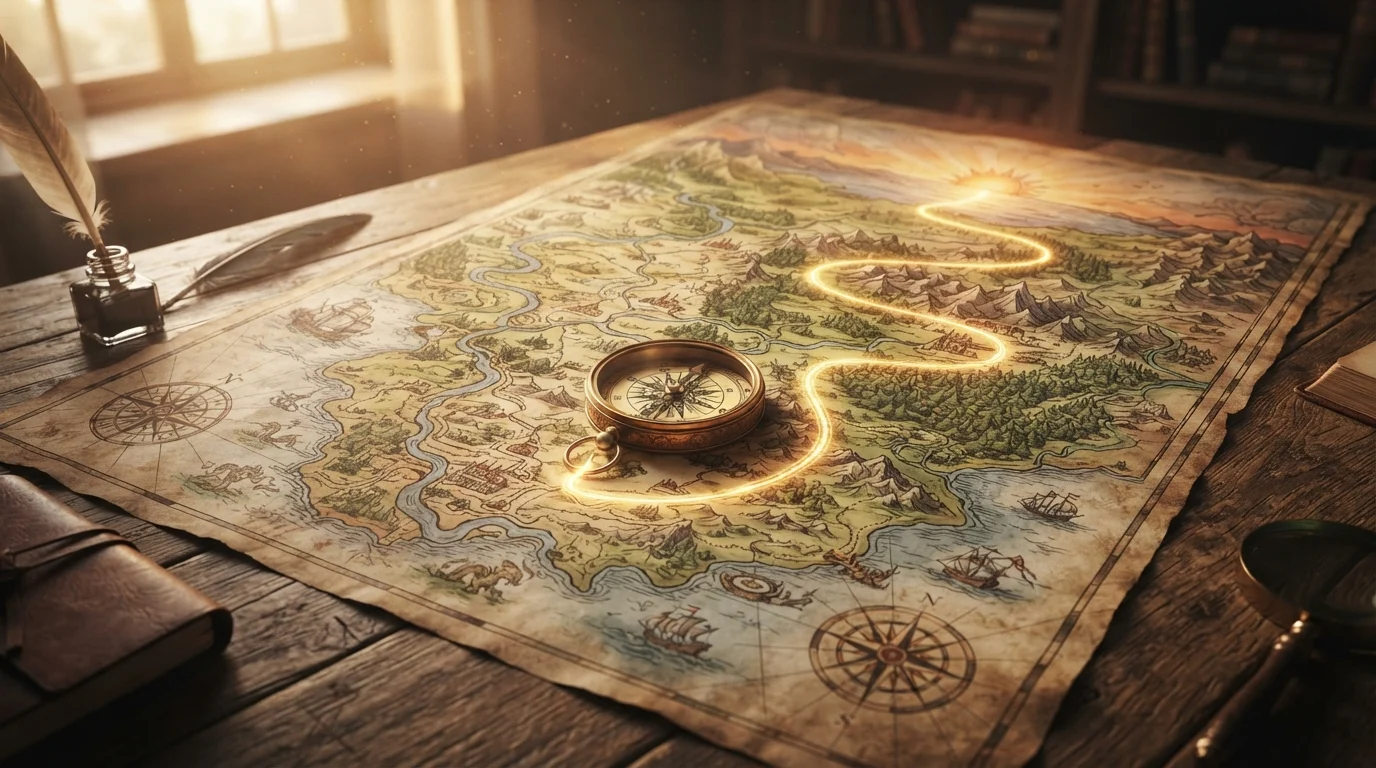
Maps are more than tools for finding places. Map symbolism explores what maps can represent emotionally, spiritually, culturally, and psychologically. They often symbolize journeys, direction, discovery, identity, boundaries, purpose, and the search for a meaningful path.
A map can show where you are, where you have been, and where you might go next. Because of this, maps frequently become powerful symbols of life itself especially when people are facing change, uncertainty, exploration, or important decisions.
Map Symbolism Meaning (Clear Definition)
Map symbolism refers to the symbolic meanings associated with maps, including guidance, exploration, direction, identity, boundaries, and the journey through life.
At the simplest level, a map transforms an unknown space into something understandable. Symbolically, it can therefore represent the desire to make sense of life and find one’s way through unfamiliar circumstances.
Common meanings of map symbolism include:
| Symbolic Meaning | What It Represents |
|---|---|
| Guidance | Finding direction or making a decision |
| Journey | Personal growth and life experiences |
| Exploration | Curiosity, adventure, and discovery |
| Direction | Purpose, goals, and a sense of destination |
| Identity | Understanding where you belong |
| Boundaries | Personal, political, or emotional limits |
| Discovery | Revealing something previously unknown |
| Possibility | Different paths and future opportunities |
A map does not necessarily tell you which path to take. Instead, it gives you a framework for understanding the paths available to you.
What Does Map Symbolism Represent?
Map symbolism can represent several interconnected ideas.
1. Guidance and Direction
One of the strongest meanings of a map is guidance. When someone feels uncertain about their next step, a map can symbolize the need for clarity and orientation.
A symbolic map may suggest questions such as:
- Where am I now?
- Where do I want to go?
- What obstacles stand in my way?
- Which paths are available?
- What destination matters most to me?
2. The Journey of Life
A map can symbolize life’s journey. Roads, rivers, mountains, cities, and destinations may represent different experiences, relationships, challenges, and opportunities.
Unlike a straight road, life rarely follows a predictable route. Map symbolism can therefore remind us that changing direction does not necessarily mean losing our way.
3. Exploration and Adventure
Maps have long been associated with exploration. They can symbolize curiosity, independence, adventure, and the desire to discover unfamiliar places.
An old or incomplete map can be particularly powerful because it suggests the existence of something not yet known.
4. Identity and Belonging
Maps also define places and relationships between places. In this sense, they can represent identity, home, heritage, and belonging.
A map of one’s birthplace, homeland, or childhood surroundings may carry emotional meaning far beyond geography.
5. Boundaries and Control
Maps can show borders, territories, and divisions. Symbolically, these features may represent personal boundaries, social divisions, ownership, authority, or separation.
This makes maps symbols not only of freedom and exploration but also of structure and control.
Spiritual Meaning of Map Symbolism
Spiritually, a map can symbolize guidance on the journey toward purpose, self-understanding, or spiritual growth.
A map may represent the belief that even when the destination is uncertain, there is value in moving forward with awareness.
A map as spiritual guidance
Seeing or using a map symbolically may suggest a search for direction. It can represent an inner desire to understand what comes next rather than simply moving without purpose.
A map and personal transformation
A journey shown on a map can symbolize transformation. The starting point represents where you began, while the destination represents an aspiration, goal, or new stage of life.
The distance between them may symbolize the experiences required to grow.
An incomplete map
An incomplete map can have a particularly meaningful spiritual interpretation. It may represent uncertainty, mystery, or the idea that the future cannot be completely known.
Rather than viewing uncertainty as failure, the symbolism can encourage openness to discovery.
A compass and map together
Maps and compasses are closely connected symbols. While the map represents the landscape and possible routes, the compass traditionally represents orientation and inner direction.
Together, they can symbolize the balance between understanding your circumstances and knowing what matters to you.
Biblical / Religious Meaning of Map Symbolism
Maps themselves are not given one universal symbolic meaning in the Bible. However, the broader religious themes associated with journeys, paths, wilderness, destinations, guidance, and pilgrimage can give map imagery additional significance.
In biblical literature, journeys frequently carry spiritual meaning. Travel can involve testing, transformation, obedience, uncertainty, and arrival at a significant destination.
The imagery of a path is especially important in religious thought. A map can therefore serve as a modern symbolic representation of the search for the right path.
From this perspective, map symbolism may suggest:
- spiritual direction
- pilgrimage
- seeking guidance
- trust during uncertainty
- movement toward a meaningful destination
- the difference between one’s plans and a larger spiritual purpose
The precise meaning depends heavily on the religious tradition and the context in which the map appears.
Map Symbolism in History and Culture
Maps have played important practical and cultural roles throughout history. They have been used to understand landscapes, navigate seas, establish territories, support travel, and communicate knowledge.
Because of these functions, maps gradually acquired meanings beyond geography.
Maps and exploration
Historical maps often symbolize exploration and the expansion of geographical knowledge. Blank areas on older maps could represent places that were unfamiliar or poorly understood.
This helped create a powerful cultural association between maps and the unknown.
Maps and power
Maps can also represent political power. Drawing a boundary is not merely a geographical act; it can define territory, ownership, jurisdiction, and national identity.
Consequently, map symbolism can involve both connection and division.
Maps and memory
Personal maps can preserve memories of important places. A map of a childhood neighborhood, a memorable journey, or a meaningful city can function almost like a visual diary.
In this sense, maps can symbolize the relationship between place and memory.
Maps and changing perspectives
A map also depends on perspective. The same world can be represented in different ways depending on projection, scale, purpose, and cultural viewpoint.
This gives maps another symbolic meaning: our understanding of reality is shaped by the perspective through which we view it.
Map Symbolism in Literature and Art
Maps have appeared frequently in literature and visual art because they provide an immediate metaphor for journeys, mystery, identity, and discovery.
In stories, a map may lead characters toward a hidden place, treasure, lost civilization, or dangerous territory. It can become a physical representation of the adventure ahead.
Artists may also use maps to explore:
- memory
- migration
- borders
- belonging
- displacement
- history
- geography
- personal identity
A map incorporated into artwork can transform an ordinary geographical document into a symbol of someone’s inner or collective experience.
In literature, the phrase “finding one’s way” can also be interpreted metaphorically. The map becomes a representation of knowledge, while the journey represents lived experience.
Dream Meaning of Map Symbolism
Dreams involving maps are often interpreted symbolically in relation to direction, choices, uncertainty, and personal journeys. Dream meanings are subjective, so the details and emotions surrounding the dream are important.
Dreaming of reading a map
Reading a map may symbolize trying to understand your current circumstances or decide what to do next.
Dreaming of a map with a destination
A clearly marked destination can represent a goal, ambition, or desired outcome.
Dreaming of being lost with a map
Being lost despite having a map may symbolize uncertainty. It can suggest that having information is not always enough to feel confident about a decision.
Dreaming of an old map
An old map may represent the past, memories, inherited beliefs, or a previous understanding of your life.
Dreaming of drawing a map
Creating a map may symbolize taking greater control of your direction and trying to organize an uncertain future.
Modern Meaning of Map Symbolism
In modern life, map symbolism has expanded beyond paper maps and navigation.
Digital maps, GPS systems, virtual worlds, and location-based technology have made maps an everyday part of life. Yet their deeper symbolic meanings remain relevant.
A modern map can represent choice, accessibility, connection, and constant movement.
At the same time, digital navigation introduces an interesting contrast. When technology automatically tells us where to go, we may spend less time thinking about direction ourselves.
This makes the map a useful metaphor for a broader question: Are we choosing our destination, or simply following the route provided to us?
Maps can also symbolize personal planning. A career plan, travel itinerary, relationship journey, or long-term goal can all be understood metaphorically as a map.
Common Map Symbolism Themes
The most important symbolic associations can be summarized as follows:
- Direction — knowing where to move next
- Guidance — finding help during uncertainty
- Journey — experiencing growth and change
- Exploration — discovering unfamiliar possibilities
- Purpose — moving toward a meaningful goal
- Identity — understanding where you belong
- Boundaries — recognizing limits and divisions
- Discovery — revealing what was previously unknown
- Choice — recognizing that multiple paths may exist
- Perspective — understanding that reality can be viewed in different ways
Frequently Asked Questions About Map Symbolism
What is the main meaning of map symbolism?
The main meaning of map symbolism is guidance and direction, often connected with journeys, choices, exploration, and finding one’s path through life.
What does a map symbolize spiritually?
Spiritually, a map can symbolize guidance, personal growth, pilgrimage, and the search for a meaningful direction or purpose.
What does a map symbolize in dreams?
A map in a dream may symbolize uncertainty, decision-making, goals, or a desire to understand your direction in life. Its meaning depends on the dream’s context and emotions.
What does an old map symbolize?
An old map can symbolize history, memory, the past, inherited knowledge, or an earlier understanding of one’s life and surroundings.
What does a map symbolize in art?
In art, maps can symbolize identity, belonging, migration, memory, borders, exploration, and the relationship between people and places.
Conclusion
Map symbolism is ultimately about finding your way. If a map represents a physical journey, spiritual search, personal transformation, or exploration of the unknown, it reminds us that life contains many possible routes.
Sometimes the most meaningful part of the journey is not knowing exactly where every road will lead.

I’m Beau Warren, a passionate writer exploring the meanings behind symbols, dreams, colors, animals, and traditions. I enjoy creating well-researched, engaging content that inspires curiosity and deeper understanding every day.