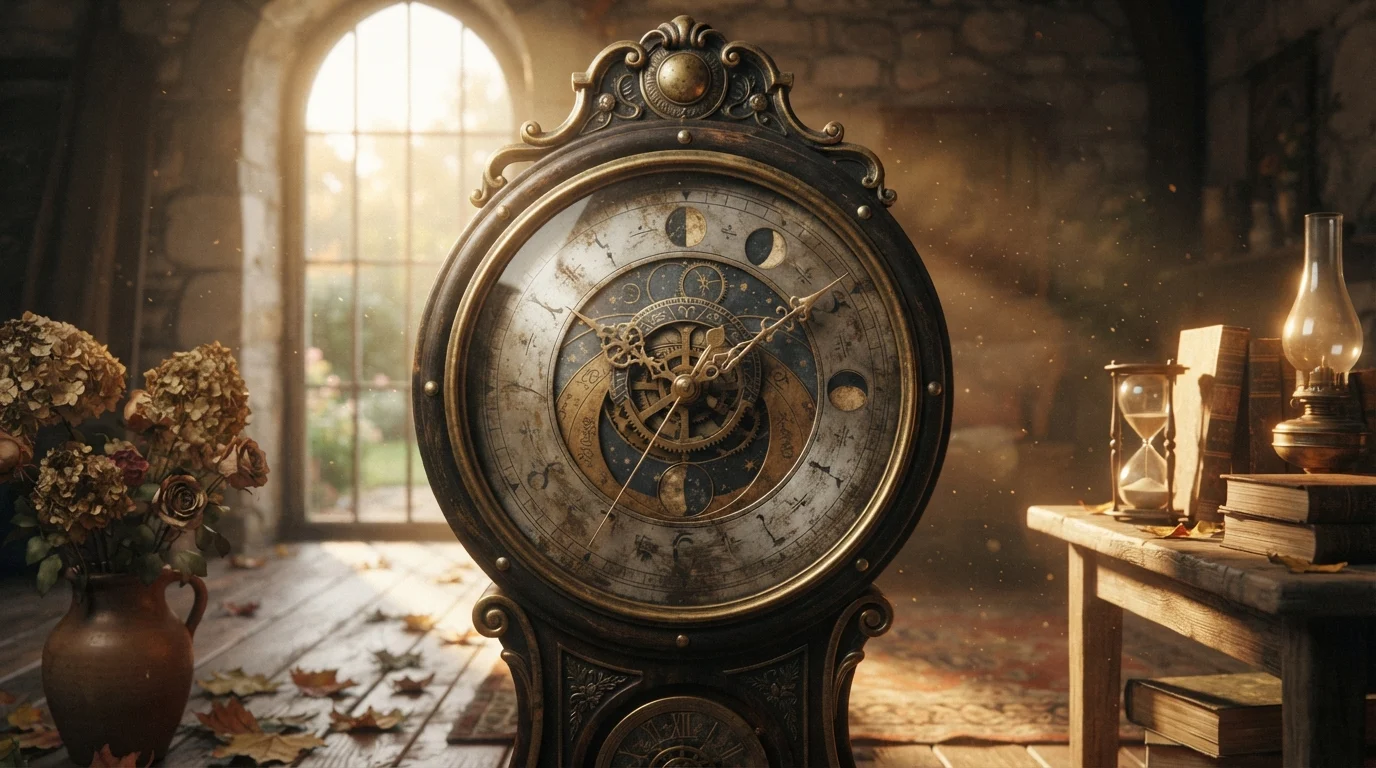
A clock is more than a device that tells us what hour it is. Clock symbolism connects time with life, change, mortality, memory, patience, and the awareness that every moment eventually passes.
If seen in a dream, artwork, story, or everyday setting, a clock can represent both the pressure of time and the beauty of living in the present.
Because clocks constantly move forward, they often remind us that life is temporary and that every moment has value. At the same time, a stopped clock can suggest something entirely different: hesitation, endings, memories, or a moment preserved in the past.
Clock Symbolism Meaning (Clear Definition)
Clock symbolism refers to the meanings and ideas associated with clocks beyond their practical purpose of measuring time. A clock commonly symbolizes time, mortality, change, deadlines, life cycles, memory, patience, and the passage of life.
In simple terms, a clock often represents the relationship between human life and time.
The meaning can change depending on the context. A clock moving normally may suggest progress, while a broken or stopped clock may symbolize interruption or an ending.
Common Clock Symbolism Meanings
| Clock Symbol | Common Meaning |
|---|---|
| Moving clock | Progress and the passage of time |
| Stopped clock | An ending, pause, memory, or suspended moment |
| Broken clock | Disruption, uncertainty, or loss of control |
| Fast-moving clock | Anxiety, urgency, or fear of running out of time |
| Slow clock | Patience, waiting, or resistance to change |
| Old clock | History, memory, tradition, or mortality |
| Alarm clock | Awakening, responsibility, or a new beginning |
| Clock without hands | Uncertainty or timelessness |
| Midnight | Transition, mystery, endings, or beginnings |
| Repeating clock time | Attention, routine, or recurring patterns |
What Does Clock Symbolism Represent?
Clocks can carry several layers of meaning. Their symbolism often depends on the situation in which they appear.
1. The Passage of Time
The most obvious meaning of a clock is the movement of time. Its hands continually progress, making it a natural symbol of life’s journey.
A clock can remind us that childhood, youth, relationships, opportunities, and experiences all move forward.
2. Mortality
Because human life exists within a limited amount of time, clocks are frequently associated with mortality.
An old clock ticking in a quiet room can create a powerful reminder that every person has a finite amount of time. In this sense, clock symbolism can encourage reflection on how we choose to spend our lives.
3. Change and Transformation
Time naturally brings change. People grow older, circumstances evolve, relationships develop, and priorities shift.
For this reason, clocks can symbolize transformation and the inevitability of moving from one stage of life to another.
4. Deadlines and Pressure
A clock can also represent urgency. Watching the minutes disappear may create feelings of pressure, responsibility, or fear of missing an opportunity.
This meaning is particularly strong when clocks appear alongside examinations, appointments, work deadlines, or important decisions.
5. Routine and Discipline
Clocks organize daily life. They tell us when to wake, work, eat, rest, study, and sleep.
As a result, clocks can symbolize discipline, structure, responsibility, and routine.
6. Memory and the Past
An antique clock can evoke memories of another period. It may represent family history, childhood, ancestors, or a world that no longer exists.
The clock therefore becomes a bridge between the present and the past.
Spiritual Meaning of Clock Symbolism
Spiritually, clock symbolism often relates to divine timing, life cycles, personal growth, patience, and awareness of the present moment.
A clock may encourage someone to consider if they are rushing through life or resisting necessary change.
Clock as a Symbol of Divine Timing
In many spiritual traditions, people believe that important events unfold according to a larger timing that may not always match human expectations.
A clock can therefore symbolize the idea that something may happen when the time is right rather than simply when we want it to happen.
Clock as a Reminder to Live in the Present
The past cannot be changed, and the future cannot be completely controlled. A clock moving forward can serve as a simple reminder to pay attention to the present.
Its message may be:
This moment matters because it will not return in exactly the same form.
Clock and Personal Growth
Time is closely connected with development. Spiritual clock symbolism can therefore represent lessons that unfold gradually.
Some changes require patience. Some answers become clear only after experience. A clock can symbolize the wisdom that comes from allowing life to develop naturally.
Biblical / Religious Meaning of Clock Symbolism
The modern clock itself is not a major biblical symbol, and biblical texts were written in historical periods before modern mechanical clocks became common.
However, time, seasons, waiting, mortality, and divine timing are important themes in religious thought.
The Bible frequently reflects on the passage of time and the changing seasons of life. Ecclesiastes, for example, famously describes different times and seasons for human experiences.
From this perspective, a clock can serve as a modern visual representation of themes such as:
- The appointed time for different experiences
- Patience and waiting
- Human mortality
- The temporary nature of earthly life
- The importance of using one’s time wisely
- Trust in a larger divine order
Religious interpretations vary, so a clock does not have one universally established biblical meaning.
Clock Symbolism in History and Culture
Clocks have played an important role in human culture because societies have long searched for ways to understand and measure time.
Before mechanical clocks, people used natural indicators such as the movement of the sun and stars. Sundials, water clocks, hourglasses, and other devices gradually provided increasingly precise ways of measuring passing hours.
As mechanical clocks became widespread, the clock became more than a scientific invention. It became a cultural symbol of order, productivity, civilization, and social organization.
The Clock as a Symbol of Civilization
Public clocks historically helped communities coordinate activities. Bells and clock towers could announce important times to entire towns.
This gave clocks a communal meaning: they represented shared time.
The Clock and Industrial Society
With industrialization, precise time became increasingly important. Work schedules, transportation, factories, and business activities depended on people arriving and working at specific times.
Consequently, clocks came to symbolize punctuality, productivity, discipline, and the demands of organized society.
The Antique Clock
An antique clock often carries an additional emotional meaning. Its worn materials and continued ticking can suggest heritage, ancestry, memory, and the connection between generations.
Clock Symbolism in Literature and Art
Clocks have long been powerful symbols in literature and visual art because they provide an immediate image of time passing.
A writer may use a clock to create tension before an important event. An artist may place a clock beside an aging person to emphasize mortality. A stopped clock can suggest that a character remains emotionally trapped in a particular moment.
Common Artistic Uses of Clocks
A ticking clock can represent suspense or urgency.
A broken clock can symbolize disorder, uncertainty, or a life disrupted by an event.
An antique clock can represent memory and history.
A melting or distorted clock can suggest the subjective nature of time.
A clock at midnight can represent transition, mystery, endings, or the beginning of a new phase.
One famous example is Salvador Dalí’s use of distorted clocks in The Persistence of Memory. The unusual clocks challenge the ordinary idea that time is rigid and objective, contributing to the artwork’s dreamlike atmosphere.
Dream Meaning of Clock Symbolism
Dreams involving clocks are often interpreted in relation to time, urgency, change, and personal concerns. However, dream symbolism is subjective, and there is no single interpretation that applies to everyone.
Seeing a Clock in a Dream
A clock may reflect awareness of time or an important deadline in waking life.
A Clock Moving Very Fast
A rapidly moving clock may represent feelings that life is progressing too quickly or that an important opportunity is disappearing.
A Clock Moving Slowly
A slow clock may reflect waiting, impatience, frustration, or the feeling that an important situation is taking too long to change.
A Stopped Clock
A stopped clock may symbolize a moment that feels emotionally significant or unresolved. It can also represent an ending or a desire to remain connected to the past.
A Broken Clock
A broken clock may represent uncertainty or a disruption in plans. It can also suggest that normal expectations about time or progress no longer seem to apply.
Repeatedly Seeing the Same Time
Repeated clock times in dreams may simply reflect something that has become psychologically noticeable or important to the dreamer. Rather than assuming a universal spiritual message, consider what that particular time or situation means personally.
Modern Meaning of Clock Symbolism
In modern life, clocks remain closely connected with productivity, technology, schedules, and personal organization.
Digital clocks, smartphones, computers, smartwatches, and other devices have made time constantly visible.
Yet the deeper symbolism has not disappeared.
Modern Clock Symbolism Includes:
- Productivity: managing time efficiently
- Work-life balance: deciding how much time to give different responsibilities
- Urgency: responding to deadlines and expectations
- Personal freedom: having control over one’s schedule
- Aging: becoming aware of life’s limited duration
- Mindfulness: appreciating the present moment
- Change: accepting that circumstances evolve
Modern clock symbolism can therefore contain a tension between using time efficiently and actually experiencing life.
A person can spend every minute productively while still missing the meaning of the moments themselves.
What Does a Broken Clock Symbolize?
A broken clock commonly symbolizes interruption, uncertainty, lost direction, or a situation that no longer follows its expected course.
Depending on the context, it may also represent emotional stagnation or an inability to move beyond a particular experience.
What Does a Stopped Clock Symbolize?
A stopped clock often represents a frozen moment, an ending, memory, or something that has been left unresolved.
Its meaning can become especially powerful when the clock is associated with a particular event, relationship, or period of life.
What Does an Alarm Clock Symbolize?
An alarm clock commonly symbolizes awakening, responsibility, deadlines, and new beginnings.
Symbolically, it can suggest that it is time to pay attention, take action, or move into a new stage of life.
What Does a Clock Symbolize Spiritually?
Spiritually, a clock can symbolize divine timing, patience, personal growth, life cycles, and the temporary nature of human existence.
It can encourage reflection on whether we are trusting the process of life or becoming overly focused on controlling its timing.
Is Clock Symbolism Always About Mortality?
No. Although mortality is one important interpretation, clocks can also represent progress, routine, discipline, opportunity, patience, memory, and change.
The surrounding context determines which meaning is most relevant.
Conclusion
Clock symbolism reminds us that time is both ordinary and precious. A clock can represent deadlines and responsibilities, but it can also symbolize growth, memory, mortality, patience, and the quiet movement of life from one moment to the next.
Perhaps its most meaningful message is simple: time keeps moving, so the moments we have today deserve our attention.

I’m Sophia Brown, passionate about exploring symbols, their meanings, and cultural significance. I enjoy researching history, spirituality, and traditions, creating clear, engaging articles that inspire curiosity and deeper understanding for every reader.