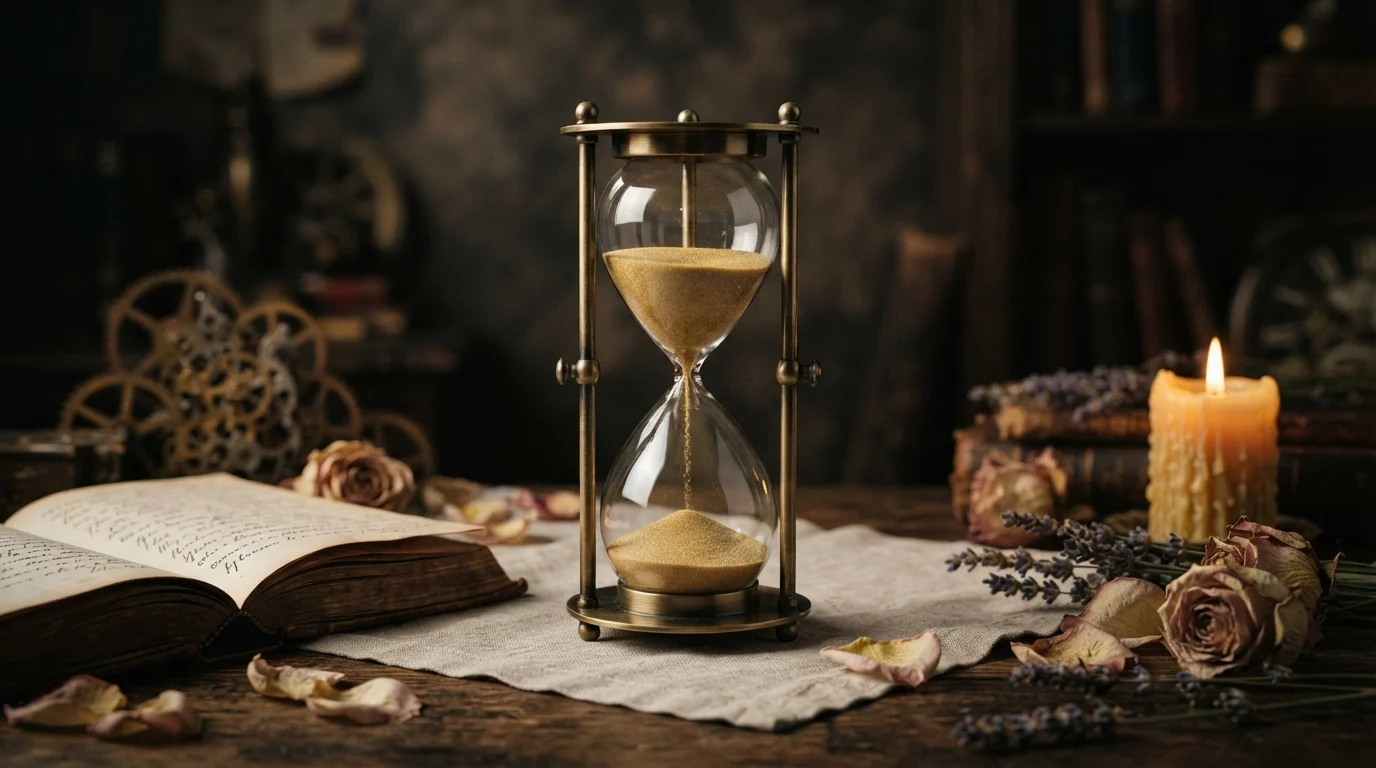
An hourglass is one of the clearest symbols of time, reminding us that every moment moves forward and cannot be recovered. Hourglass symbolism often represents the passage of time, mortality, patience, transformation, and the importance of living in the present.
Its falling sand creates a simple but powerful image: life is always moving, even when we feel still.
Across history, art, spirituality, dreams, and modern culture, the hourglass has carried both comforting and serious meanings. It can remind us to appreciate the present, accept change, and use our limited time wisely.
Hourglass Symbolism Meaning (Clear Definition)
Hourglass symbolism represents the passage of time, mortality, patience, balance, and the temporary nature of life. Because sand steadily moves from one chamber to another, an hourglass illustrates that time is constantly passing and cannot be reversed.
The hourglass can symbolize:
- The passage of time
- Mortality and the finite nature of life
- Patience and waiting
- Change and transformation
- Balance between past and future
- The value of the present moment
- Cycles and renewal
Unlike a clock, which continuously displays time, an hourglass shows time as something tangible. You can actually watch the remaining sand decrease, making its symbolism especially powerful.
What Does Hourglass Symbolism Represent?
At its heart, the hourglass represents time that cannot be stopped. The sand begins in one chamber and gradually moves into another, creating a visual metaphor for life’s journey.
1. The Passage of Time
The most obvious meaning is the steady movement of time. Every grain of sand represents a moment that passes.
This symbolism encourages us to recognize that time is valuable because it is limited.
2. Mortality
An hourglass can also represent human mortality. When the upper chamber becomes empty, the measured period has ended.
For this reason, hourglasses have often been associated with death, remembrance, and the temporary nature of existence.
3. Patience
The sand does not fall instantly. It moves gradually, one grain at a time.
This makes the hourglass a symbol of patience, reminding us that some outcomes require time and cannot be rushed.
4. Transformation
When the sand moves from one side to the other, its location changes while the sand itself remains essentially the same.
This can symbolize personal transformation: change does not necessarily mean becoming someone completely different. Sometimes it means moving into a new stage of life.
5. Balance
The two chambers of an hourglass can represent opposing but connected states: past and future, beginning and ending, activity and rest, or youth and age.
The narrow center connects them, symbolizing transition and balance.
| Symbolic Meaning | What the Hourglass Suggests |
|---|---|
| Time | Every moment is passing |
| Mortality | Life is finite |
| Patience | Some things require time |
| Change | Life moves from one stage to another |
| Balance | Opposing phases remain connected |
| Impermanence | Nothing remains exactly the same |
| Present moment | Today is the time we actually possess |
Spiritual Meaning of Hourglass Symbolism
Spiritually, the hourglass can be viewed as a reminder that earthly life is temporary while the lessons gained from life can have lasting meaning.
Its movement encourages mindfulness. Rather than becoming trapped in regret about the past or anxiety about the future, the hourglass invites us to pay attention to the moment that is currently unfolding.
The hourglass may also symbolize spiritual growth through time. Experiences, challenges, relationships, and personal changes gradually shape a person’s understanding.
Hourglass as a Symbol of Impermanence
Many spiritual traditions emphasize that physical circumstances are constantly changing. The hourglass expresses this idea visually.
The sand never remains permanently in one position. Likewise, happiness, difficulty, success, relationships, and life circumstances can all change.
Hourglass and Mindfulness
An hourglass can encourage a simple question:
How am I using the time I have?
Rather than treating time as something unlimited, its symbolism encourages conscious living, gratitude, and meaningful action.
Hourglass and Personal Transformation
The movement of sand can also represent spiritual development. One phase ends as another begins, creating an ongoing journey rather than a single fixed destination.
Biblical / Religious Meaning of Hourglass Symbolism
The hourglass itself is not a major biblical symbol, and the Bible does not establish a specific religious meaning for the object.
However, its symbolism connects naturally with biblical themes concerning the brevity of human life, the passing of time, wisdom, and mortality.
Scripture frequently reflects on the temporary nature of earthly existence. From this perspective, an hourglass can serve as a visual reminder that human life is limited and that time should be used wisely.
Its symbolism may therefore suggest:
- The brevity of life
- Awareness of mortality
- The importance of wisdom
- The temporary nature of earthly concerns
- Reflection on how one’s time is spent
In a broader religious context, the hourglass can represent the movement from one stage of existence to another and the recognition that earthly life is not permanent.
Hourglass Symbolism in History and Culture
The hourglass has a long association with measuring periods of time. Before modern clocks and precise mechanical timekeeping became widespread, sand based timekeeping offered a practical way to measure a defined interval.
Over time, the object gained symbolic meaning beyond its practical function.
In European art and visual culture, hourglasses were frequently connected with vanitas, a tradition emphasizing the temporary nature of worldly life. Alongside objects such as skulls, extinguished candles, and fading flowers, the hourglass reminded viewers that wealth, beauty, youth, and power eventually pass away.
The image also became associated with death and mortality. The familiar figure of Death carrying an hourglass developed into a powerful cultural representation of life’s limited duration.
Yet the symbolism was not always negative. An hourglass could also represent order, patience, discipline, and the predictable rhythm of time.
Hourglass Symbolism in Literature and Art
Writers and artists have long used the hourglass as a metaphor because its physical appearance communicates complex ideas immediately.
In literature, an hourglass may represent a character’s limited time, an approaching deadline, aging, or an irreversible decision.
It can also create tension. When a character knows that the sand is running out, the hourglass becomes a visual representation of urgency.
In art, the object often communicates mortality without requiring words. A beautiful painting containing an hourglass can suggest that beauty itself is temporary.
Common Artistic Meanings of the Hourglass
- Vanity: worldly achievements do not last forever.
- Mortality: every life eventually reaches an end.
- Memory: the past cannot be recovered.
- Urgency: limited time encourages action.
- Transition: one phase gives way to another.
- Wisdom: awareness of time can lead to more meaningful choices.
The hourglass is especially effective in symbolic art because its meaning can change depending on the objects surrounding it.
An hourglass beside flowers may emphasize fading beauty. An hourglass beside a book may suggest knowledge gained over time. An hourglass beside a skull may emphasize mortality.
Dream Meaning of Hourglass Symbolism
Dreaming about an hourglass often relates to time, deadlines, change, patience, or awareness of life’s limited opportunities.
The meaning depends strongly on what happens in the dream.
Seeing an Hourglass
Seeing an hourglass may suggest that you are becoming more conscious of time or a particular stage of your life.
Watching the Sand Fall
Watching the sand may indicate awareness that something is changing or that an important period is coming to an end.
An Empty Hourglass
An empty hourglass can symbolize completion, endings, or the feeling that an opportunity has passed.
Turning the Hourglass Over
Turning an hourglass upside down may represent a fresh start, renewal, or entering another cycle.
A Broken Hourglass
A broken hourglass can symbolize disrupted plans, anxiety about time, or a desire to escape pressure and expectations.
Dream symbolism is highly personal, so an hourglass in a dream should be considered alongside your emotions and the circumstances surrounding the dream.
Modern Meaning of Hourglass Symbolism
Today, the hourglass remains a recognizable symbol of time, waiting, deadlines, and limited opportunity.
Digital technology has made timekeeping nearly effortless, yet the hourglass continues to appeal because it makes time visible.
A countdown timer may tell us how much time remains, but an hourglass allows us to see time physically disappearing.
In modern life, hourglass symbolism can therefore encourage a healthier relationship with time.
Instead of seeing time only as something to manage, the hourglass invites us to see it as something to appreciate.
It can represent:
- Living in the present
- Taking meaningful breaks
- Accepting natural change
- Avoiding unnecessary delay
- Appreciating relationships
- Making intentional decisions
- Recognizing that opportunities can be temporary
The symbol is especially relevant in a world where people often feel rushed. Its slow movement offers a quiet reminder that not everything needs to happen instantly.
What Does an Hourglass Symbolize Spiritually?
Spiritually, an hourglass commonly symbolizes impermanence, mindfulness, personal growth, and the limited nature of earthly life. It can encourage people to appreciate the present instead of becoming consumed by the past or future.
Is an Hourglass a Symbol of Death?
Yes, an hourglass has historically been associated with death and mortality because its falling sand represents the limited duration of human life. However, it can also symbolize patience, transformation, balance, and the value of time.
What Does an Hourglass Mean in a Dream?
An hourglass in a dream may represent awareness of time, an approaching deadline, personal change, or the ending of a particular life phase. The specific meaning depends on the dream’s circumstances and the emotions involved.
What Does an Hourglass Symbolize in Love?
In relationships, an hourglass can symbolize the importance of appreciating shared time, patience, commitment, and the changing stages of love. It may also suggest that meaningful relationships require attention because time together is limited.
Why Is the Hourglass a Symbol of Time?
An hourglass represents time because sand steadily moves from one chamber to another at a measurable rate. Once the sand has fallen, the measured period is complete, making the object a simple visual metaphor for time passing.
Conclusion
Hourglass symbolism is ultimately a reminder that time is precious, temporary, and always moving forward. It can represent mortality and endings, but it can also inspire patience, transformation, balance, and gratitude.
The falling sand offers a simple lesson: we cannot stop time, but we can choose how we use the moments we have.

I’m Camden Holland, a passionate writer at Symbolop, where I explore the meanings, history, and cultural significance of symbols. I enjoy creating clear, engaging content that helps readers discover the fascinating stories behind symbols from around the world.