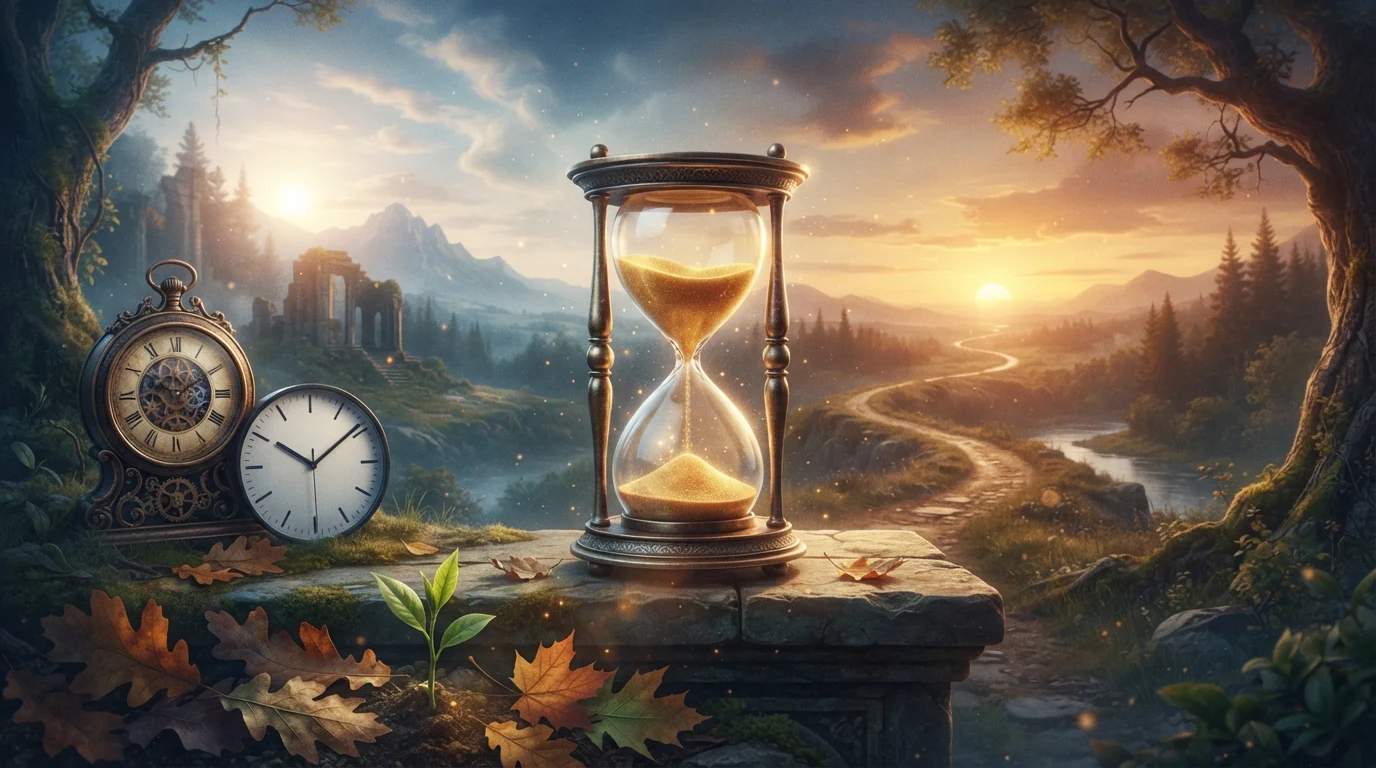
Time is one of the most universal symbols in human experience. Time symbolism represents change, growth, mortality, memory, opportunity, and the continuous movement of life. Although time cannot be seen or held, people often use clocks, seasons, aging, calendars, and cycles to give it symbolic meaning.
From ancient cultures to modern life, time has reminded people that everything changes. It can represent both endings and beginnings, encouraging us to appreciate the present while learning from the past and preparing for the future.
Time Symbolism Meaning (Clear Definition)
Time symbolism is the use of time, clocks, seasons, aging, cycles, and temporal movement to represent deeper ideas such as change, mortality, growth, patience, destiny, and renewal.
At its simplest, time symbolizes the passage of life. It shows that nothing remains exactly the same forever.
Depending on the context, time can have positive or negative meanings. It may represent progress and personal growth, but it can also remind us of aging, loss, deadlines, and the temporary nature of existence.
Common meanings associated with time symbolism include:
- Change and transformation
- Growth and maturity
- Mortality and impermanence
- Patience and endurance
- Memory and nostalgia
- Opportunity and possibility
- Cycles and renewal
- Destiny and life direction
- Healing and emotional recovery
- The importance of living in the present
Time is therefore both a practical reality and a powerful metaphor for the human journey.
What Does Time Symbolism Represent?
Time symbolism can represent different ideas depending on how it appears.
| Symbolic Aspect of Time | Meaning |
|---|---|
| Clock | Awareness of time, deadlines, order, and mortality |
| Sunrise | New beginnings and hope |
| Sunset | Completion, endings, and reflection |
| Seasons | Cycles, transformation, and renewal |
| Aging | Experience, maturity, and impermanence |
| Hourglass | Limited time and the passage of life |
| Calendar | Planning, milestones, and the structure of life |
| Repeating cycles | Renewal, continuity, and natural rhythms |
| Forgotten time | Freedom, escape, or loss of awareness |
| Waiting | Patience, anticipation, and emotional growth |
One of the deepest ideas connected with time is impermanence. Every moment passes, which means that happiness, difficulty, youth, relationships, and circumstances can all change.
This can seem unsettling, but it can also be comforting. Difficult periods do not last forever, and new opportunities can emerge as circumstances change.
Time as a Symbol of Change
Nothing in life stays completely still. People grow, relationships evolve, societies transform, and nature moves through its seasons.
For this reason, time often symbolizes transformation. It represents the invisible force through which one stage of life becomes another.
Time as a Symbol of Mortality
Time also reminds humans that life is limited. The movement of a clock or the changing of seasons can become a metaphor for the gradual passage toward old age and death.
Rather than simply representing fear, this symbolism can encourage greater appreciation for life.
Time as a Symbol of Opportunity
Time can also symbolize possibility. Every new day provides another opportunity to make a decision, repair something, learn a lesson, or begin again.
This interpretation makes time a symbol of hope rather than limitation.
Spiritual Meaning of Time Symbolism
Spiritually, time often represents growth, divine timing, transformation, patience, and the journey of the soul.
Many spiritual traditions encourage people to recognize that human beings experience life moment by moment, while ultimate reality may be understood as existing beyond ordinary concepts of time.
Time can therefore become a reminder to trust the process of life.
Divine Timing
The idea of divine timing suggests that events may unfold according to a greater order rather than according to human expectations.
When something does not happen immediately, people may interpret the delay as an opportunity for preparation, growth, or learning.
Time and Personal Growth
Spiritual growth is rarely viewed as something that happens instantly. Time allows experiences to teach lessons gradually.
A person may not understand the meaning of an event when it happens but may recognize its significance years later.
Time as a Spiritual Teacher
Time teaches several important lessons:
- Everything changes.
- Patience can produce wisdom.
- Difficult periods eventually shift.
- Experiences become memories.
- Growth often happens gradually.
- The present moment has value.
- Life is temporary and therefore precious.
In this sense, time is not merely something that passes. It can be viewed as a teacher that reveals what truly matters.
Biblical / Religious Meaning of Time Symbolism
Time has significant symbolic importance in the Bible and in religious thought more broadly.
Biblical teachings frequently distinguish between human experiences of time and God’s eternal nature. Scripture also presents life as having seasons, appointed moments, beginnings, endings, waiting periods, and times of fulfillment.
One of the clearest biblical ideas is that there is a time and season for different experiences in life. This perspective encourages people to recognize that circumstances change and that different stages may have different purposes.
Time can therefore symbolize:
- God’s timing
- Human mortality
- Seasons of life
- Patience and waiting
- Judgment and accountability
- Renewal and restoration
- Eternity
The contrast between temporary human life and divine eternity is especially important in religious symbolism.
For many believers, time serves as a reminder that earthly life is temporary while spiritual existence is understood as extending beyond ordinary human time.
Time Symbolism in History and Culture
Time has been symbolically important across civilizations for thousands of years.
Ancient societies closely observed the movement of the sun, moon, and stars. Natural cycles helped communities organize agriculture, religious ceremonies, travel, and social life.
The changing seasons became especially powerful symbols because they provided a visible representation of life’s cycles.
Ancient Time Cycles
Many cultures viewed time as cyclical rather than simply linear. Birth, growth, decline, death, and renewal appeared repeatedly in nature.
The cycle of the seasons became a natural metaphor for human existence:
Spring → Summer → Autumn → Winter → Renewal
Spring can symbolize birth and youth. Summer may represent strength and abundance. Autumn can symbolize maturity and harvest, while winter may represent decline, rest, death, or preparation for renewal.
Clocks and Hourglasses
Mechanical clocks eventually introduced another powerful image of time.
A clock can symbolize structure, discipline, urgency, and mortality. An hourglass has an even more direct association with limited time because its sand gradually runs from one chamber to another.
The image suggests that life is constantly moving forward and cannot be reversed.
Cultural Views of Time
Different cultures have developed different relationships with time. Some emphasize schedules, deadlines, and linear progress, while others place greater emphasis on natural cycles, traditions, and recurring patterns.
These differences demonstrate that time is both a physical reality and a cultural symbol.
Time Symbolism in Literature and Art
Time is one of the most frequently explored themes in literature and art because it connects directly with memory, identity, love, aging, loss, and mortality.
Writers often use time to show how characters change. A character may begin a story with one worldview and end with another after experiencing years of hardship, love, failure, or discovery.
Common Time Symbols in Literature
Literary representations of time include:
- Clocks representing mortality
- Seasons representing stages of life
- Aging representing experience
- Memories representing the persistence of the past
- Repetition representing cycles
- Time travel representing regret or possibility
- Ruins representing the effects of time
- Dawn representing renewal
- Night representing endings or uncertainty
Time can also create emotional contrasts. A childhood memory may represent innocence, while an old photograph may symbolize everything that has changed since the moment it captured.
Time in Visual Art
Artists frequently use clocks, watches, calendars, fading objects, old photographs, and changing landscapes to communicate the passage of time.
A damaged or melting clock may suggest that time is unstable or that human attempts to control it are ultimately limited.
Similarly, an aging face can represent wisdom, mortality, experience, and the unavoidable movement of life.
Dream Meaning of Time Symbolism
Dreams involving time can have many possible interpretations, depending on the dreamer’s emotions and circumstances.
Seeing a clock in a dream may symbolize awareness of deadlines, anxiety about the future, or concern about how quickly life is moving.
Dreaming about time running out may reflect pressure, regret, or fear of missing an important opportunity.
Dreaming about turning back time may symbolize a desire to change the past, repair a relationship, undo a mistake, or return to a happier period.
A dream in which time stops may represent feeling emotionally stuck or wanting to escape pressure and responsibilities.
A broken clock may symbolize confusion about timing, disrupted plans, or uncertainty about the future.
Dream symbolism is personal, however. The meaning of time in a dream is often connected more closely to the dreamer’s emotions and current circumstances than to a universal interpretation.
Modern Meaning of Time Symbolism
In modern life, time symbolism is closely connected with productivity, technology, aging, personal goals, and the pressure to accomplish more.
Digital clocks and smartphones make time constantly visible. Notifications, calendars, schedules, countdowns, and deadlines can make people increasingly aware of every passing minute.
As a result, modern time symbolism often carries two contrasting meanings.
On one side, time represents productivity and achievement. People talk about saving time, managing time, investing time, and making the most of every day.
On the other side, time represents presence and well-being. Modern ideas about mindfulness encourage people to stop focusing entirely on the past or future and pay greater attention to the present moment.
Time and Personal Development
Time is often viewed as an investment. Learning a skill, building a relationship, developing a career, or recovering from a difficult experience requires patience.
The symbolism here is simple: meaningful growth takes time.
Time and Relationships
Time spent with another person can symbolize love, loyalty, and emotional investment.
When people say that someone “made time” for them, the expression carries symbolic weight. It suggests that attention and time are among the most valuable things a person can give.
Time and Memory
Time also transforms experiences into memories.
A place, photograph, song, or object may suddenly bring the past into the present. In this way, time symbolism is closely connected with nostalgia and the desire to preserve meaningful moments.
Why Is Time Such a Powerful Symbol?
Time is powerful as a symbol because every human being experiences it, yet nobody can physically control it.
We can measure time, organize it, remember it, and anticipate it, but we cannot stop its movement.
This creates a unique symbolic tension. Humans want to control their future and sometimes return to their past, while time continually moves forward.
That is why time can simultaneously represent:
- Freedom and limitation
- Hope and uncertainty
- Growth and aging
- Memory and loss
- Beginnings and endings
- Patience and urgency
Ultimately, time reminds us that life is a journey rather than a permanent state.
What Does a Clock Symbolize?
A clock commonly symbolizes the passage of time, deadlines, structure, mortality, and awareness of life’s limited nature.
A clock may also represent the need to make a decision or recognize that an important moment has arrived.
What Does an Hourglass Symbolize?
An hourglass symbolizes limited time and the fact that moments cannot be recovered once they have passed.
It is often associated with mortality, patience, urgency, and the temporary nature of life.
What Does Time Symbolize Spiritually?
Spiritually, time can symbolize growth, divine timing, patience, transformation, and the journey through different stages of life.
It may also remind a person to trust that meaningful changes often unfold gradually.
What Does Time Symbolize in Dreams?
Time in dreams may represent deadlines, personal growth, regret, anxiety about the future, or a desire to change the past.
The meaning depends heavily on the dreamer’s feelings and the specific details of the dream.
Is Time a Symbol of Change?
Yes. Time is one of the strongest symbols of change because everything evolves as time passes.
It can represent physical aging, emotional development, changing relationships, new beginnings, and the transition from one stage of life to another.
Conclusion
Time symbolism reminds us that life is constantly moving, changing, and unfolding. It represents mortality and impermanence, but it also represents growth, opportunity, healing, renewal, and hope.
We cannot stop time, but we can choose how we use the moments we are given. In that sense, the deepest meaning of time may be a simple invitation: appreciate the present, learn from the past, and move toward the future with purpose.

I’m Beau Warren, a passionate writer exploring the meanings behind symbols, dreams, colors, animals, and traditions. I enjoy creating well-researched, engaging content that inspires curiosity and deeper understanding every day.