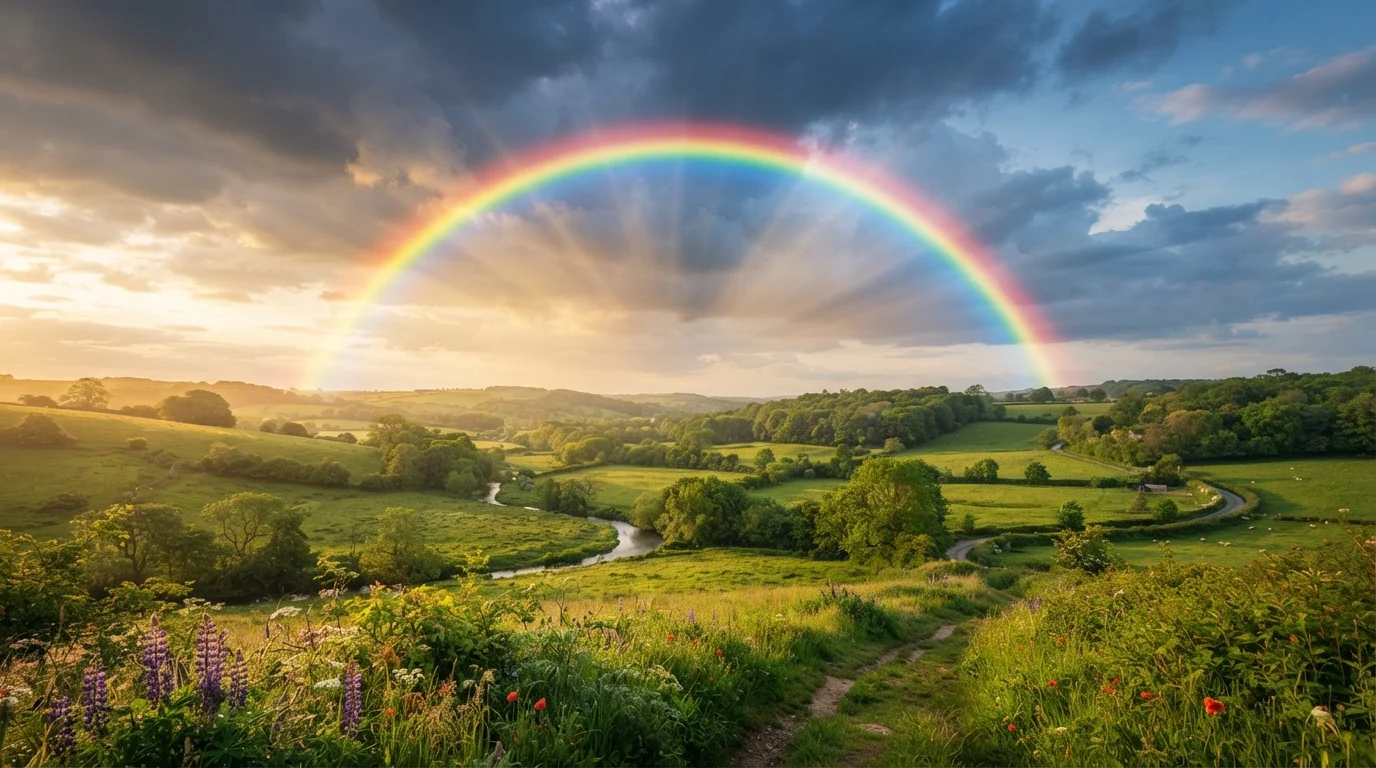
A rainbow is one of nature’s most beautiful and recognizable symbols. Rainbow symbolism often represents hope, renewal, transformation, peace, and the promise that difficult moments can lead to brighter days.
Across religions, cultures, literature, dreams, and modern life, the rainbow carries powerful meanings that continue to inspire people.
Because a rainbow appears after rain and disappears as conditions change, it is often viewed as a reminder of impermanence. It can suggest that hardship is temporary and that beauty can emerge unexpectedly from difficult experiences.
Rainbow Symbolism Meaning (Clear Definition)
Rainbow symbolism refers to the meanings people associate with the rainbow, including hope, new beginnings, harmony, transformation, peace, and spiritual connection.
The rainbow’s symbolism comes largely from its natural appearance. It emerges when sunlight interacts with water droplets, creating a colorful arc across the sky. This combination of light appearing after rain has made the rainbow a natural metaphor for optimism and renewal.
Common meanings associated with rainbows include:
| Rainbow Symbolism | Common Meaning |
|---|---|
| Hope | Confidence that better times are ahead |
| Renewal | A fresh beginning after difficulty |
| Transformation | Personal growth and positive change |
| Peace | Harmony, reconciliation, and calm |
| Promise | A reminder of faith, commitment, or assurance |
| Unity | Different elements coming together beautifully |
| Spiritual connection | A perceived link between earthly and higher realms |
| Joy | Happiness, celebration, and wonder |
The exact meaning can vary depending on personal beliefs, cultural background, and the situation in which the rainbow appears.
What Does Rainbow Symbolism Represent?
Rainbow symbolism represents the idea that contrasting experiences can coexist and create something beautiful.
Rain and sunlight are very different conditions, yet together they can produce a rainbow. For this reason, the rainbow often represents balance between struggle and hope, darkness and light, or uncertainty and possibility.
1. Hope After Hardship
Perhaps the most widely recognized meaning of a rainbow is hope. Since rainbows frequently appear after rainfall, they can symbolize better circumstances following a difficult period.
2. New Beginnings
A rainbow may represent the beginning of a new chapter. It can symbolize leaving behind an old situation and moving forward with greater optimism.
3. Transformation
The rainbow can also represent personal transformation. Just as ordinary sunlight and water become something extraordinary under the right conditions, challenging experiences can contribute to growth.
4. Peace and Reconciliation
Rainbows are commonly associated with peace. Their balanced spectrum of colors can suggest cooperation, acceptance, and harmony between differences.
5. Unity in Diversity
A rainbow contains multiple colors that remain distinct while forming one beautiful image. This makes it a natural symbol of diversity, inclusion, and unity.
Spiritual Meaning of Rainbow Symbolism
The spiritual meaning of rainbow symbolism often centers on hope, divine guidance, transformation, and connection between the physical and spiritual worlds.
In spiritual traditions, rainbows may be interpreted as signs of reassurance or reminders to maintain faith during uncertain periods.
Some spiritual interpretations include:
- A sign of hope: A rainbow may encourage someone to remain optimistic.
- A symbol of spiritual growth: It can represent moving through challenges toward greater awareness.
- A bridge between worlds: Its arc across the sky can be interpreted metaphorically as a connection between earth and heaven.
- A reminder of divine presence: Some people view unexpected rainbows as meaningful spiritual experiences.
- A symbol of emotional healing: The rainbow can represent finding peace after grief, disappointment, or conflict.
These interpretations are matters of personal spirituality rather than universal facts. For many people, the meaning comes from what the rainbow represents in their own life.
Biblical / Religious Meaning of Rainbow Symbolism
The rainbow has an especially significant place in the Bible. In the Book of Genesis, a rainbow appears after the Flood as a sign of God’s covenant with Noah and living creatures on earth.
In this context, the rainbow is associated with promise, mercy, faithfulness, and divine covenant.
Genesis describes the rainbow as a sign of the covenant between God and the earth. Because of this biblical association, the rainbow can carry a deeper religious meaning for Christians and others familiar with the biblical story.
The rainbow also appears in the Book of Revelation, where it is connected with heavenly imagery and divine majesty.
Beyond Christianity, colorful arcs and celestial phenomena have been interpreted in various religious and spiritual traditions as signs of blessing, protection, connection, or supernatural significance. However, these meanings differ considerably between cultures and belief systems.
Rainbow Symbolism in History and Culture
Rainbows have fascinated human societies for thousands of years. Before modern science explained how rainbows form, many cultures interpreted them through mythology, religion, and folklore.
Ancient Greek Tradition
In Greek mythology, Iris was associated with the rainbow and served as a messenger between the gods and humanity. This helped connect the rainbow with communication between the divine and earthly realms.
Norse Mythology
In Norse mythology, the rainbow bridge Bifröst connects the world of humans with the realm of the gods. This imagery reinforces the idea of the rainbow as a bridge or pathway between different realms.
Irish Folklore
In Irish folklore, the rainbow is famously associated with the idea of a leprechaun hiding a pot of gold at its end. Although this is primarily a folkloric tradition, it has contributed to the rainbow’s association with fortune, discovery, and hidden rewards.
Indigenous and Other Cultural Traditions
Various Indigenous cultures and other societies have developed their own interpretations of rainbows. In some traditions, rainbows can be connected with ancestors, spirits, weather, sacred places, or communication between different realms.
These examples demonstrate that rainbow symbolism is not limited to one universal interpretation. Instead, its meaning has developed differently across human cultures.
Rainbow Symbolism in Literature and Art
Artists and writers have long used rainbows as visual and literary symbols.
In literature, a rainbow can represent hope after suffering, a distant goal, emotional transformation, or an ideal that seems difficult to reach. Its appearance can mark a turning point in a story.
In poetry, the rainbow often provides a contrast between temporary hardship and lasting beauty. A storm may represent sorrow or conflict, while the rainbow represents the possibility of renewal.
In visual art, rainbows can create feelings of wonder, optimism, spirituality, or harmony. Their brilliant colors naturally attract attention, making them effective symbols for scenes involving revelation, celebration, or emotional resolution.
The rainbow can also function as a symbol of something beautiful precisely because it is temporary. Unlike a permanent object, it exists only under particular conditions. This quality gives it an additional association with fleeting moments and appreciating beauty while it lasts.
Dream Meaning of Rainbow Symbolism
Dreams involving rainbows are often interpreted positively, although dream meanings are highly personal.
A rainbow in a dream may symbolize hope, emotional healing, opportunity, transformation, or optimism about the future.
The surrounding details can influence the interpretation.
Seeing a Bright Rainbow
A bright rainbow may represent happiness, hope, or a sense that a difficult period is coming to an end.
Seeing a Rainbow After a Storm
This can symbolize recovery and renewal. It may reflect the dreamer’s desire to move beyond emotional difficulties.
Walking Toward a Rainbow
Walking toward a rainbow may represent pursuing a goal, dream, or new opportunity.
A Fading Rainbow
A disappearing rainbow might symbolize the temporary nature of a situation or concern about losing an opportunity.
A Double Rainbow
A double rainbow may suggest abundance, unexpected blessings, or a sense of intensified hope. It can also simply reflect something memorable from waking life.
Dream symbolism should not be treated as a fixed prediction. Personal memories, emotions, and experiences usually play an important role in determining what a dream means to the person who experienced it.
Modern Meaning of Rainbow Symbolism
In modern society, the rainbow has developed meanings beyond traditional spirituality and mythology.
One of the most recognizable modern associations is with LGBTQ+ pride, diversity, equality, and inclusion. The rainbow flag has become a globally recognized symbol connected with LGBTQ+ communities and rights.
At the same time, the rainbow continues to be used more broadly to represent hope, positivity, celebration, creativity, and diversity.
Rainbows appear in advertising, fashion, design, social campaigns, celebrations, artwork, and personal expressions. Their modern meaning depends heavily on context.
For one person, a rainbow may represent spiritual faith. For another, it may symbolize identity and inclusion. Someone else may simply see it as a reminder to appreciate beauty in everyday life.
Why Are Rainbows So Powerful as Symbols?
The emotional power of the rainbow comes from several qualities that make it unusual.
First, it is temporary. A rainbow can disappear within minutes, reminding us that beautiful moments are often fleeting.
Second, it follows conditions associated with rain and storms. This naturally creates a connection between difficulty and hope.
Third, its colors appear together without becoming identical. This makes it a compelling symbol of diversity and harmony.
Finally, rainbows are relatively rare and visually striking. Seeing one can create a sense of wonder, surprise, and emotional significance.
Together, these qualities explain why rainbow symbolism has remained powerful across generations.
Common Rainbow Symbolism and Their Meanings
The most common interpretations can be summarized as follows:
- Hope: Better possibilities after difficult times.
- Renewal: Beginning again with greater optimism.
- Transformation: Turning challenges into personal growth.
- Peace: Reconciliation, harmony, and emotional calm.
- Promise: Faithfulness, reassurance, or commitment.
- Unity: Different elements coming together as one.
- Diversity: Beauty created through differences.
- Joy: Celebration, happiness, and wonder.
- Spiritual connection: A symbolic link between earthly and heavenly realms.
- Resilience: Continuing forward despite adversity.
Frequently Asked Questions About Rainbow Symbolism
What is the spiritual meaning of a rainbow?
Spiritually, a rainbow is often associated with hope, renewal, divine guidance, transformation, and connection. Its meaning can vary depending on a person’s beliefs and experiences.
What does a rainbow symbolize in the Bible?
In the Bible, the rainbow is a sign of God’s covenant with Noah after the Flood. It is therefore strongly associated with promise, mercy, faithfulness, and divine reassurance.
What does seeing a rainbow symbolize?
Seeing a rainbow is commonly interpreted as a symbol of hope, positive change, peace, or new beginnings. Some people also experience it as a personally meaningful or spiritual moment.
What does a rainbow mean in a dream?
A rainbow in a dream may represent hope, healing, opportunity, or transformation. The meaning depends on the dream’s details and the dreamer’s personal circumstances.
What does a rainbow symbolize in modern culture?
Today, the rainbow can symbolize hope, diversity, inclusion, creativity, and LGBTQ+ pride. Its meaning depends strongly on the cultural and social context in which it appears.
Conclusion
Rainbow symbolism is powerful because it brings together contrasting ideas: rain and sunlight, hardship and hope, individuality and unity, impermanence and beauty.
Across spiritual traditions, religions, cultures, dreams, art, and modern life, the rainbow continues to remind people that difficult moments can give way to renewal and possibility.
A rainbow may last only briefly, but its message can endure: beauty can appear after the storm, and a new beginning may be closer than it seems.

Hi, I’m Kingston Fox, the administrator of Symbolop. I manage our platform and enjoy exploring symbols, their meanings, and cultural significance while ensuring readers have a reliable, engaging experience.