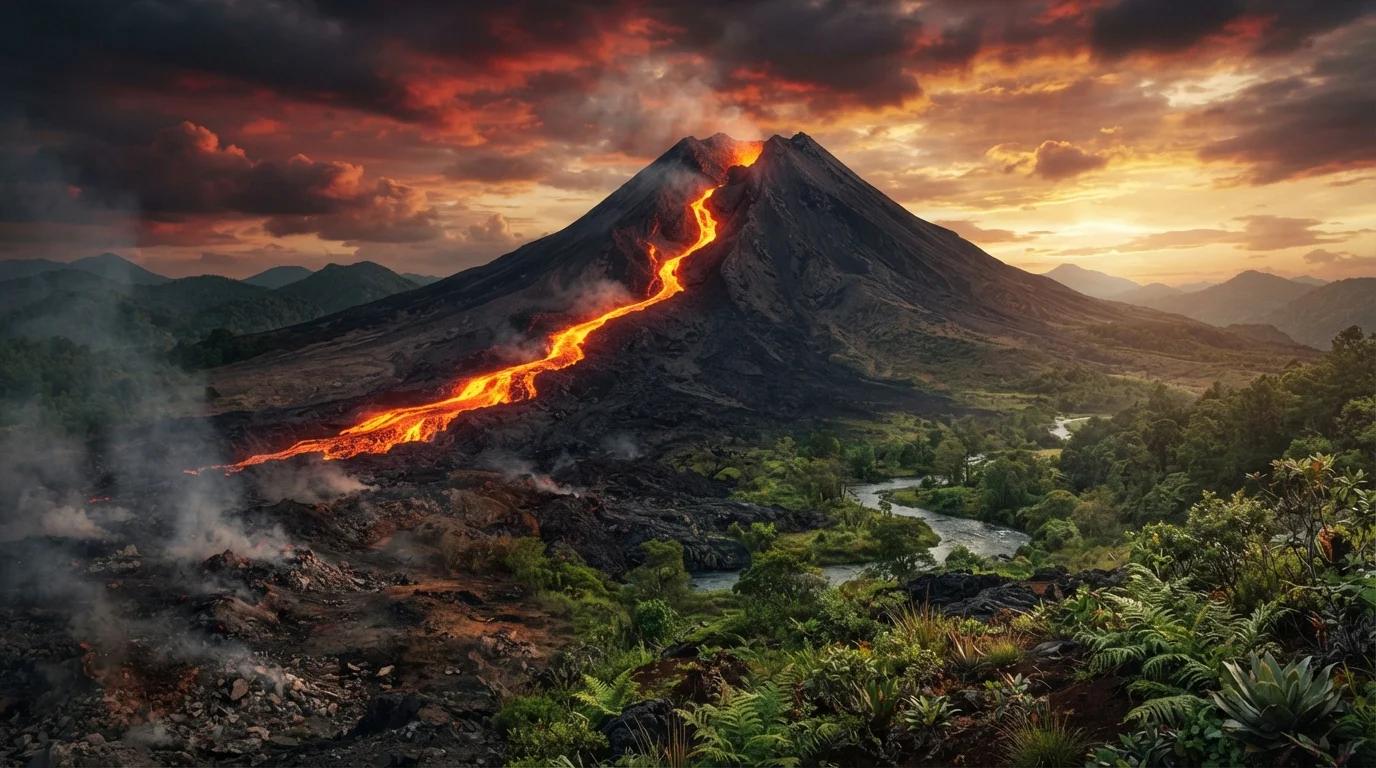
Volcano symbolism often represents powerful emotions, transformation, destruction, renewal, and forces that remain hidden until they demand attention. A volcano can be both terrifying and creative: it destroys landscapes while also producing new land.
Because of this contrast, volcanoes have long symbolized intense inner energy, sudden change, rebirth, passion, and the release of what has been suppressed.
If you encounter a volcano in mythology, artwork, dreams, spirituality, or everyday language, its symbolism often points to something powerful beneath the surface.
Volcano Symbolism Meaning (Clear Definition)
Volcano symbolism refers to the symbolic meanings associated with volcanic mountains, eruptions, lava, smoke, ash, and volcanic landscapes. At its core, a volcano represents power building beneath the surface and eventually finding a way to emerge.
A volcano may symbolize:
- Suppressed emotions waiting to be expressed
- Transformation through intense change
- Destruction that makes room for something new
- Passion and creative energy
- Rebirth and renewal
- Hidden strength
- Sudden breakthroughs or upheaval
- The consequences of ignoring inner pressure
The meaning depends heavily on the situation. A dormant volcano may suggest potential or controlled power, while an erupting volcano can symbolize emotional release or dramatic change.
Quick Symbolism Table
| Volcano Element | Common Symbolic Meaning |
|---|---|
| Dormant volcano | Hidden potential, patience, restraint |
| Erupting volcano | Emotional release, upheaval, transformation |
| Lava | Passion, life force, destructive energy |
| Smoke | Confusion, warning, mystery |
| Ash | Loss, purification, aftermath |
| New volcanic land | Rebirth, growth, new beginnings |
| Mountain | Strength, endurance, higher perspective |
In simple terms, volcano symbolism is often about what happens when powerful forces can no longer remain hidden.
What Does Volcano Symbolism Represent?
A volcano represents the tension between what is visible and what exists beneath the surface.
From a distance, a volcano may appear quiet and stable. Yet deep underground, enormous geological forces can be active. Symbolically, this makes the volcano a powerful image for people who appear calm while experiencing intense emotions, ambitions, fears, or desires internally.
1. Suppressed Emotions
One of the strongest interpretations of a volcano is emotional pressure.
Anger, grief, frustration, jealousy, passion, or resentment may build gradually. Like magma underground, these emotions can remain hidden for a long time before eventually reaching the surface.
The eruption symbolizes the moment when suppression becomes impossible.
2. Transformation
Volcanic activity destroys existing landscapes, but it can also create new ones.
This makes the volcano a symbol of transformation. A difficult period may break apart an old way of living while creating the conditions for something different to emerge.
3. Passion and Energy
Fire and molten lava naturally suggest intensity. Volcanoes can therefore symbolize powerful motivation, ambition, sexuality, creativity, or determination.
The message is not necessarily negative. Powerful energy can be destructive when uncontrolled, but it can also become a source of creation.
4. Destruction and Renewal
Volcanoes demonstrate that destruction and creation can exist together.
An eruption may bury forests, buildings, and fields under ash or lava. Over time, however, volcanic soil can support new ecosystems.
This gives volcano symbolism a deeper meaning: ending one chapter may be necessary before another can begin.
5. Hidden Potential
A dormant volcano is especially meaningful because it contains enormous potential without currently displaying it.
It can represent abilities, ambitions, emotions, or opportunities that have not yet emerged.
Spiritual Meaning of Volcano Symbolism
Spiritually, volcanoes can represent inner awakening, purification, transformation, and the release of powerful energy.
A volcano may be viewed as a meeting point between the depths of the earth and the open sky. Symbolically, this can suggest a journey from unconscious or hidden material toward conscious awareness.
Volcano as Spiritual Awakening
An eruption can symbolize a spiritual awakening that cannot be ignored.
Sometimes personal growth begins with disruption. A person may suddenly question old beliefs, relationships, habits, or assumptions. Although this process can feel chaotic, it can eventually lead to greater awareness.
Volcano as Emotional Purification
Fire is often associated with purification. In this sense, volcanic fire can symbolize the burning away of outdated patterns.
What emerges afterward may be a cleaner understanding of oneself.
Volcano as Inner Power
The immense energy of a volcano can represent the power already existing within a person.
The symbolism encourages awareness of that energy rather than allowing it to accumulate unnoticed. Passion and strength become more constructive when consciously directed.
Volcano as Rebirth
After an eruption, the landscape may eventually recover. New plants appear, animals return, and ecosystems develop.
Spiritually, this can symbolize resilience: what looks like an ending may eventually become the foundation for renewal.
Biblical / Religious Meaning of Volcano Symbolism
The Bible does not establish a specific symbolic meaning for volcanoes because volcanoes are not a recurring biblical symbol in the same way that mountains, fire, water, storms, or deserts are.
However, volcano symbolism can be interpreted alongside broader biblical themes involving fire, mountains, divine power, judgment, purification, and transformation.
Fire frequently carries powerful religious associations. It may represent God’s presence, holiness, judgment, testing, or purification. Mountains can likewise represent encounters with the divine or moments of revelation.
Because volcanoes combine mountains, fire, smoke, and overwhelming natural power, they can remind readers of these broader religious themes.
However, it is important not to claim that every volcanic image has a specific biblical meaning. A symbolic interpretation should be distinguished from direct biblical teaching.
Religious Themes Connected With Volcano Imagery
- Fire: purification, judgment, divine presence
- Mountain: revelation, strength, sacred encounters
- Smoke: mystery and awe
- Destruction: judgment or the ending of an old order
- Renewal: restoration and new beginnings
Thus, from a religious perspective, volcano symbolism may serve as a metaphor for the overwhelming power of creation and the possibility of transformation.
Volcano Symbolism in History and Culture
Volcanoes have fascinated human societies for thousands of years because their eruptions can appear almost supernatural.
Before modern geology explained volcanic activity, people often interpreted eruptions through mythology, religion, and stories about powerful beings.
In ancient cultures, volcanic mountains could be associated with gods, spirits, underworlds, or sacred forces.
Greek and Roman Traditions
In classical mythology, volcanic activity became associated with divine craftsmanship and fire.
The Roman god Vulcan, associated with fire and metalworking, gave his name to the word “volcano.” This connection reflects the ancient tendency to explain the mysterious power beneath volcanic mountains through supernatural imagery.
Hawaiian Traditions
In Native Hawaiian traditions, volcanic landscapes hold profound cultural and spiritual significance. Pele, the goddess associated with fire, lightning, wind, and volcanoes, is closely connected with the volcanic landscape of Hawaiʻi.
These traditions demonstrate how volcanoes can represent both creative power and destructive force, rather than fitting neatly into a purely positive or negative category.
Volcanoes as Sacred Mountains
Across different cultures, mountains have often been regarded as places of spiritual significance. Volcanic mountains can intensify this perception because they visibly demonstrate the immense forces operating within the earth.
As a result, volcano symbolism frequently carries themes of awe, mystery, danger, power, and sacred transformation.
Volcano Symbolism in Literature and Art
Artists and writers have long used volcanoes as metaphors for emotional and social forces.
A volcano can represent a character’s anger, a society approaching revolution, an unavoidable crisis, or a moment when hidden truth finally becomes visible.
Common Literary Uses
In literature, a volcano may symbolize:
- Anger that has been suppressed
- A relationship reaching its breaking point
- Political or social revolution
- Passion that cannot be controlled
- An approaching crisis
- The destruction of an old identity
- The emergence of hidden truth
Volcanic landscapes also create powerful visual contrasts. A dark mountain, glowing lava, smoke filled sky, and surrounding darkness can communicate danger and beauty simultaneously.
This duality is one reason volcanoes remain compelling artistic symbols.
Dream Meaning of Volcano Symbolism
Dreaming about a volcano often relates to strong emotions, pressure, conflict, change, or something that feels difficult to control.
The exact interpretation depends on the dream’s details and the dreamer’s personal circumstances.
Dreaming of an Erupting Volcano
An erupting volcano may symbolize emotions reaching a breaking point.
It could reflect anger, stress, fear, excitement, or another intense feeling that has been building beneath the surface.
Dreaming of a Dormant Volcano
A quiet volcano can represent potential energy.
You may be aware that something significant exists beneath the surface, even though it has not yet become visible.
Dreaming of Lava
Lava may symbolize powerful emotions or desires moving toward conscious awareness.
Because lava is hot and destructive but also creative, it can represent both danger and transformation.
Escaping a Volcanic Eruption
Trying to escape a volcano in a dream may suggest that you are attempting to avoid a difficult situation or overwhelming emotion.
The dream does not necessarily predict an actual event. More often, it reflects how your mind is processing pressure or uncertainty.
Watching a Volcano From a Distance
Observing an eruption without being directly affected may indicate awareness of intense circumstances while maintaining emotional distance.
You may recognize that something is changing without feeling ready to become directly involved.
Modern Meaning of Volcano Symbolism
Today, volcanoes are commonly used as metaphors for emotional pressure, social unrest, sudden change, creativity, and personal transformation.
Someone described as “a volcano” may appear calm but possess tremendous intensity beneath the surface.
In modern psychology-inspired language, volcanic imagery can represent emotions that have been suppressed for too long. While this is a metaphor rather than a universal psychological rule, it provides a useful way to understand why volcano imagery feels emotionally powerful.
Volcano symbolism can also apply to creative work. An artist, writer, entrepreneur, or performer may experience a period of intense internal development before producing something remarkable.
The eruption, in this sense, becomes a metaphor for creative expression finally breaking through.
Volcano Symbolism in Everyday Life
The symbolism can be especially meaningful when facing major personal changes.
A difficult ending may feel destructive at first, yet it can create space for growth. An emotional confrontation may reveal something that needed to be addressed. A sudden change may force someone to abandon an outdated path.
The volcano reminds us that transformation is not always gentle.
Sometimes growth begins with pressure, disruption, and the courage to let something buried finally come to the surface.
Positive and Negative Meanings of Volcano Symbolism
Volcano symbolism has both constructive and destructive interpretations.
Positive Meanings
- Transformation
- Renewal
- Creativity
- Passion
- Inner strength
- Emotional release
- New beginnings
- Hidden potential
- Personal awakening
Negative Meanings
- Anger
- Emotional instability
- Destruction
- Conflict
- Repressed feelings
- Sudden upheaval
- Loss of control
- Fear of the unknown
The most appropriate meaning depends on the context.
An erupting volcano may symbolize destruction in one situation and liberation in another. A dormant volcano may represent peaceful stability or powerful emotions being held back.
Volcano Symbolism and Personal Transformation
Perhaps the most meaningful lesson of the volcano is that destruction does not always mean the end.
Volcanic eruptions can dramatically change landscapes, but new life can eventually emerge from those altered environments.
In symbolic terms, this reflects a familiar human experience. A major life transition can destroy certainty, routines, or expectations. Yet that disruption can also reveal strengths and possibilities that were previously hidden.
Volcano symbolism therefore encourages a balanced view of change.
Not every eruption should be feared. Sometimes the pressure is telling you that something needs to change.
Frequently Asked Questions About Volcano Symbolism
What does a volcano symbolize spiritually?
A volcano can symbolize spiritual awakening, purification, inner power, emotional release, and transformation. Its eruption may represent something hidden finally becoming conscious.
What does an erupting volcano symbolize?
An erupting volcano commonly symbolizes intense emotions, sudden change, suppressed energy, conflict, or a major transformation. Its meaning depends on the surrounding context.
What does a dormant volcano symbolize?
A dormant volcano often represents hidden potential, restrained power, patience, or emotions and abilities that have not yet been expressed.
What does dreaming about a volcano mean?
Dreaming about a volcano may reflect emotional pressure, fear, excitement, conflict, or an approaching period of change. The dream’s specific details and your personal experiences are important for interpretation.
Is volcano symbolism positive or negative?
It can be either. Volcanoes symbolize destruction and danger, but they can also represent passion, creativity, renewal, resilience, and the creation of something new.
Conclusion
Volcano symbolism is ultimately about powerful forces beneath the surface. It reminds us that hidden emotions, ambitions, creativity, and potential can build until they demand expression.
Although an eruption can be destructive, it can also clear the way for renewal. In that sense, the volcano offers a powerful reminder: transformation may be intense, but what emerges afterward can be stronger, freer, and entirely new.

I’m Beau Warren, a passionate writer exploring the meanings behind symbols, dreams, colors, animals, and traditions. I enjoy creating well-researched, engaging content that inspires curiosity and deeper understanding every day.