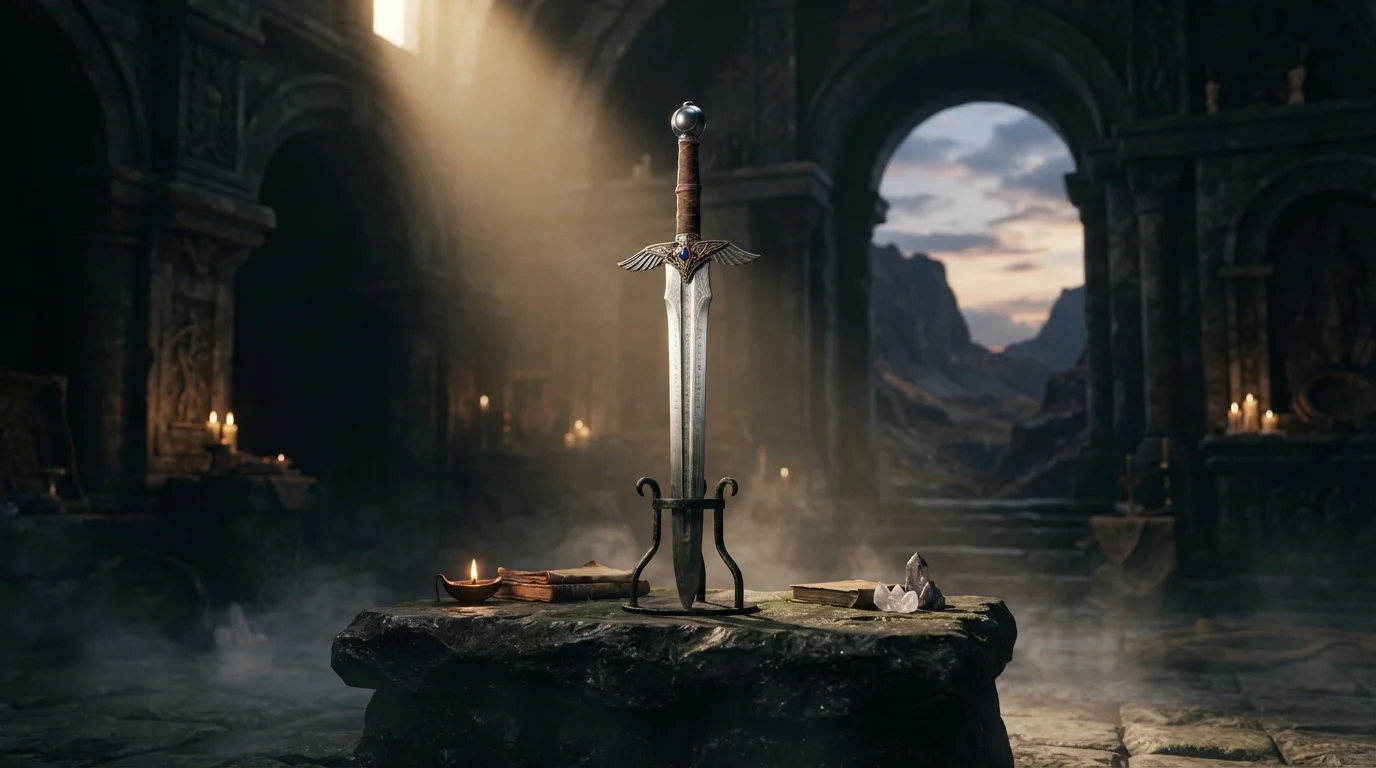
Sword symbolism has appeared across human history as a powerful image of strength, courage, justice, protection, conflict, and transformation. A sword can represent both creation and destruction, depending on how it is used and the context in which it appears.
From ancient warriors and religious traditions to dreams, literature, and modern art, the sword often symbolizes the ability to confront challenges, defend what matters, and cut through confusion.
Its sharp edge can also represent truth, decisive action, and the separation between opposing forces.
Sword Symbolism Meaning (Clear Definition)
Sword symbolism refers to the symbolic meanings associated with swords in religion, mythology, history, dreams, literature, and everyday culture.
At its simplest, a sword commonly represents strength, courage, authority, protection, justice, truth, conflict, and decisive action.
Because a sword has both a protective and destructive function, its meaning can change dramatically depending on the surrounding circumstances.
| Symbolic Meaning | What the Sword Can Represent |
|---|---|
| Strength | Inner power and physical or emotional resilience |
| Courage | Facing danger or difficult circumstances |
| Protection | Defending oneself or others |
| Justice | Upholding principles and confronting wrongdoing |
| Truth | Cutting through lies, confusion, or deception |
| Authority | Power, leadership, and responsibility |
| Conflict | Struggle, confrontation, or division |
| Transformation | Ending one phase and beginning another |
The sword’s symbolism is therefore rarely limited to violence. It can also represent discipline, moral responsibility, clarity, and the courage to make difficult decisions.
What Does Sword Symbolism Represent?
A sword can carry several interconnected meanings.
Strength and Courage
One of the most familiar sword meanings is strength. Historically, swords were associated with warriors, leaders, and people expected to face danger.
Symbolically, carrying a sword may suggest having the courage to stand firm when circumstances become difficult.
Protection and Defense
A sword can represent the responsibility to protect something valuable.
This might mean protecting family, personal boundaries, beliefs, principles, or a community. In this sense, sword symbolism is less about aggression and more about defense and responsibility.
Justice and Authority
Swords frequently appear alongside images of judges, rulers, warriors, and guardians. Their association with authority can symbolize the enforcement of rules or the pursuit of justice.
The sword can therefore represent the difficult responsibility of making decisions and accepting their consequences.
Truth and Clarity
Because a blade cuts through material, the sword has also become a metaphor for cutting through confusion.
A symbolic sword may represent distinguishing truth from falsehood, making a clear decision, or removing something that prevents progress.
Conflict and Separation
The darker side of sword symbolism relates to war, violence, disagreement, and division.
A sword may appear as a reminder that conflict can have consequences. In symbolic contexts, it can represent an internal struggle as much as an external battle.
Spiritual Meaning of Sword Symbolism
Spiritually, the sword can represent inner strength, spiritual discernment, protection, truth, and transformation.
A sword may symbolize the ability to distinguish what is helpful from what is harmful. Its sharp edge can represent awareness the ability to recognize what needs to be confronted, removed, or changed.
In some spiritual interpretations, the sword represents the struggle between opposing forces such as:
- Truth and deception
- Courage and fear
- Good intentions and harmful actions
- Wisdom and ignorance
- Discipline and temptation
- Growth and resistance
The sword can also represent personal empowerment. Rather than waiting for circumstances to change, the symbolism encourages decisive action and personal responsibility.
At the same time, spiritual sword symbolism can carry a warning: power without wisdom can become destructive. The sword is therefore often associated not only with strength but also with restraint.
Biblical / Religious Meaning of Sword Symbolism
The sword has important symbolic roles in several religious traditions, including Christianity and Judaism.
In the Bible, the sword can symbolize warfare and judgment, but it can also represent spiritual truth and divine authority. One particularly important Christian image is the “sword of the Spirit,” described in Ephesians 6:17 in connection with the word of God.
Biblical sword imagery can therefore have multiple meanings depending on the passage, including:
- Judgment
- Protection
- Divine authority
- Conflict between opposing forces
- Spiritual truth
- The power of God’s word
The sword also appears in the Book of Genesis in the description of the cherubim and the flaming sword guarding the way to the tree of life. Here, the image conveys separation, sacred boundaries, and restricted access.
These examples show why interpreting a biblical sword symbol requires attention to its specific scriptural context rather than assigning one universal meaning.
Sword Symbolism in History and Culture
Swords have carried enormous cultural significance because they were historically both practical weapons and prestigious objects.
In many societies, a sword could communicate social position, military status, leadership, or honor. Ceremonial swords still appear in traditions connected with authority and important public occasions.
Different cultures developed their own sword traditions and symbolism.
The European knightly sword became strongly associated with chivalry, loyalty, warfare, and noble duty. The Japanese katana became connected with samurai culture, craftsmanship, discipline, and martial traditions. In South Asian history, swords have also appeared as symbols of courage, sovereignty, protection, and martial identity.


4
Although these traditions differ significantly, a recurring theme is the relationship between power and responsibility.
A sword was not merely something that demonstrated physical strength. In many cultural settings, it represented expectations placed upon the person who carried it.
Sword Symbolism in Literature and Art
Writers and artists have used swords as visual and literary symbols for centuries.
In stories, a sword can represent a hero’s identity, moral struggle, destiny, or authority. A legendary sword may become an extension of its owner’s character.
A broken sword, for example, can suggest defeat, loss, or the end of an era. A newly forged sword may symbolize preparation, rebirth, or the beginning of a new journey.
Artists may use swords to communicate ideas such as:
- Heroism
- Sacrifice
- Justice
- Violence
- Power
- Rebellion
- Moral conflict
- Victory and defeat
The meaning often depends on who holds the sword and what surrounds it. A sword held by a protector may communicate safety, while the same object held by an aggressor can represent oppression.
Dream Meaning of Sword Symbolism
Dreams involving swords can have many possible interpretations, and there is no single universal meaning.
A sword in a dream may symbolize conflict, personal strength, protection, anger, decision-making, or the need to establish boundaries.
The details of the dream are especially important.
Holding a Sword
Holding a sword may represent confidence, readiness, or a desire to defend yourself or something important to you.
Seeing a Sword
Simply seeing a sword may indicate that a situation requires courage, clarity, or a decisive response.
Fighting With a Sword
A sword fight may reflect conflict or competition. It could symbolize an argument with another person or an internal struggle involving difficult choices.
A Broken Sword
A broken sword may represent feelings of weakness, disappointment, defeat, or the loss of confidence.
A Shining or Bright Sword
A bright sword may symbolize clarity, truth, revelation, or renewed strength.
Dream symbolism is highly personal, so emotions and life circumstances surrounding the dream are often more meaningful than any fixed interpretation.
Modern Meaning of Sword Symbolism
In modern culture, the sword continues to symbolize many of the same ideas that made it powerful historically.
It frequently appears in fantasy films, video games, tattoos, logos, jewelry, artwork, and personal emblems. Modern audiences may associate it with heroism, independence, resilience, personal power, and overcoming adversity.
For some people, sword imagery represents the ability to cut away negativity or unhealthy patterns. For others, it represents courage and the determination to protect personal values.
A sword can also symbolize boundaries. Its presence may communicate that something deserves protection and that not every situation should be approached without limits.
Sword Symbolism in Different Contexts
The meaning of a sword becomes clearer when its context is considered.
- Sword pointing upward: aspiration, victory, spiritual strength, or readiness
- Sword pointing downward: restraint, surrender, peace, or the end of conflict
- Two crossed swords: opposition, competition, or confrontation
- Broken sword: defeat, sacrifice, loss, or transformation
- Flaming sword: spiritual authority, judgment, or sacred protection
- Sword and shield: defense, courage, and balanced protection
- Sheathed sword: controlled power, restraint, or peace
- Drawn sword: readiness, confrontation, or decisive action
These interpretations are symbolic rather than universal. The same image can communicate something different depending on its cultural or personal setting.
What Does a Sword Symbolize Spiritually?
Spiritually, a sword often symbolizes truth, discernment, courage, protection, and the willingness to confront challenges. It can also represent separating oneself from harmful influences or outdated patterns.
What Does a Sword Symbolize in the Bible?
In biblical symbolism, a sword can represent judgment, warfare, divine authority, and spiritual truth. The precise meaning depends on the passage and its surrounding context.
What Does a Sword Mean in a Dream?
A sword in a dream may symbolize strength, conflict, protection, boundaries, or an important decision. The dreamer’s emotions and circumstances can influence its personal meaning.
What Does a Broken Sword Symbolize?
A broken sword can symbolize defeat, loss of power, sacrifice, disappointment, or the end of a struggle. In some contexts, it can also represent transformation and the decision to stop fighting.
Is Sword Symbolism Always Negative?
No. Although swords are associated with warfare and violence, they can also symbolize protection, courage, justice, truth, discipline, and responsibility. The surrounding context determines which meaning is most relevant.
Conclusion
Sword symbolism is ultimately about power guided by purpose. A sword can represent courage in the face of difficulty, protection of what matters, the pursuit of truth, or the difficult decisions that shape a person’s path.
Its deepest symbolism comes from the balance between strength and restraint. A sword may be powerful, but its meaning depends on how that power is understood and used.

I’m Camden Holland, a passionate writer at Symbolop, where I explore the meanings, history, and cultural significance of symbols. I enjoy creating clear, engaging content that helps readers discover the fascinating stories behind symbols from around the world.