Bridge symbolism is deeply connected with connection, transition, transformation, and overcoming separation. A bridge joins two places that were once divided, making it a powerful symbol of movement from one stage of life to another.
Across history, bridges have represented relationships, reconciliation, hope, spiritual journeys, and the courage to cross into the unknown.
If seen in dreams, religious imagery, literature, art, or everyday life, a bridge often suggests that something is changing or that two different worlds are being brought together.
Bridge Symbolism Meaning (Clear Definition)
Bridge symbolism refers to the symbolic meaning associated with a structure that connects two separate places. At its simplest, a bridge represents connection, transition, passage, and overcoming obstacles.
A bridge allows people to move from one side to another, which makes it a natural metaphor for life’s journeys. The two sides may represent the past and future, conflict and peace, isolation and belonging, or uncertainty and understanding.
In simple terms, bridge symbolism represents:
- Connection between people, places, or ideas
- Transition from one stage of life to another
- Overcoming obstacles and separation
- Reconciliation and healing
- Personal growth and transformation
- Hope for a new beginning
- A journey toward an unknown future
The meaning can change depending on the bridge’s condition, location, direction, and the emotions surrounding it.
A strong, beautiful bridge may suggest confidence and opportunity, while a broken or unstable bridge can symbolize fear, uncertainty, or a difficult transition.
What Does Bridge Symbolism Represent?
Bridge symbolism has several layers of meaning. Because bridges physically connect what is separated, they naturally become metaphors for emotional, psychological, and spiritual connections.
1. Connection
The most universal meaning of a bridge is connection.
A bridge can symbolize bringing people together after distance or disagreement. In relationships, it may represent communication, understanding, trust, and emotional closeness.
2. Transition
A bridge is rarely the destination. It is something you cross while moving toward somewhere else.
For this reason, bridges often symbolize a period of transition. You may be leaving an old situation behind while moving toward a new chapter.
3. Overcoming Obstacles
Water, valleys, roads, and difficult terrain can separate two destinations. A bridge creates a way through the obstacle.
Symbolically, this makes a bridge a powerful image of resilience. It suggests that separation does not always have to be permanent.
4. Transformation
Crossing a bridge can represent becoming a different version of yourself.
You may begin on one side with one identity, belief, relationship, or lifestyle and arrive on the other side with a new perspective.
5. Reconciliation
A bridge can also symbolize peace after conflict.
When two people or groups have been divided, building a “bridge” suggests creating understanding and finding common ground.
6. Hope
A bridge provides a path when there appears to be no easy way forward.
It can therefore symbolize hope—the belief that another side exists and that it is possible to reach it.
7. Courage
Crossing a bridge requires movement.
This is especially meaningful when the destination is unfamiliar. Symbolically, a bridge can represent the courage required to leave what is comfortable and step into uncertainty.
Symbolic Meanings of Bridges at a Glance
| Bridge Symbolism | Common Meaning |
|---|---|
| Crossing a bridge | Transition and personal growth |
| Building a bridge | Creating connection or reconciliation |
| Broken bridge | Separation, fear, or blocked progress |
| Strong bridge | Stability, trust, and confidence |
| Long bridge | A lengthy journey or major life transition |
| Narrow bridge | A difficult or uncertain decision |
| Bridge over water | Emotional or spiritual transition |
| Burning bridge | Ending a relationship or chapter permanently |
| Beautiful bridge | Hope, harmony, and possibility |
| Old bridge | History, memory, or inherited wisdom |
Spiritual Meaning of Bridge Symbolism
Spiritually, a bridge can represent a passage between different states of consciousness, experiences, or stages of life.
It may symbolize the journey from confusion toward understanding, fear toward faith, or separation toward unity.
A bridge can also represent the idea that difficult experiences are not necessarily dead ends. Sometimes they become pathways to spiritual growth.
Bridge as a Symbol of Spiritual Transition
Many spiritual traditions describe life as a journey. A person moves through periods of learning, struggle, change, loss, discovery, and renewal.
In this context, the bridge becomes a metaphor for the passage between these stages.
Crossing it may suggest:
- Leaving behind outdated beliefs
- Developing greater self-awareness
- Accepting change
- Moving beyond fear
- Seeking spiritual wisdom
- Entering a new phase of life
Bridge Between the Physical and Spiritual Worlds
In symbolic and religious imagery, bridges can sometimes represent a connection between the earthly world and the spiritual realm.
The physical bridge becomes an image of passage: one world on one side, another on the other.
This interpretation should not be treated as one universal religious doctrine. Instead, it reflects a recurring symbolic pattern in which crossing represents transformation, passage, or spiritual movement.
The Bridge as Inner Growth
Sometimes the most important bridge is internal.
You may need to connect who you were with who you are becoming. In that sense, bridge symbolism can represent self-acceptance and integration.
Rather than rejecting the past, the bridge suggests carrying its lessons forward.
Biblical / Religious Meaning of Bridge Symbolism
The Bible does not establish the bridge as a single official symbol with one fixed meaning. However, the broader idea of crossing, pathways, separation, reconciliation, and reaching another place appears throughout religious thought.
Because bridges connect what is separated, they are often interpreted metaphorically in religious contexts.
Bridges and Reconciliation
In Christian symbolism, reconciliation is a major spiritual theme. The idea of restoring a broken relationship can be understood metaphorically as building a bridge.
A bridge can therefore represent forgiveness, peace, and restored connection.
Bridges and Spiritual Journeys
Religious stories frequently involve journeys from one place or condition to another. Crossing water, wilderness, borders, or difficult terrain can symbolize testing, transformation, or deliverance.
Although these stories do not necessarily involve literal bridges, the bridge metaphor can help illustrate the same broader idea: faith can provide a path through separation and uncertainty.
Bridge Symbolism in Other Religious Traditions
Across different cultures and religions, crossing imagery can symbolize movement between earthly life and spiritual existence, judgment and redemption, ignorance and wisdom, or one stage of existence and another.
However, the exact interpretation differs considerably between traditions.
The safest general interpretation is that a bridge in religious symbolism often evokes passage, connection, transformation, and movement toward something beyond the present state.
Bridge Symbolism in History and Culture
Bridges have been important to civilizations for thousands of years. Their practical purpose—connecting separated communities—has naturally influenced their cultural symbolism.
Ancient bridges helped people cross rivers, valleys, and difficult landscapes. Over time, they became more than engineering achievements. They became symbols of civilization, cooperation, progress, and human ingenuity.
Bridges as Symbols of Civilization
Building a bridge requires planning, resources, knowledge, and cooperation.
A bridge can therefore represent humanity’s ability to solve problems that appear impossible.
Where nature creates separation, people create connection.
Bridges and Political Relationships
The phrase “building bridges” is frequently used when discussing diplomacy and cooperation.
Two communities, nations, or groups may have different beliefs, histories, or interests, yet a bridge symbolizes the possibility of communication.
This gives bridges a strong cultural association with:
- Diplomacy
- Cooperation
- Peace
- Understanding
- Unity
- Social connection
“Burning Bridges”
One of the most recognizable modern expressions involving bridges is “burning bridges.”
To burn a bridge means to destroy a connection or eliminate the possibility of returning to a previous situation.
Symbolically, it can represent:
- Permanent separation
- A decisive ending
- Rejection of the past
- Commitment to moving forward
- Loss of an opportunity for reconciliation
The expression shows how deeply bridge imagery has entered everyday language.
Famous Bridges as Cultural Symbols
Certain bridges have become cultural landmarks and symbols of the cities or communities where they stand.
They can represent identity, innovation, connection, and shared history. A bridge may become so recognizable that it functions as a visual shorthand for an entire place.
Bridge Symbolism in Literature and Art
Bridges are powerful literary and artistic symbols because they provide a simple physical image for complicated human experiences.
A character standing on a bridge may literally be between two locations, but symbolically they may also be between two identities, relationships, or choices.
Bridges as Literary Metaphors
Writers often use bridges to represent moments of decision.
A character crossing a bridge may be leaving the past behind. A character refusing to cross may be afraid of change.
A damaged bridge can represent a broken relationship, while a newly built bridge can symbolize reconciliation.
Bridges and Human Relationships
In poetry and fiction, bridges frequently represent emotional connections.
Two people may be separated by distance, misunderstanding, or conflict. The metaphorical bridge becomes communication—the thing that allows them to reach one another.
Bridges in Visual Art
Artists can use bridges to create strong contrasts:
- Light and darkness
- Near and far
- Old and new
- Nature and civilization
- Isolation and connection
- Safety and danger
A bridge disappearing into fog, for example, can create a sense of mystery and uncertainty.
A bridge illuminated at night may suggest hope or guidance.
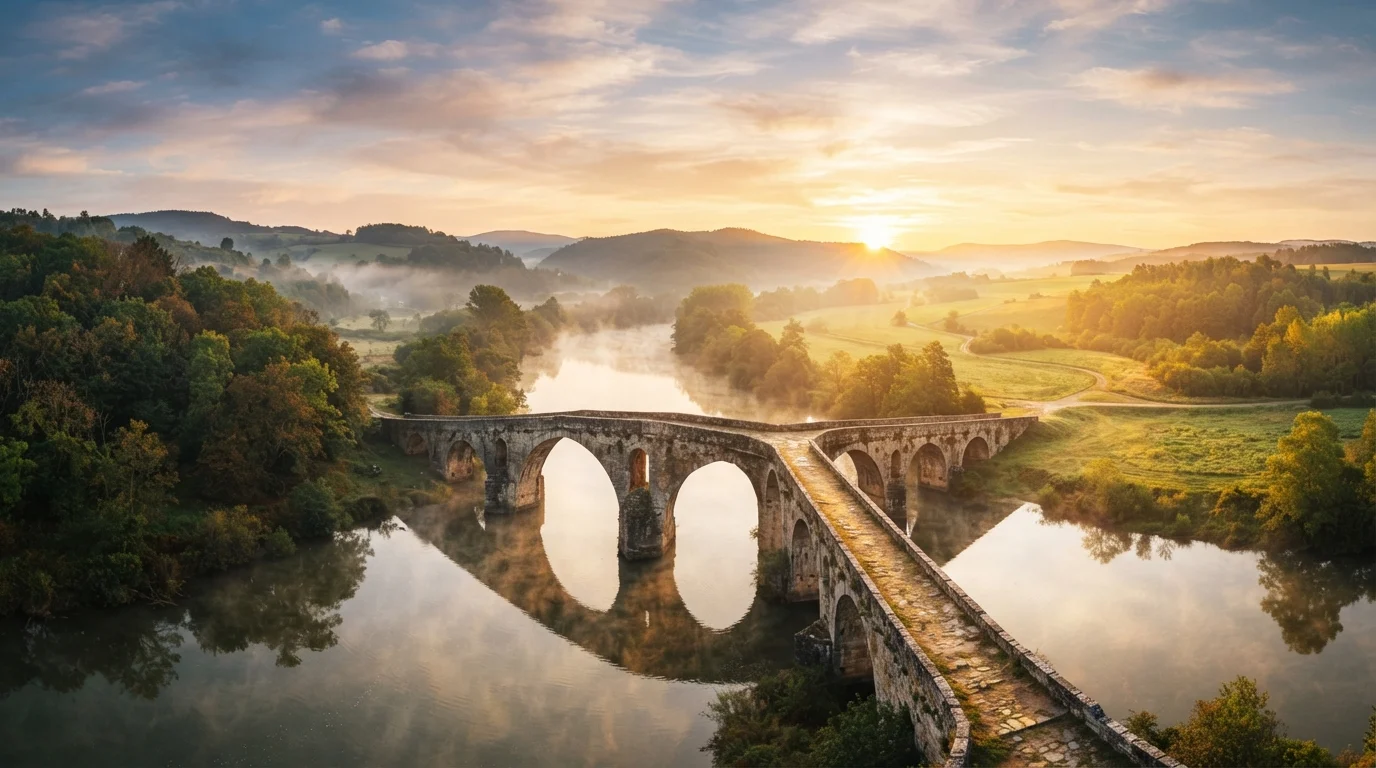
A bridge stretching toward a sunrise can symbolize renewal and a promising future.
Dream Meaning of Bridge Symbolism
Dreaming about a bridge often relates to transition, decisions, relationships, uncertainty, or personal change.
The meaning depends heavily on what happens in the dream and how you feel while experiencing it.
Dreaming of Crossing a Bridge
Crossing a bridge may suggest that you are moving through an important transition.
It can symbolize leaving something behind and becoming ready for what comes next.
Dreaming of a Broken Bridge
A broken bridge may represent a perceived obstacle.
You might feel that something is preventing you from reaching a goal, repairing a relationship, or moving forward.
It can also symbolize uncertainty about whether a transition is safe.
Dreaming of a Falling or Collapsing Bridge
A collapsing bridge can reflect fear that an important connection or plan will fail.
It may symbolize anxiety about change, trust, relationships, career decisions, or an uncertain future.
Dreaming of a Long Bridge
A very long bridge can symbolize a transition that feels slow or demanding.
You may understand where you want to go but feel that reaching that destination will take considerable effort.
Dreaming of Standing on a Bridge
Standing still on a bridge can symbolize being caught between two choices.
You may be emotionally connected to the past while also feeling drawn toward something new.
Dreaming of a Beautiful Bridge
A beautiful, stable bridge may represent hope, confidence, harmony, and positive transformation.
The dream may reflect your belief that a difficult situation can eventually lead somewhere meaningful.
Dream interpretation is subjective, so the strongest clue is usually your personal emotional response to the bridge.
Modern Meaning of Bridge Symbolism
Today, bridge symbolism remains highly relevant because modern life constantly involves transitions and connections.
People change careers, move to new places, start relationships, end relationships, rebuild after difficulties, and develop new identities.
The bridge provides a simple image for all of these experiences.
Bridges and Personal Development
Personal growth often requires leaving familiar patterns.
A bridge represents the process of moving beyond what you already know without completely losing the lessons of your past.
Bridges and Communication
In modern language, people often talk about “bridging the gap.”
This can refer to differences in:
- Culture
- Age
- Education
- Politics
- Technology
- Relationships
- Generations
- Communities
The metaphor suggests that differences do not necessarily have to create permanent separation.
Bridges and Technology
Technology has created new ways for people to connect across enormous distances.
In this sense, digital communication can also be viewed metaphorically as a bridge between people who would otherwise remain separated.
Bridges and Social Unity
A bridge can symbolize the effort to understand people who have different experiences.
It does not necessarily mean eliminating differences. Instead, it can mean creating enough understanding for meaningful communication to take place.
The Symbolism of Different Types of Bridges
Not every bridge carries exactly the same symbolic message.
Stone Bridge
A stone bridge often symbolizes strength, permanence, tradition, and endurance.
Because stone survives for generations, it can represent something built to last.
Wooden Bridge
A wooden bridge may symbolize simplicity, nature, vulnerability, or a temporary passage.
Its condition can be especially important in interpreting its meaning.
Suspension Bridge
A suspension bridge can represent balance, flexibility, and trust.
It may appear delicate while remaining remarkably strong, making it an interesting metaphor for resilience.
Broken Bridge
A broken bridge commonly represents separation, failed communication, obstacles, or an interrupted journey.
Bridge Over Water
A bridge over water combines two powerful symbols: the bridge as transition and water as emotion, change, or the unconscious.
Together, they can suggest moving through deep emotional experiences toward a new state.
Narrow Bridge
A narrow bridge can symbolize a difficult choice or a journey that requires careful attention.
It may represent vulnerability and the fear of making a mistake.
Bridge Symbolism in Relationships
In relationships, bridge symbolism is especially meaningful.
A bridge can represent the emotional work required to bring two people closer together.
Communication is often the first bridge between people. Listening, empathy, honesty, forgiveness, and trust can strengthen that connection.
When a relationship becomes distant, people may describe themselves as having “lost touch” or needing to “build a bridge.”
This makes the bridge a natural symbol of emotional repair.
A relationship bridge can represent:
- Trust
- Communication
- Forgiveness
- Understanding
- Emotional intimacy
- Reconciliation
- Shared experiences
At the same time, a broken bridge can represent boundaries or separation. Not every bridge needs to be rebuilt; sometimes moving forward means accepting that a particular connection has ended.
Bridge Symbolism and Life Transitions
Some of the strongest meanings of bridges appear during major life changes.
Graduation, marriage, relocation, career changes, personal transformation, and other turning points can feel like standing at one side of a bridge.
The future may be visible, but the journey is still uncertain.
This is why bridge symbolism can feel so inspirational. It reminds us that uncertainty does not automatically mean danger.
Sometimes the only way to discover what lies ahead is to take the first step.
Frequently Asked Questions About Bridge Symbolism
What is the main meaning of bridge symbolism?
The main meaning of bridge symbolism is connection and transition. Bridges commonly represent overcoming separation, moving forward, reconciliation, and entering a new stage of life.
What does a bridge symbolize spiritually?
Spiritually, a bridge can symbolize a journey from one state of being to another. It may represent personal transformation, spiritual growth, faith, or movement from confusion toward understanding.
What does a bridge symbolize in dreams?
A bridge in a dream often symbolizes change, transition, relationships, or an important decision. A strong bridge may suggest confidence, while a broken bridge can reflect obstacles or uncertainty.
What does a broken bridge symbolize?
A broken bridge commonly symbolizes separation, blocked progress, failed communication, or the end of a connection. Its meaning depends on the person’s circumstances and emotional response.
What does crossing a bridge symbolize?
Crossing a bridge often represents moving beyond the past and entering a new phase. It can symbolize courage, personal growth, transformation, and willingness to face uncertainty.
Conclusion
Bridge symbolism ultimately reminds us that separation does not always have to be permanent. A bridge creates a path where there was once a gap, making it a lasting symbol of connection, courage, transformation, reconciliation, and hope.
If encountered in a dream, a work of art, a religious metaphor, or everyday language, the bridge asks us to consider what we are leaving behind and what we are brave enough to cross toward.
Sometimes growth begins with nothing more than taking the first step across.

I’m Camden Holland, a passionate writer at Symbolop, where I explore the meanings, history, and cultural significance of symbols. I enjoy creating clear, engaging content that helps readers discover the fascinating stories behind symbols from around the world.