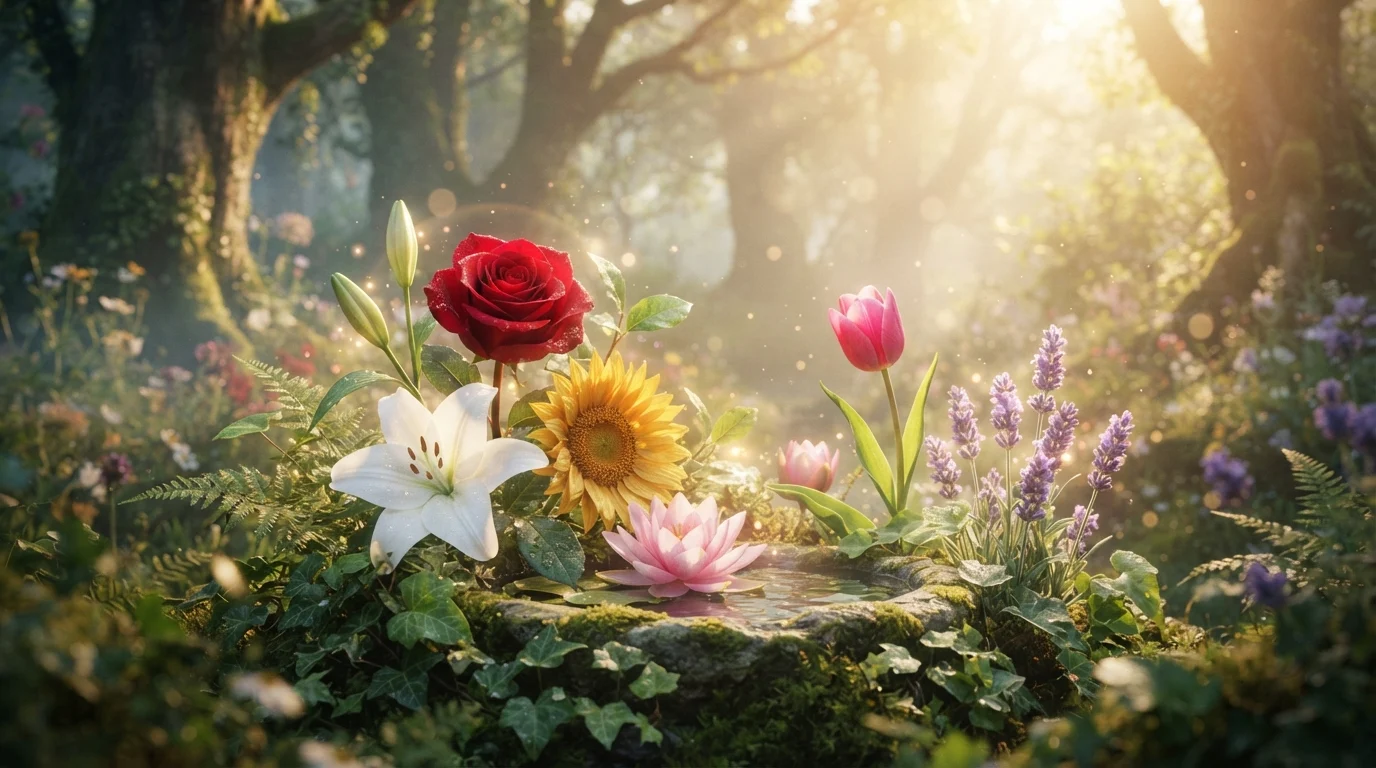
Flowers have fascinated people for thousands of years because they combine beauty, fragility, growth, and transformation in one natural form. Flower symbolism explores the meanings people have attached to flowers, their colors, shapes, fragrances, seasons, and life cycles.
From a red rose representing passionate love to a white lily suggesting purity and remembrance, flowers can communicate emotions that words sometimes cannot express.
Their meanings vary across cultures and traditions, but many share universal themes such as love, hope, renewal, beauty, grief, and spiritual growth.
Flower Symbolism Meaning (Clear Definition)
Flower symbolism is the practice of giving flowers symbolic meanings based on their appearance, color, cultural traditions, spiritual associations, and natural life cycle.
Flowers can symbolize:
- Love and affection — especially roses, tulips, and carnations
- Purity and innocence — often associated with white flowers
- Growth and transformation — represented by blooming flowers
- Hope and renewal — connected with spring flowers and new blossoms
- Grief and remembrance — commonly expressed through lilies, chrysanthemums, and other memorial flowers
- Beauty and impermanence — flowers bloom brightly but eventually fade
- Spiritual awakening — particularly associated with lotus and sacred flowers
Because flowers appear throughout human life from celebrations and weddings to funerals and religious ceremonies they have become powerful symbols of the human experience.
What Does Flower Symbolism Represent?
Flower symbolism can represent many different emotions and ideas depending on the flower, color, setting, and cultural context.
Love and Romance
Flowers are among the oldest symbols of romantic affection. Roses, tulips, orchids, and carnations can express attraction, devotion, tenderness, or admiration.
A red rose, for example, is strongly connected with passionate love, while a pink rose may communicate appreciation, affection, or gentleness.
Beauty
Flowers naturally represent beauty because of their colors, shapes, and fragrances. At the same time, their short-lived blooms remind us that physical beauty is temporary.
This creates an important symbolic connection between beauty and impermanence.
Growth and Transformation
A flower begins as a seed, develops roots and leaves, and eventually blossoms. This natural process makes flowers powerful symbols of personal growth and transformation.
A blooming flower can represent someone entering a new stage of life, overcoming difficulties, or discovering their potential.
Hope and Renewal
Flowers returning after winter are often seen as signs of new beginnings. Spring blossoms can symbolize optimism, healing, fresh opportunities, and the promise of better days.
Grief and Remembrance
Flowers also have a strong connection with death and remembrance. Their beauty can honor a person’s life while their temporary nature reflects the fragility of human existence.
Common Flower Symbolism by Type
| Flower | Common Symbolic Meaning |
|---|---|
| Rose | Love, passion, beauty |
| Lily | Purity, renewal, remembrance |
| Lotus | Spiritual awakening, enlightenment, rebirth |
| Sunflower | Joy, optimism, vitality |
| Daisy | Innocence, simplicity, new beginnings |
| Tulip | Love, elegance, perfect affection |
| Orchid | Beauty, refinement, strength |
| Lavender | Peace, calm, devotion |
| Chrysanthemum | Honor, remembrance, longevity |
| Daffodil | Renewal, hope, new beginnings |
Spiritual Meaning of Flower Symbolism
Flowers often carry deep spiritual meanings because their life cycle mirrors ideas of birth, growth, death, and renewal.
A seed disappearing into the earth and eventually becoming a beautiful flower can symbolize the hidden stages of spiritual development. What appears dormant may actually be preparing for transformation.
Flowers as Symbols of Spiritual Growth
A blooming flower can represent awakening consciousness, inner wisdom, and the unfolding of one’s spiritual potential.
The lotus is especially important in several Eastern spiritual traditions. Because it grows from muddy water yet rises above the surface to bloom, it is often associated with purity, resilience, awakening, and transcendence.
Flowers and the Soul
Flowers can also symbolize the soul’s journey. Their roots connect them with the earth, while their blossoms reach toward the light.
This natural movement can be interpreted as a metaphor for grounding, growth, and the desire to move toward higher understanding.
Flowers as Signs of Hope
When flowers appear during difficult periods, they may serve as reminders that life continues to change. A small blossom can become a powerful symbol of patience, faith, healing, and renewal.
Biblical / Religious Meaning of Flower Symbolism
Flowers appear throughout religious traditions as symbols of beauty, mortality, divine creation, purity, renewal, and spiritual devotion.
In Christianity, flowers are often connected with the beauty of God’s creation. Biblical passages also use flowers and grass to illustrate the temporary nature of human life.
The imagery of flowers can therefore carry a dual meaning: life is beautiful, but earthly existence is temporary.
The lily has become especially associated with Christian symbolism. White lilies are frequently connected with purity, resurrection, innocence, and Easter traditions.
Other religions and spiritual traditions also give flowers important symbolic roles. The lotus, for instance, holds profound significance in Buddhism and Hinduism, where it can represent purity, spiritual awakening, divine beauty, and liberation.
Because religious symbolism differs between traditions, the meaning of a particular flower should always be understood within its cultural and spiritual context.
Flower Symbolism in History and Culture
Flowers have played important roles in ceremonies, clothing, art, medicine, celebrations, and communication throughout history.
In Victorian-era Europe, flowers became particularly associated with floriography, commonly known as the language of flowers. People used specific flowers to communicate emotions and messages that could be difficult or inappropriate to say directly.
For example, giving someone a particular flower could express love, admiration, friendship, sympathy, or even rejection.
Flowers have also held distinctive meanings in different cultures.
In Japan, cherry blossoms are strongly associated with the fleeting nature of life because their beauty lasts for such a short time. Chrysanthemums have important cultural associations in Japan as well.
In Mexico, marigolds are prominently associated with Día de los Muertos traditions and remembrance of deceased loved ones.
Across South Asia, flowers are frequently used in religious offerings, weddings, festivals, and devotional practices.
These examples show that flower meanings are not universal in every detail. The same flower may communicate different ideas depending on where and how it is used.
Flower Symbolism in Literature and Art
Flowers have been powerful artistic symbols for centuries.
Writers often use flowers to represent love, youth, innocence, mortality, temptation, or emotional transformation. A blooming flower may suggest the beginning of something beautiful, while a fading flower can represent aging or loss.
Poetry frequently compares human life to flowers because both can be beautiful yet temporary.
Artists also use flowers to create symbolic layers within paintings. A bouquet might appear decorative at first but contain deeper messages about wealth, mortality, love, religion, or the passage of time.
Still-life paintings featuring flowers sometimes emphasize vanitas, a tradition of reminding viewers that earthly beauty and material possessions eventually disappear.
This makes flowers especially effective artistic symbols: they can represent both the fullness of life and its inevitable impermanence.
Dream Meaning of Flower Symbolism
Dreams about flowers can have different meanings depending on the flower, its color, condition, and the emotions experienced during the dream.
A blooming flower may symbolize growth, happiness, love, or a new opportunity. A wilted flower could represent disappointment, endings, fading relationships, or concerns about change.
Common Flower Dreams
- Seeing blooming flowers: Growth, happiness, hope, or emotional fulfillment
- Receiving flowers: Affection, appreciation, recognition, or emotional connection
- Giving flowers: Love, gratitude, apology, or admiration
- Picking flowers: Enjoying an opportunity or trying to preserve something beautiful
- Wilted flowers: Loss, disappointment, endings, or temporary circumstances
- White flowers: Peace, innocence, purity, or remembrance
- Red flowers: Passion, romance, desire, or strong emotions
- Yellow flowers: Happiness, friendship, optimism, or sometimes jealousy
Dream symbolism is personal rather than absolute. Your experiences, emotions, relationships, and memories can influence what flowers mean in a particular dream.
Modern Meaning of Flower Symbolism
Today, flowers remain one of the simplest ways to communicate emotion without speaking.
People give flowers to celebrate birthdays, anniversaries, graduations, weddings, achievements, new beginnings, and personal milestones. They are also used to express sympathy when words feel inadequate.
Modern flower symbolism often combines traditional meanings with personal associations.
For example, someone may choose sunflowers simply because they remind them of a loved one, even though sunflowers traditionally symbolize happiness, vitality, and optimism.
Social media and modern design have also made floral imagery increasingly popular. Flowers appear in tattoos, fashion, home décor, branding, photography, jewelry, and personal artwork.
A flower tattoo, for instance, may represent a person’s identity, a meaningful relationship, recovery from hardship, or an important period of transformation.
Ultimately, modern flower symbolism is both traditional and deeply personal.
Frequently Asked Questions About Flower Symbolism
What is the most common meaning of flowers?
Flowers commonly symbolize love, beauty, growth, hope, renewal, and the temporary nature of life. Their exact meaning depends on the specific flower, color, culture, and context.
What flower symbolizes love?
Roses are among the strongest symbols of romantic love, especially red roses. Tulips, carnations, orchids, and other flowers can also represent affection and devotion.
What flower symbolizes new beginnings?
Daffodils, tulips, and cherry blossoms are often associated with renewal, spring, hope, and new beginnings. Their connection with seasonal change makes them especially powerful symbols of fresh starts.
What flower symbolizes spiritual growth?
The lotus is one of the most recognized symbols of spiritual growth and awakening. Its journey from muddy water to an open blossom represents transformation, resilience, purity, and enlightenment in several Eastern traditions.
What do flowers symbolize in dreams?
Flowers in dreams can symbolize emotions, relationships, growth, beauty, hope, or change. A flower’s condition, color, and the dreamer’s personal feelings are important when interpreting the dream.
Conclusion
Flower symbolism reminds us that nature can communicate powerful ideas without words. Flowers can represent love and beauty, but they can also express grief, transformation, spiritual awakening, hope, and the passing of time.
If found in a garden, a dream, a work of art, or a meaningful gift, a flower can become a quiet reminder that life is constantly blooming, changing, and beginning again.

I’m Sophia Brown, passionate about exploring symbols, their meanings, and cultural significance. I enjoy researching history, spirituality, and traditions, creating clear, engaging articles that inspire curiosity and deeper understanding for every reader.