A key may look like a simple object, but key symbolism carries powerful meanings connected to access, opportunity, freedom, mystery, authority, and transformation. Across history and cultures, keys have represented the ability to open what was closed and discover what lies beyond.
Because of this, seeing or using a key can feel deeply meaningful. A key may symbolize a new opportunity, an answer to a difficult question, personal growth, or the power to make an important choice.
Key Symbolism Meaning (Clear Definition)
Key symbolism refers to the symbolic meanings associated with keys, especially ideas such as access, discovery, freedom, knowledge, authority, opportunity, and unlocking hidden potential.
In simple terms, a key symbolizes the power or ability to open something that was previously closed, inaccessible, or unknown.
The meaning can change depending on the situation. A golden key may suggest opportunity or success, while a broken key may symbolize frustration, lost access, or an obstacle.
Common meanings associated with keys include:
- Access – gaining entry to something important
- Opportunity – discovering a new possibility
- Freedom – escaping limitations or restrictions
- Knowledge – unlocking understanding or hidden truth
- Authority – having control, responsibility, or permission
- Mystery – discovering something unknown
- Transformation – entering a new stage of life
- Security – protecting something valuable
A key therefore represents more than opening a door. It can symbolize the moment when a barrier disappears and a new possibility becomes available.
What Does Key Symbolism Represent?
Keys commonly represent access, power, knowledge, opportunity, freedom, and personal transformation.
The symbolic meaning often depends on what the key is opening.
For example, a key opening a beautiful door may represent a promising opportunity. A key that cannot open a lock might represent uncertainty or an obstacle.
Key Symbolism at a Glance
| Key Symbol | Possible Meaning |
|---|---|
| Key | Access, opportunity, knowledge |
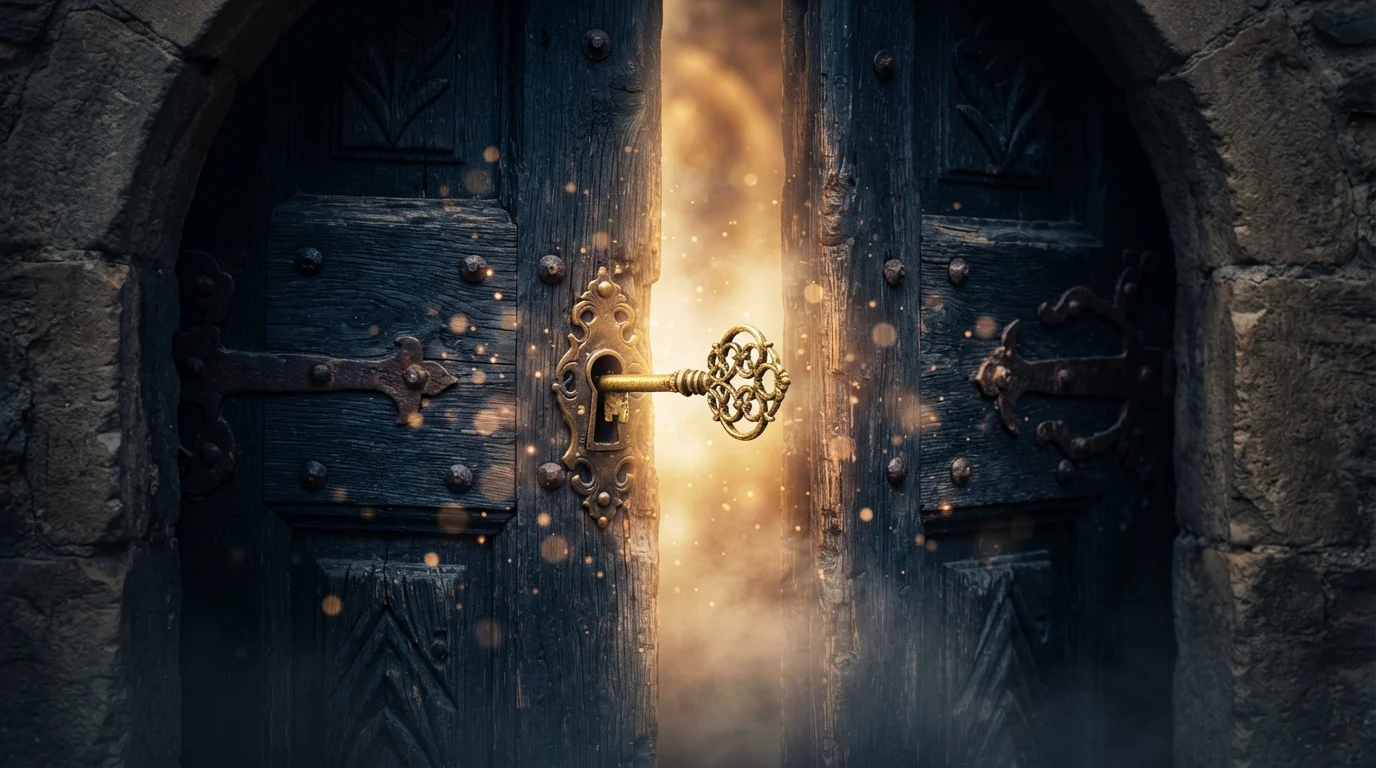
| Golden key | Success, valuable opportunity, prosperity |
| Old key | History, memories, hidden knowledge |
| Broken key | Obstacles, disappointment, lost access |
| Large key | Authority, responsibility, major opportunity |
| Small key | A subtle solution or overlooked opportunity |
| Key and lock | Mystery, protection, potential |
| Finding a key | Discovery, answers, new possibilities |
| Losing a key | Confusion, insecurity, missed opportunity |
| Giving someone a key | Trust, responsibility, intimacy |
| Receiving a key | Permission, acceptance, opportunity |
1. Keys Symbolize Access
The most obvious symbolism of a key is access.
A key gives someone permission to enter a place that others may not be able to enter. Symbolically, this can represent access to knowledge, relationships, opportunities, experiences, or parts of yourself.
2. Keys Represent Opportunity
A key can symbolize an opportunity waiting to be used.
The key itself may not change anything until someone turns it. This makes it a powerful metaphor for action: having an opportunity is different from choosing to use it.
3. Keys Symbolize Knowledge
Keys are frequently associated with discovering answers.
Something locked can represent a mystery, secret, or unanswered question. The key becomes a symbol of understanding—the thing that allows hidden information to become clear.
4. Keys Represent Freedom
A key can unlock a prison, gate, room, or other restriction.
For this reason, key symbolism can represent freedom from fear, limitations, difficult circumstances, or emotional burdens.
5. Keys Represent Authority
Historically, possessing a key could indicate that someone had control over a building, treasury, city, or important space.
As a result, keys can symbolize responsibility, leadership, trust, and authority.
Spiritual Meaning of Key Symbolism
The spiritual meaning of keys is often connected to opening doors, discovering one’s purpose, receiving guidance, and moving into a new phase of life.
Spiritually, a key can suggest that something once inaccessible is becoming available.
It may represent:
- A new spiritual understanding
- An answer to a long-standing question
- A personal breakthrough
- A new beginning
- Access to hidden wisdom
- Freedom from old limitations
- Divine guidance
- A deeper connection with your inner self
Keys as Symbols of Spiritual Doors
A door often represents a transition between one state and another. A key represents the means of making that transition possible.
In this sense, a spiritual key may symbolize the insight, courage, faith, or decision needed to move forward.
Sometimes the “key” is not an object at all. It may be a lesson, relationship, realization, opportunity, or personal quality that helps you enter a new chapter.
Finding a Spiritual Key
Finding a key can symbolize discovering something valuable within yourself.
It may represent an answer, new direction, hidden ability, or realization that helps you overcome an obstacle.
The symbolism can be especially meaningful when the key appears unexpectedly.
Biblical / Religious Meaning of Key Symbolism
Keys have strong symbolism in the Bible and Christian tradition. They are often associated with authority, access, stewardship, and the power to open or close.
One of the most significant biblical references appears in Matthew 16:19, where Jesus speaks of the “keys of the kingdom of heaven.” The image connects keys with spiritual authority and responsibility.
Revelation also uses key imagery, including references to the key of David and keys associated with spiritual realms.
In Luke 11:52, Jesus speaks of the “key of knowledge,” connecting the key metaphor with understanding and access to truth.
Christian Meaning of a Key
In Christian symbolism, a key may represent:
- Spiritual authority
- Access to God’s kingdom
- Faith and responsibility
- Knowledge and truth
- Stewardship
- Divine permission
- Spiritual leadership
The keys of Saint Peter are another important Christian symbol. They are traditionally associated with Saint Peter and represent spiritual authority.
It is important to remember that biblical symbolism depends on context. A key does not have one universal meaning in every religious passage.
Key Symbolism in History and Culture
Keys have held practical and symbolic importance for thousands of years.
In ancient societies, keys could represent ownership, wealth, protection, and social status. Someone trusted with a key could be responsible for valuable possessions or important buildings.
Over time, the key became a symbol of authority and trust.
Keys and Medieval Society
During medieval times, keys were associated with castles, estates, churches, and cities. Giving someone a key could represent granting access or recognizing authority.
The symbolic act of presenting a key to a ruler or leader became particularly meaningful.
Keys as Symbols of Trust
A key can provide access to a private home or protected space. Giving someone a key therefore carries a strong emotional meaning.
It can symbolize:
- Trust
- Intimacy
- Acceptance
- Responsibility
- Belonging
- Commitment
This is why receiving someone’s house key can feel like an important relationship milestone.
Keys and City Ceremonies
Keys have also appeared in ceremonies where cities symbolically present a key to an honored person.
The ceremonial key represents recognition, welcome, trust, and honorary access.
Thus, the simple key has evolved from a practical tool into a powerful cultural symbol.
Key Symbolism in Literature and Art
Keys frequently appear in literature, paintings, films, and visual storytelling because they immediately suggest mystery and discovery.
A character holding a key may be about to uncover a secret, enter an unfamiliar world, or change the course of their life.
Keys in Literature
A key can represent the solution to a mystery.
Writers may use a locked door and key to create suspense. The reader understands that something important exists behind the door, but the key determines whether the character can reach it.
The symbolism can also become psychological. A locked room might represent a hidden memory, secret desire, suppressed emotion, or unknown aspect of identity.
Keys in Art
Artists may use keys to explore themes of:
- Mystery
- Secrets
- Memory
- Death
- Freedom
- Knowledge
- Love
- Spirituality
- Transformation
An antique key, for example, may evoke forgotten memories or a connection to the past. A key surrounded by light may suggest revelation or spiritual awakening.
Dream Meaning of Key Symbolism
Dreaming about keys can have different interpretations depending on the details and emotions involved.
A key in a dream may symbolize access to an opportunity, a solution to a problem, personal power, or something you are trying to understand.
Common Key Dreams and Their Meanings
Finding a key:
Finding a key may represent discovering an answer, opportunity, or new direction.
Losing a key:
Losing a key can symbolize anxiety, uncertainty, missed opportunities, or fear of losing control.
Receiving a key:
Receiving a key may represent trust, acceptance, responsibility, or a new opportunity.
Giving someone a key:
Giving someone a key can symbolize trust, emotional closeness, commitment, or allowing someone into your private world.
A broken key:
A broken key may represent frustration or feeling unable to solve a problem.
A key that opens a door:
This may symbolize progress, discovery, transformation, or overcoming an obstacle.
Many keys:
A collection of keys may represent multiple choices, opportunities, responsibilities, or possible paths.
Dream symbolism is personal, so the emotions you experienced during the dream can be just as important as the key itself.
Modern Meaning of Key Symbolism
Today, keys continue to symbolize many of the same ideas, even though modern technology has changed how we access places and information.
Physical keys remain associated with homes, privacy, ownership, and security. At the same time, the idea of a “key” has become metaphorical.
People talk about the “key to success,” the “key to happiness,” or the “key to understanding” something.
In modern life, a key can therefore symbolize the essential thing that makes progress possible.
Key Symbolism in Relationships
Giving someone a key to your home often communicates trust and belonging.
It can mean:
“You are welcome in my private world.”
For couples, this gesture can represent a deeper level of commitment. Among friends or family members, it may symbolize reliability and trust.
Key Symbolism in Personal Growth
A key can also represent the personal qualities that unlock your potential.
Patience may be the key to understanding. Courage may be the key to change. Self-knowledge may be the key to healing old patterns.
The metaphor reminds us that sometimes the door is not the real obstacle the missing key is.
Positive and Negative Key Symbolism
Key symbolism can have both positive and challenging interpretations.
Positive Meanings
- Opportunity
- Freedom
- Success
- Discovery
- Knowledge
- Trust
- Security
- New beginnings
- Personal power
- Transformation
Challenging Meanings
- Lost opportunities
- Restricted access
- Secrets
- Isolation
- Confusion
- Fear of change
- Loss of control
- Obstacles
- Exclusion
The surrounding context determines which meaning feels most appropriate.
What Does a Golden Key Symbolize?
A golden key commonly symbolizes exceptional opportunity, success, prosperity, privilege, or access to something valuable.
Because gold is traditionally associated with wealth and importance, a golden key can suggest that the opportunity it unlocks is especially significant.
In stories and dreams, it may represent discovering something precious or reaching a long-desired goal.
What Does an Old Key Symbolize?
An old key often represents the past, memories, hidden history, forgotten knowledge, or something waiting to be rediscovered.
Its aged appearance can make it a symbol of experiences that still hold meaning.
An old key may also suggest that an answer to a current problem could be connected to something learned in the past.
What Does a Broken Key Symbolize?
A broken key can symbolize an obstacle, disappointment, failed expectations, or feeling unable to access something important.
It may also represent the need to find a different solution.
Rather than always being negative, a broken key can remind you that one approach may not work and another path may need to be explored.
FAQs About Key Symbolism
What is the main meaning of key symbolism?
The main meaning of a key is access. It commonly represents opportunity, freedom, knowledge, authority, security, and the ability to overcome barriers.
What does a key symbolize spiritually?
Spiritually, a key can symbolize new beginnings, divine guidance, hidden wisdom, personal transformation, and the opening of new possibilities.
What does finding a key symbolize?
Finding a key often symbolizes discovering an answer, opportunity, solution, or previously hidden aspect of yourself.
What does a key symbolize in dreams?
A key in a dream can represent access, solutions, choices, personal power, or opportunities. Its meaning depends strongly on the dream’s context and your emotions.
What does a key symbolize in Christianity?
In Christianity, keys can symbolize spiritual authority, responsibility, knowledge, and access to God’s kingdom. Biblical references such as the “keys of the kingdom” give the symbol particular religious significance.
Conclusion: The Deeper Meaning of the Key
Key symbolism is ultimately about possibility.
A key represents the moment when something closed can become open, something hidden can become known, and something unreachable can become accessible.
If it appears in a dream, religious image, work of art, relationship, or everyday life, the key invites us to ask an important question: What door is waiting for me to open?
Sometimes the key represents an opportunity. Sometimes it represents knowledge. And sometimes, the key is the courage to turn it.

I’m Sophia Brown, passionate about exploring symbols, their meanings, and cultural significance. I enjoy researching history, spirituality, and traditions, creating clear, engaging articles that inspire curiosity and deeper understanding for every reader.