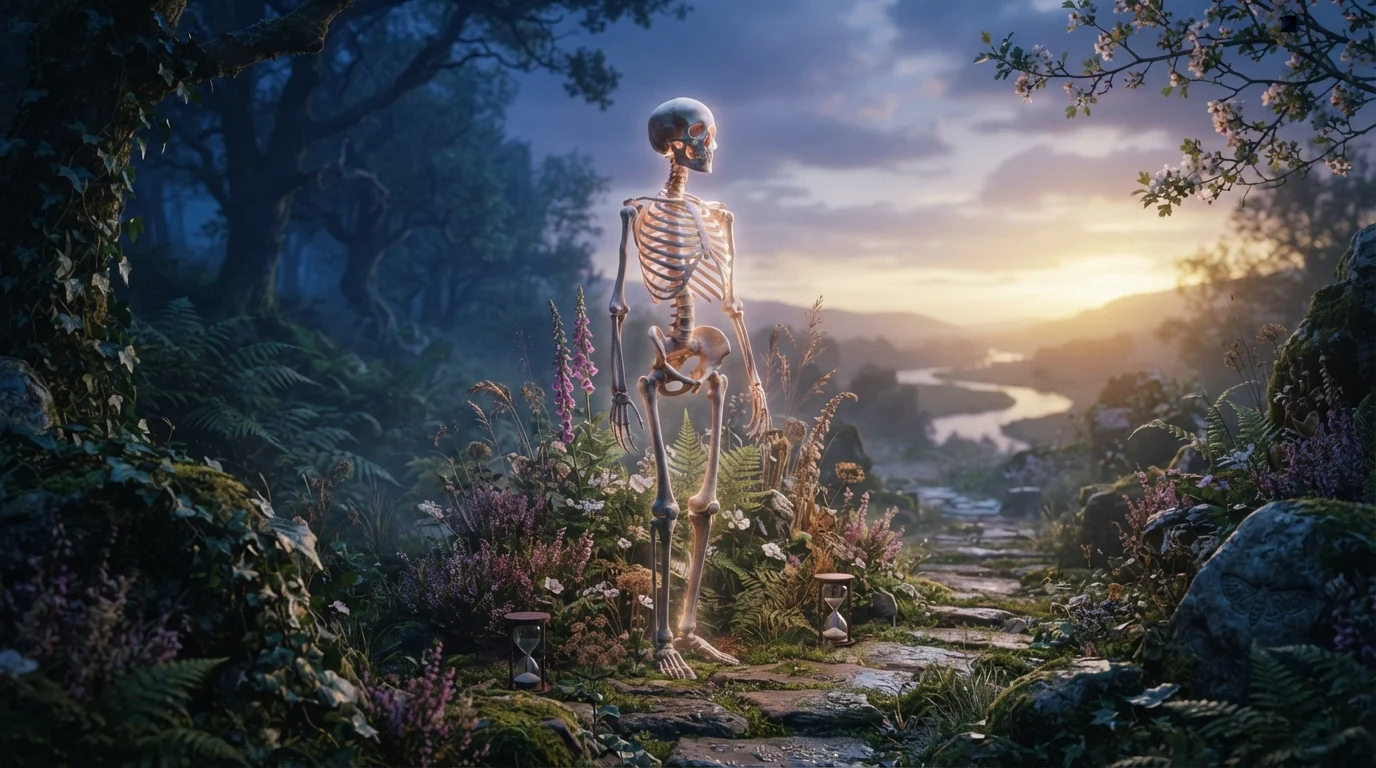
Skeleton symbolism often represents mortality, transformation, hidden truths, and the essential structure beneath outward appearances. Across cultures, skeletons can evoke fear and death, but they can also symbolize wisdom, remembrance, rebirth, equality, and the temporary nature of life.
Because bones remain after much of the body has disappeared, the skeleton has long been viewed as a powerful reminder of what endures beneath the surface. Its meaning can change significantly depending on culture, religion, dreams, art, and personal experience.
Skeleton Symbolism Meaning (Clear Definition)
Skeleton symbolism refers to the symbolic meanings associated with bones, skeletons, and skeletal imagery. The most common interpretations include death, mortality, transformation, impermanence, hidden reality, and the passage of time.
A skeleton can represent the physical remains of what once lived, making it a natural symbol of life’s temporary nature. At the same time, the skeleton is the framework that supports the body, so it can symbolize strength, structure, foundations, and what remains essential when everything superficial is removed.
In simple terms, skeleton symbolism can represent:
- Mortality and the end of life
- The passage of time
- Transformation and change
- Hidden truths or things beneath the surface
- Strength and inner structure
- Remembrance of the dead
- Equality in the face of death
- Rebirth after an ending
The meaning depends heavily on the context in which the skeleton appears.
What Does Skeleton Symbolism Represent?
Skeletons carry several layers of symbolism because they connect two seemingly different ideas: death and structure.
Mortality
Perhaps the most familiar meaning is mortality. A skeleton reminds us that every physical life eventually changes and ends.
This interpretation can encourage reflection on time, priorities, and the temporary nature of worldly experiences.
Impermanence
Skeleton imagery can symbolize the fact that nothing physical remains unchanged forever. Beauty, youth, possessions, and status all pass through different stages.
In this sense, the skeleton can serve as a reminder to appreciate the present.
Transformation
A skeleton may also symbolize transformation. Death imagery does not always represent literal death; in symbolic contexts, it can represent the ending of one phase and the beginning of another.
Hidden Truth
Because bones exist beneath the visible body, skeleton symbolism can suggest something concealed beneath appearances.
The phrase “skeletons in the closet,” for example, uses skeletal imagery to represent secrets or uncomfortable truths from the past.
Inner Strength
The skeleton is also the body’s supporting framework. Symbolically, this can represent foundations, stability, resilience, and the inner structure that allows a person or system to stand.
Equality
Skeletons look remarkably similar regardless of social status, wealth, or occupation. For this reason, skeletal imagery can symbolize the idea that death ultimately places human beings on common ground.
Remembrance
A skeleton or bone can represent someone who has died and the memory they left behind. In commemorative traditions, skeletal imagery may therefore carry meanings of ancestry, remembrance, and connection with the past.
A Quick Symbolism Guide
| Skeleton Symbolism | Possible Meaning |
|---|---|
| Skull and skeleton | Mortality and death |
| Bare bones | Essential truth or simplicity |
| Skeleton beneath clothing | Hidden reality |
| Skeleton emerging from darkness | Facing fear or the unknown |
| Skeleton with flowers | Death, remembrance, and renewal |
| Dancing skeleton | Acceptance of mortality or celebration of life |
| Ancient skeleton | History, time, and the past |
| Broken bones | Vulnerability, loss, or change |
| Strong skeleton | Foundations, endurance, and resilience |
Spiritual Meaning of Skeleton Symbolism
The spiritual meaning of skeleton symbolism often centers on mortality, transformation, release, and the deeper self.
A skeleton strips away many of the features people use to define themselves externally. Without clothing, facial expression, wealth, or social status, only the underlying structure remains.
Symbolically, this can encourage a person to look beyond appearances and consider what is truly essential.
Skeleton imagery may therefore suggest:
- Letting go of an old identity
- Accepting change
- Facing fears rather than avoiding them
- Remembering the temporary nature of physical life
- Searching for deeper truth
- Releasing attachments to the past
- Recognizing inner strength
In some spiritual interpretations, skeletal imagery can also represent a transition between stages of existence. The symbolism is not necessarily negative; an ending can create space for something new.
The important distinction is that spiritual symbolism varies between traditions. There is no single universal spiritual meaning of a skeleton.
Biblical / Religious Meaning of Skeleton Symbolism
Skeleton and bone imagery appears in several religious traditions, including the Bible, where bones can symbolize mortality, death, restoration, identity, and spiritual renewal.
One of the best-known biblical passages involving bones is Ezekiel 37, commonly known as the vision of the dry bones. In the vision, dry bones are brought together and restored, forming a powerful image of renewal and restoration.
This story has contributed to the association between bones and the possibility of life emerging from apparent lifelessness.
The Bible also frequently uses bones in expressions concerning human frailty and mortality. In these contexts, bones can emphasize the physical limitations of human beings.
Other religious traditions have their own interpretations of skeletal imagery. In some Buddhist contexts, contemplation of bones and corpses has been used as a meditation on impermanence and attachment. Christian artistic traditions have also used skulls and bones as reminders of mortality, particularly through the memento mori tradition.
These examples show that skeletal imagery can carry a meaning deeper than fear of death. It can encourage reflection on mortality, spiritual priorities, renewal, and the temporary nature of physical existence.
Skeleton Symbolism in History and Culture
Skeleton symbolism has appeared throughout human history because death is a universal human experience.
In European art and culture, skeletal figures became strongly associated with memento mori, a Latin expression meaning “remember that you must die.” Such imagery encouraged people to remember mortality rather than become completely absorbed in earthly achievements.
During the medieval and early modern periods, skeletons and skulls frequently appeared in religious art, manuscripts, paintings, tombs, and decorative objects.
The Dance of Death, or Danse Macabre, became another important European motif. It typically depicted skeletons interacting with people from different levels of society, emphasizing the universality of death.
Skeleton imagery also developed very different meanings in other cultural settings.
For example, during Día de los Muertos in Mexico, calaveras and skeletal figures can be associated with remembrance, family, celebration, and the continuing relationship between the living and the dead. These traditions should not be reduced simply to symbols of fear or darkness.
Modern popular culture has added additional meanings. Skeletons can now represent Halloween, horror, rebellion, humor, gothic aesthetics, mystery, or playful recognition of mortality.
The same image can therefore communicate completely different ideas depending on where and how it is used.
Skeleton Symbolism in Literature and Art
Artists and writers have long used skeletons because they provide an immediate visual representation of mortality.
In literature, a skeleton may symbolize death itself, but it can also represent forgotten history, buried secrets, guilt, decay, or the consequences of time.
In visual art, the skeleton frequently appears beside objects associated with temporary pleasures, such as flowers, food, money, jewelry, books, or musical instruments. Such compositions can contrast the temporary nature of worldly possessions with the certainty of mortality.
Skeletons can also be portrayed humorously.
A dancing skeleton, for example, may transform an otherwise frightening image into something playful. This approach can suggest acceptance of death or encourage people to appreciate life rather than remain consumed by fear.
Artists may also use bones as a visual metaphor for stripping something down to its essentials. A skeletal structure can reveal what lies underneath a complex exterior.
Dream Meaning of Skeleton Symbolism
Dream interpretations are subjective, and there is no scientifically established universal meaning for seeing a skeleton in a dream. Personal experiences, emotions, memories, and cultural background can strongly influence dream imagery.
Depending on the context, a skeleton dream may be associated with themes such as:
- Fear of mortality
- An unresolved issue from the past
- The ending of a particular life chapter
- Hidden information coming to light
- Emotional vulnerability
- Personal transformation
- Memories of someone who has died
For example, dreaming about an old skeleton might feel connected to the past, while seeing a skeleton emerge from the ground could symbolize something previously hidden becoming noticeable.
Your emotional reaction matters as much as the image itself. Feeling frightened, peaceful, curious, or relieved can lead to very different personal interpretations.
Rather than treating a dream as a fixed prediction, it can be more useful to consider what the skeleton represents to you and what was happening in your life when the dream occurred.
Modern Meaning of Skeleton Symbolism
Today, skeleton symbolism has expanded beyond traditional associations with death.
Skeletons commonly appear in fashion, tattoos, graphic design, entertainment, music, Halloween decorations, and social media imagery. Their meanings can range from serious to humorous.
A skeleton tattoo, for example, might symbolize mortality, personal transformation, survival, remembrance, rebellion, or simply an appreciation for a particular artistic style.
In popular culture, skeletons are often used to communicate:
- Gothic identity
- Mystery
- Fearlessness
- Humor about death
- Rebellion
- Individuality
- Acceptance of impermanence
- Connection with history or the past
The popularity of skeletal imagery demonstrates how symbols evolve. An image once primarily associated with religious warnings about mortality can become a fashion statement, artistic motif, or humorous character.
Ultimately, modern skeleton symbolism is highly contextual. The surrounding colors, objects, words, setting, and artistic style can completely change its message.
Common Questions About Skeleton Symbolism
What does a skeleton symbolize spiritually?
A skeleton can spiritually symbolize mortality, transformation, impermanence, hidden truth, and the importance of looking beyond outward appearances. Its meaning varies across spiritual traditions.
Is skeleton symbolism always negative?
No. Skeleton imagery can represent death and fear, but it can also symbolize renewal, remembrance, inner strength, equality, humor, and acceptance of life’s temporary nature.
What does a skeleton symbolize in art?
In art, skeletons often symbolize mortality and the passage of time. They can also represent hidden truths, forgotten history, transformation, or the contrast between temporary pleasures and inevitable death.
What does a skeleton mean in a dream?
A skeleton in a dream can have many personal interpretations, including unresolved issues, change, mortality, vulnerability, or something from the past. Dream symbolism is subjective rather than a fixed prediction.
What does a skeleton tattoo symbolize?
A skeleton tattoo may represent mortality, personal transformation, remembrance, resilience, rebellion, or an acceptance of life’s impermanence. The surrounding design and the person’s personal meaning are important.
Conclusion
Skeleton symbolism reaches far beyond the simple idea of death. It can remind us of mortality while also representing transformation, inner structure, remembrance, equality, hidden truths, and renewal.
If found in religious imagery, ancient art, dreams, literature, tattoos, or modern culture, the skeleton invites us to look beneath the surface. Its deepest message may be that life is temporary, yet what we learn, remember, and build can give that temporary journey lasting meaning.

I’m Camden Holland, a passionate writer at Symbolop, where I explore the meanings, history, and cultural significance of symbols. I enjoy creating clear, engaging content that helps readers discover the fascinating stories behind symbols from around the world.