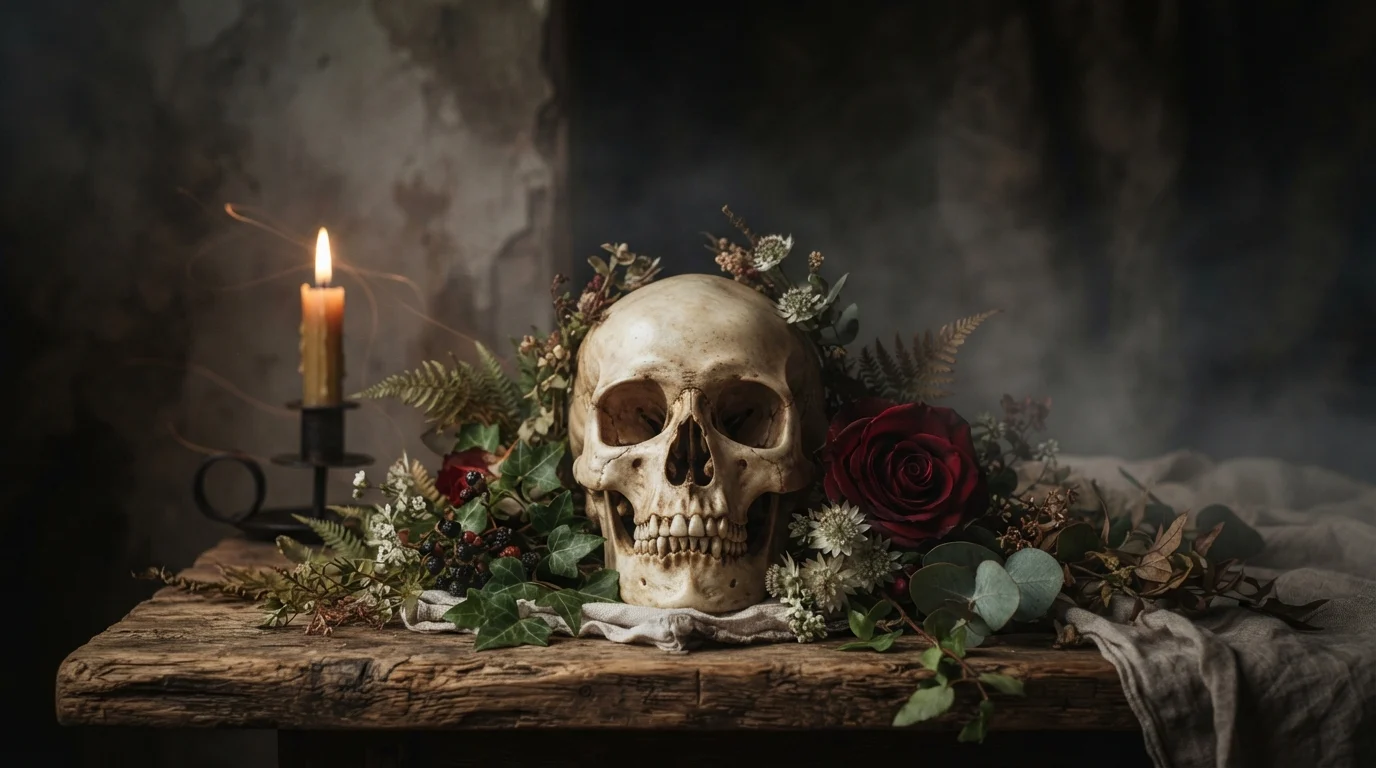
Skull symbolism has fascinated people for centuries because the human skull can represent both mortality and transformation. It may evoke thoughts of death, but its meaning goes far beyond endings.
Across religions, cultures, art, dreams, and modern design, the skull can symbolize impermanence, courage, wisdom, rebellion, protection, and the cycle of life.
Its interpretation often depends on the context in which it appears. A skull in a religious painting may communicate a very different message from a skull used in fashion, tattoo art, or a dream.
Skull Symbolism Meaning (Clear Definition)
Skull symbolism refers to the meanings and ideas associated with the human skull as a symbolic image. Most commonly, it represents mortality, death, impermanence, transformation, and the awareness that life is temporary.
However, the skull is not always negative. In many traditions, it encourages people to appreciate life more deeply by reminding them that nothing lasts forever.
Common meanings associated with skull symbolism include:
| Symbolic Meaning | What It Can Represent |
|---|---|
| Death | The end of physical life or an awareness of mortality |
| Mortality | The temporary nature of human existence |
| Transformation | Change, rebirth, or moving beyond an old identity |
| Wisdom | Lessons gained through experience and awareness of life’s limits |
| Courage | Fearlessness in facing danger, death, or uncertainty |
| Rebellion | Resistance to authority, convention, or social expectations |
| Protection | A warning against danger or harmful forces |
| Remembrance | Honoring people who have died or remembering the past |
The skull therefore has a dual character: it can symbolize an ending while also pointing toward a new beginning.
What Does Skull Symbolism Represent?
At its deepest level, the skull represents the reality of human existence. Unlike many other symbols, it directly confronts the fact that life has an ending.
This is why skulls have often appeared in traditions that encourage reflection. Seeing a skull can serve as a reminder to value time, relationships, and meaningful experiences.
Mortality and Impermanence
One of the oldest interpretations of the skull is mortality. The skull reminds us that wealth, status, appearance, and possessions are temporary.
This idea is closely connected with memento mori, a Latin phrase meaning “remember that you must die.” The concept encourages reflection on mortality so that life can be lived with greater awareness.
Transformation and Change
A skull can also symbolize transformation. When viewed metaphorically, the death of an old identity can make room for a new one.
For this reason, skull imagery sometimes appears in contexts involving personal growth, major life changes, or leaving the past behind.
Courage and Fearlessness
Because the skull openly represents death, it can become a symbol of courage. Rather than avoiding thoughts of danger or mortality, the image can communicate a willingness to face difficult realities.
Rebellion and Individuality
In modern culture, skull imagery is frequently associated with independence and rebellion. It can challenge conventional ideas about beauty, authority, and acceptable behavior.
This interpretation is particularly visible in motorcycle culture, rock and metal aesthetics, tattoo art, and alternative fashion.
Spiritual Meaning of Skull Symbolism
Spiritually, skull symbolism often encourages people to contemplate impermanence, inner transformation, and the deeper meaning of existence.
The skull can represent the idea that physical life is temporary while spiritual lessons, memories, or values may continue beyond a person’s visible existence.
Awareness of Impermanence
Many spiritual traditions emphasize that circumstances constantly change. The skull can act as a visual reminder that nothing in the physical world remains unchanged forever.
Rather than being purely frightening, this symbolism can encourage gratitude and presence.
Ego and Detachment
The skull may also symbolize the temporary nature of the physical self. From this perspective, it can represent detachment from excessive concern with appearance, status, possessions, or ego.
The message is not necessarily to reject worldly life, but to recognize its temporary nature.
Rebirth and Inner Transformation
In symbolic traditions, death can represent the end of one stage rather than literal physical death. A skull may therefore signify an inner transformation in which an old way of thinking gives way to something new.
This makes skull imagery relevant to personal growth, spiritual awakening, and major transitions.
Biblical / Religious Meaning of Skull Symbolism
The skull has appeared in Christian religious imagery, although its meaning depends heavily on context. In Christian art, a skull can represent mortality, repentance, humility, and contemplation of death.
One important association is Golgotha, traditionally understood as the place of Jesus’ crucifixion. The name is connected with the idea of a “place of the skull,” which has contributed to the skull’s presence in Christian visual traditions.
The Skull as a Reminder of Mortality
Christian art has sometimes used skulls to remind viewers that earthly life is temporary. This connects with the broader memento mori tradition, in which death becomes a prompt for spiritual reflection.
The Skull and Repentance
A skull may also encourage humility and repentance. Instead of celebrating worldly status, the symbol can remind believers that earthly achievements do not last forever.
Religious Interpretations Vary
The skull does not have one universal meaning across every religion or denomination. In some traditions it can represent mortality and spiritual reflection, while in others it may have different symbolic associations.
Context is therefore essential when interpreting religious skull imagery.
Skull Symbolism in History and Culture
Skull symbolism has existed in many different cultures and historical periods. Its meaning has changed depending on religious beliefs, social customs, artistic traditions, and historical circumstances.
Ancient Traditions
Human skulls have appeared in ancient ritual and artistic contexts. Some cultures treated human remains as objects connected with ancestors, death, remembrance, or ritual practice.
These examples demonstrate that skull imagery has not always been intended simply to frighten people.
Medieval and Renaissance Europe
During the medieval and Renaissance periods, skulls became important symbols in European religious and artistic traditions.
Artists frequently used skulls to communicate the temporary nature of earthly life. Still-life paintings containing skulls, extinguished candles, decaying fruit, and other objects became especially effective ways of expressing impermanence.
Mexican Día de los Muertos Traditions
One of the most recognizable cultural forms of skull imagery is the calavera, associated with Día de los Muertos traditions in Mexico.
Unlike the frightening skull often used in horror imagery, decorated sugar skulls can be colorful and celebratory. They are connected with remembrance and honoring deceased loved ones.
This is an important example of why skull symbolism cannot be reduced to “death equals something negative.” In this context, the skull can be part of a celebration of memory, family, and continuing connection.
Pirates and the Jolly Roger
The skull and crossbones became strongly associated with pirates through the famous Jolly Roger flag.
Here, the skull functioned primarily as a warning. It communicated danger, death, and intimidation rather than spiritual reflection.
Military and Warning Symbols
Skulls have also been used in military insignia and warning imagery. Their visual impact makes them effective at communicating danger, mortality, and fear.
Skull Symbolism in Literature and Art
Artists and writers have long used skulls to explore profound questions about life and death.
In literature, a skull can symbolize mortality, lost innocence, memory, grief, or philosophical reflection. Shakespeare’s Hamlet offers one of the best known examples through Hamlet’s contemplation of Yorick’s skull.
The image forces the character to confront the physical reality of death and the temporary nature of human existence.
Vanitas Art
Skull imagery is especially important in vanitas art, a tradition that emphasizes the temporary nature of earthly pleasures and achievements.
Paintings may combine skulls with objects such as books, musical instruments, jewelry, flowers, clocks, or candles. Each object can reinforce the message that worldly achievements and pleasures eventually pass away.
Modern Art
Contemporary artists often reinterpret the skull in completely different ways. It may appear as a symbol of identity, social criticism, mortality, consumer culture, beauty, or transformation.
The meaning can change dramatically depending on color, composition, surrounding imagery, and artistic intention.
Dream Meaning of Skull Symbolism
Dreams involving skulls can have many possible interpretations. There is no single universal meaning, and a dream’s emotional atmosphere and personal context are often more important than the symbol itself.
A skull in a dream may represent:
- Awareness of mortality or the passage of time
- The ending of an important chapter
- Fear of loss or change
- A desire to leave the past behind
- Personal transformation
- Unresolved memories
- A need to confront something uncomfortable
Seeing a Skull in a Dream
Simply seeing a skull may symbolize awareness of something that has ended or is changing. If the dream feels peaceful, the symbol may be connected with acceptance or transformation rather than fear.
Holding or Touching a Skull
Holding a skull may suggest direct confrontation with difficult realities. Symbolically, it can represent becoming more comfortable with change, loss, or uncertainty.
A Broken Skull
A broken skull may represent vulnerability, the collapse of an old belief, or a significant disruption. Its meaning depends strongly on what happens elsewhere in the dream.
A Skull That Feels Frightening
If the skull creates intense fear, the dream may reflect anxiety surrounding loss, uncertainty, or an unresolved situation. Dreams are highly personal, so the dreamer’s feelings should be considered alongside the imagery.
Modern Meaning of Skull Symbolism
Today, skull symbolism appears everywhere from tattoos and jewelry to clothing, graphic design, music, film, and social media aesthetics.
Its modern meanings are often more varied than traditional interpretations.
Tattoos
A skull tattoo may symbolize mortality, remembrance, personal transformation, courage, rebellion, or overcoming hardship.
Some people combine skulls with roses, snakes, clocks, wings, flowers, or other symbols to create a more specific message.
Fashion and Design
In fashion, skulls can communicate individuality, boldness, mystery, or an alternative aesthetic. For many people, the image is chosen for its visual impact rather than a literal belief about death.
Music and Popular Culture
Skulls have become particularly common in rock, metal, punk, and other alternative subcultures. They may represent rebellion, independence, intensity, or rejection of social conventions.
Warning and Danger
The skull and crossbones remains a recognizable warning symbol. It can indicate poison, toxicity, or serious danger when used in appropriate safety contexts.
A Symbol of Life Awareness
Perhaps the most meaningful modern interpretation is the reminder to live consciously. Knowing that life is temporary can encourage people to value their time, relationships, and experiences.
Skull Symbolism Across Different Contexts
The same skull can communicate very different ideas depending on where and how it appears.
- Religious art: mortality, humility, repentance, spiritual reflection
- Día de los Muertos imagery: remembrance, family, celebration, and honoring the dead
- Pirate imagery: danger, intimidation, and death
- Vanitas paintings: impermanence and the temporary nature of worldly achievements
- Tattoos: remembrance, transformation, courage, or individuality
- Dreams: personal change, fear, loss, or unresolved emotions
- Fashion: rebellion, mystery, individuality, or aesthetic expression
- Safety symbols: poison, toxicity, or serious danger
This range of meanings shows why context matters more than the image alone.
Frequently Asked Questions About Skull Symbolism
What is the main meaning of skull symbolism?
The primary meaning of skull symbolism is mortality and the temporary nature of life. It can also represent transformation, courage, remembrance, wisdom, and rebellion.
Is skull symbolism always negative?
No. A skull can have positive or reflective meanings, including courage, personal transformation, remembrance, and appreciation of life.
What does a skull symbolize spiritually?
Spiritually, a skull can represent impermanence, humility, detachment from the ego, and transformation. It may encourage deeper reflection on the meaning and temporary nature of physical existence.
What does a skull symbolize in dreams?
A skull in a dream may symbolize change, endings, mortality, fear, unresolved memories, or personal transformation. The dreamer’s emotions and circumstances are important when interpreting the image.
Why are skulls used in tattoos?
Skull tattoos can represent many things, including mortality, remembrance, overcoming adversity, independence, transformation, and rebellion. The meaning often becomes more specific through accompanying symbols.
Conclusion
Skull symbolism is far more complex than a simple representation of death. Across history, religion, art, dreams, and modern culture, the skull has represented mortality, impermanence, remembrance, courage, transformation, danger, and individuality.
Its most enduring message may be that life is temporary. Rather than making the symbol purely dark, this awareness can encourage us to appreciate the present, learn from the past, and approach change with greater courage.

I’m Beau Warren, a passionate writer exploring the meanings behind symbols, dreams, colors, animals, and traditions. I enjoy creating well-researched, engaging content that inspires curiosity and deeper understanding every day.