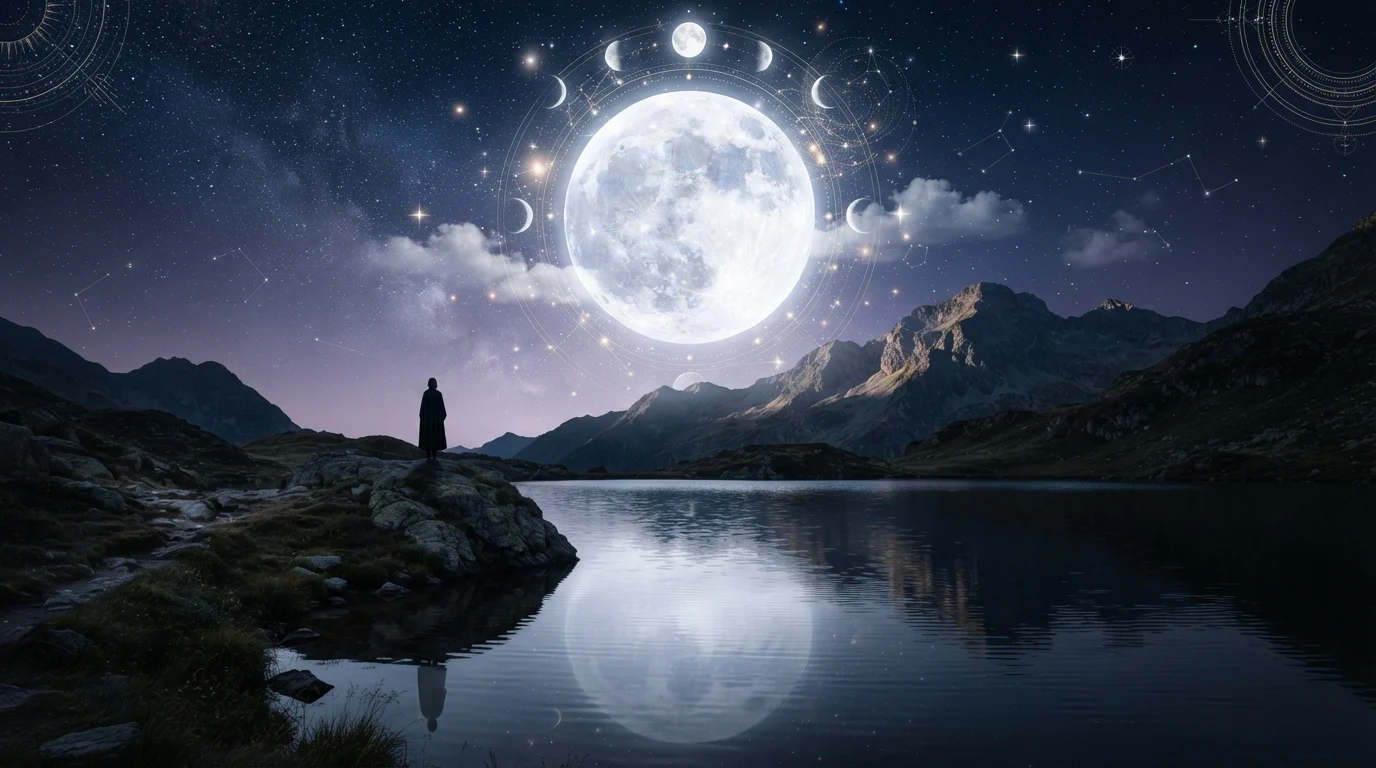
The moon has fascinated humanity for thousands of years. Its changing shape, quiet presence, and connection with night have made moon symbolism a powerful way to understand emotions, intuition, transformation, mystery, and the cycles of life.
Across religions, cultures, literature, dreams, and modern spirituality, the moon often represents something that changes while remaining deeply connected to a larger rhythm.
If you are curious about the spiritual meaning of the moon, its symbolism in dreams, or what different moon phases represent, its meaning is both ancient and surprisingly relevant today.
Moon Symbolism Meaning (Clear Definition)
Moon symbolism refers to the meanings and ideas associated with the moon, including intuition, femininity, mystery, emotional depth, transformation, renewal, and life cycles.
Because the moon appears to change throughout the month, it is often viewed as a symbol of change and renewal. Its connection with nighttime also gives it associations with the hidden, unknown, and subconscious parts of life.
Common moon symbolism includes:
| Moon Symbolism | Common Meaning |
|---|---|
| 🌙 Crescent moon | Growth, new beginnings, potential |
| 🌕 Full moon | Completion, illumination, fulfillment |
| 🌑 New moon | Renewal, reflection, fresh starts |
| 🌗 Half moon | Balance, transition, decision-making |
| Moonlight | Guidance, hope, inner awareness |
| Lunar cycle | Change, growth, and natural rhythms |
| Moon at night | Mystery, intuition, and the subconscious |
The moon can therefore symbolize both light and darkness not as opposites, but as complementary parts of existence.
What Does Moon Symbolism Represent?
Moon symbolism can represent several important aspects of human experience.
1. Change and Transformation
The moon constantly moves through different phases. This makes it a natural symbol of transformation.
A difficult period in life may feel permanent, but the moon reminds us that circumstances can change. Every phase eventually gives way to another.
2. Intuition and Inner Wisdom
The moon is often associated with intuition the quiet sense of knowing that comes from within rather than from logical analysis.
In spiritual traditions, moonlight can represent the ability to see what is not immediately obvious.
3. Mystery and the Unknown
The moon belongs to the nighttime world, making it a symbol of mystery, secrets, dreams, and unexplored possibilities.
It can represent questions that do not yet have clear answers.
4. Emotional Energy
Because the moon has long been associated with water and tides, it is frequently connected with emotions.
Moon symbolism can therefore represent emotional sensitivity, subconscious feelings, reflection, and inner movement.
5. Renewal and Rebirth
The disappearance and return of the moon can symbolize endings followed by new beginnings.
This makes lunar symbolism especially meaningful during periods of personal growth or major life transitions.
6. Balance
The moon does not always appear fully visible. Its changing phases remind us that life is rarely constant.
Sometimes we are visible and energetic; at other times, we need privacy, rest, and reflection.
Spiritual Meaning of Moon Symbolism
The spiritual meaning of the moon is often connected to intuition, inner growth, divine timing, emotional awareness, and transformation.
Many people see the moon as a reminder to slow down and listen to their inner voice. Unlike the brightness of the sun, moonlight is subtle. Symbolically, it suggests that guidance does not always arrive loudly.
The moon can also represent spiritual cycles. A person may experience periods of action, retreat, uncertainty, growth, and renewal just as the moon moves through its phases.
Moon Phases and Spiritual Meaning
- New moon: New beginnings, intention, reflection, and planting symbolic seeds.
- Waxing moon: Growth, progress, motivation, and development.
- Full moon: Illumination, completion, awareness, and emotional release.
- Waning moon: Letting go, rest, healing, and closure.
For many spiritual practitioners, these phases provide a symbolic framework for understanding personal change.
Biblical / Religious Meaning of Moon Symbolism
The moon appears in several religious and sacred traditions, although its meaning varies depending on the context.
In the Bible, the moon is frequently associated with God’s creation and the ordering of time. Genesis describes the heavenly bodies as serving as signs for seasons, days, and years.
The moon is also connected with religious calendars and appointed times in biblical tradition.
In Christianity, the moon can sometimes be interpreted symbolically as a reflection of divine light. Because the moon reflects sunlight rather than producing its own visible light, some Christian interpretations use it as an illustration of reflected spiritual light.
In Islam, the lunar calendar plays an important role in determining significant religious dates. The crescent moon has therefore become strongly associated with Islamic cultural identity and the rhythm of the religious calendar, although the crescent itself should not be confused with a universal theological symbol of Islam.
Across other religious and spiritual traditions, lunar cycles may represent creation, fertility, death and rebirth, feminine energy, or cosmic order.
Moon Symbolism in History and Culture
Moon symbolism has existed across civilizations for thousands of years.
Ancient cultures carefully observed the moon because its predictable cycle helped people measure time. This practical importance gradually became intertwined with mythology and spirituality.
The ancient Greeks associated the moon with goddesses such as Selene and Artemis. In Roman tradition, Luna represented the moon, while Diana was associated with the moon and hunting.
In ancient Egypt, lunar imagery appeared within a complex religious system involving gods, celestial cycles, and concepts of time and regeneration.
In Chinese culture, the moon has strong associations with family, reunion, beauty, and longing. The Mid Autumn Festival, for example, traditionally celebrates the full moon and the idea of family togetherness.
In Japanese culture, moon viewing, known as tsukimi, reflects an appreciation for the beauty and changing nature of the moon.
These traditions demonstrate how one celestial object can inspire remarkably different interpretations while maintaining common themes of time, beauty, mystery, and change.
Moon Symbolism in Literature and Art
The moon has been one of the most enduring images in literature and visual art.
Poets often use the moon to express loneliness, romance, longing, beauty, and contemplation. A moonlit landscape can create an atmosphere of mystery, while a full moon can symbolize emotional intensity or revelation.
Writers may also use the moon as a metaphor for changing identity. Its shifting appearance suggests that people can change without losing their essential nature.
In paintings, photography, and film, the moon frequently establishes mood. A bright full moon may create a sense of wonder or suspense, while a thin crescent can suggest solitude, hope, or a new beginning.
The moon’s symbolic power comes partly from its ability to appear familiar yet distant. It is visible to everyone, but impossible to possess.
Dream Meaning of Moon Symbolism
Dreams about the moon are often interpreted in relation to emotions, intuition, change, relationships, and the subconscious mind.
However, dream symbolism is personal rather than universal. The meaning can depend heavily on the dream’s atmosphere and your own experiences.
Common interpretations include:
- Seeing a full moon: Emotional clarity, completion, awareness, or a significant realization.
- Seeing a crescent moon: New opportunities, gradual growth, or an emerging idea.
- A bright moon: Hope, guidance, or increased self-awareness.
- A dark or hidden moon: Uncertainty, suppressed emotions, or an unknown situation.
- A moon reflected in water: Emotional reflection and deeper self-examination.
- A falling moon: Fear of change, instability, or the ending of an important phase.
Rather than treating a moon dream as a prediction, it can be more useful to ask what the moon represents to you personally.
Modern Meaning of Moon Symbolism
Today, moon symbolism remains popular in spirituality, psychology-inspired self-reflection, fashion, tattoos, jewelry, and personal art.
The moon is often chosen as a symbol of personal transformation. Someone recovering from a difficult period may see the lunar cycle as a reminder that life moves through phases.
The crescent moon is commonly associated with potential and beginnings, while the full moon can represent confidence, completion, or self-discovery.
Moon imagery is also popular because it allows people to express complex ideas without words. A simple lunar symbol can communicate mystery, independence, femininity, emotional depth, or connection with nature.
Moon Symbolism in Tattoos
A moon tattoo may represent:
- Personal transformation
- New beginnings
- Emotional strength
- Intuition
- Femininity
- Mystery
- Balance
- Connection with nature
- Acceptance of life’s changing phases
The meaning becomes even more personal when the moon is combined with stars, flowers, animals, mountains, or celestial symbols.
Different Moon Phases and Their Symbolic Meanings
Understanding lunar phases can make moon symbolism even richer.
New Moon
The new moon is associated with darkness, privacy, intention, and fresh beginnings. Symbolically, it can represent starting over before visible progress appears.
Crescent Moon
The crescent suggests potential and gradual development. It can symbolize hope, growth, ambition, and the first signs of change.
Full Moon
The full moon represents visibility and completion. It may symbolize illumination, fulfillment, heightened emotions, and important realizations.
Waning Moon
The waning moon is associated with release and closure. Symbolically, it can represent letting go of old habits, relationships, beliefs, or emotional burdens.
Moon Symbolism and Feminine Energy
The moon has historically been associated with feminine symbolism in many cultures.
Its cycles have sometimes been connected metaphorically with fertility, menstruation, motherhood, intuition, and the rhythms of the natural world.
However, moon symbolism does not have to be limited to femininity. In modern interpretations, the moon can represent anyone’s emotional intelligence, intuitive awareness, receptiveness, and ability to adapt.
Its deeper message is often about embracing qualities that are quiet rather than forceful.
Moon Symbolism and Love
In romantic symbolism, the moon often represents intimacy, longing, emotional connection, and enduring affection.
Two people looking at the same moon can symbolize connection across distance. Moonlight is also frequently used to create a romantic atmosphere because it suggests privacy and emotional depth.
A moon paired with stars can represent companionship the idea that different lights can exist together in the same darkness.
Frequently Asked Questions About Moon Symbolism
What is the main meaning of moon symbolism?
The main meanings of moon symbolism include change, intuition, mystery, emotional depth, renewal, and the natural cycles of life.
What does the moon symbolize spiritually?
Spiritually, the moon often symbolizes inner wisdom, intuition, transformation, reflection, emotional awareness, and trust in life’s cycles.
What does a full moon symbolize?
A full moon commonly symbolizes completion, illumination, heightened awareness, fulfillment, and emotional clarity.
What does a crescent moon symbolize?
A crescent moon often represents new beginnings, potential, growth, hope, and gradual transformation.
What does the moon symbolize in dreams?
In dreams, the moon can symbolize emotions, intuition, personal transformation, hidden feelings, or a need for reflection. Its meaning depends on the dream’s details and the dreamer’s personal associations.
Conclusion
Moon symbolism is ultimately a reminder that change is natural and every phase has meaning. From ancient mythology and religious traditions to dreams, art, relationships, and modern spirituality, the moon continues to represent intuition, mystery, emotional depth, renewal, and transformation.
Perhaps its most inspiring lesson is simple: even when the moon is not fully visible, it has not disappeared. Sometimes life works the same way quiet seasons can still be part of our growth.

I’m Beau Warren, a passionate writer exploring the meanings behind symbols, dreams, colors, animals, and traditions. I enjoy creating well-researched, engaging content that inspires curiosity and deeper understanding every day.